Sign In
The CEO Views Small logos
  • Home
  • Technology
    Artificial Intelligence
    Big Data
    Block Chain
    BYOD
    Cloud
    Cyber Security
    Data Center
    Digital Transformation
    Enterprise Mobility
    Enterprise Software
    IOT
    IT Services
    Innovation
  • Platforms
    How IBM Maximo Is Revolutionizing Asset Management
    How IBM Maximo Is Revolutionizing Asset Management
    IBM
    7 Min Read
    Optimizing Resources: Oracle DBA Support Services for Efficient Database Management
    Oracle
    Oracle
    9 Min Read
    The New Google Algorithm Update for 2021
    google algorithm update 2021
    Google
    5 Min Read
    Oracle Cloud Platform Now Validated for India Stack
    Service Partner Horizontal
    Oracle
    3 Min Read
    Oracle and AT&T Enter into Strategic Agreement
    oracle
    Oracle
    3 Min Read
    Check out more:
    • Google
    • HP
    • IBM
    • Oracle
  • Industry
    Banking & Insurance
    Biotech
    Construction
    Education
    Financial Services
    Healthcare
    Manufacturing
    Mining
    Public Sector
    Retail
    Telecom
    Utilities
    Gaming
    Legal
    Automotive
  • Functions
    RISMA Systems: A Comprehensive Approach to Governance, Risk and Compliance
    Risma Systems
    ENTREPRENEUR VIEWSGDPR
    9 Min Read
    Happiest Minds: A “Privacy by Design” approach is key to creating GDPR compliant businesses
    Happiest Minds 1
    GDPR
    8 Min Read
    Gemserv: GDPR 2020 and Beyond
    Gemserv 1
    GDPR
    9 Min Read
    ECCENCA:GDPR IS STILL AN UNTAMED ANIMAL
    eccenca 1
    GDPR
    6 Min Read
    Boldon James: HOW ENTERPRISES CAN MITIGATE THE GROWING THREATS OF DATA
    Boldon James 1
    GDPR
    8 Min Read
    Check out more:
    • GDPR
  • Magazines
  • Entrepreneurs Views
  • Editor’s Bucket
  • Press Release
  • Micro Blog
  • Events
Reading: Solving the Technical Paradox of Ultra-Slim Automotive Headlight Optics
Share
The CEO Views
Aa
  • Home
  • Magazines
  • Enterpreneurs Views
  • Editor’s Bucket
  • Press Release
  • Micro Blog
Search
  • World’s Best Magazines
  • Technology
    • Artificial Intelligence
    • Big Data
    • Block Chain
    • BYOD
    • Cloud
    • Cyber Security
    • Data Center
    • Digital Transformation
    • Enterprise Mobility
    • Enterprise Software
    • IOT
    • IT Services
  • Platforms
    • Google
    • HP
    • IBM
    • Oracle
  • Industry
    • Banking & Insurance
    • Biotech
    • Construction
    • Education
    • Financial Services
    • Healthcare
    • Manufacturing
    • Mining
    • Public Sector
    • Retail
    • Telecom
    • Utilities
  • Functions
    • GDPR
  • Magazines
  • Editor’s Bucket
  • Press Release
  • Micro Blog
Follow US
© 2022 Foxiz News Network. Ruby Design Company. All Rights Reserved.
The CEO Views > Blog > Industry > Automotive > Solving the Technical Paradox of Ultra-Slim Automotive Headlight Optics
Automotive

Solving the Technical Paradox of Ultra-Slim Automotive Headlight Optics

The CEO Views
Last updated: 2026/03/06 at 12:39 AM
The CEO Views
Share
Solving the Technical Paradox of Ultra Slim Automotive Headlight Optics

In the current landscape of automotive design, the “face” of the vehicle is undergoing a radical transformation. Driven by the rise of Electric Vehicles (EVs) and the pursuit of aggressive brand identities, the trend is moving toward ultra-slim, “slit-like” headlights. For Tier 1 lighting engineers, this presents a daunting technical paradox: how do you reduce the optical aperture to a height of 20mm or less while maintaining—or even exceeding—the photometric performance of traditional, larger systems?

The challenge isn’t just about styling; it’s about physics. As the lens gets smaller, the difficulty of light collection, thermal management, and beam precision increases exponentially. Moving from a generous reflector-based system to a high-density automotive optics lens requires a sophisticated understanding of both optical theory and material science.

The Physics of the “Slit” Headlight: Etendue and Efficiency Challenges

The primary struggle in miniaturized headlight design is the conservation of etendue. As the Light Emitting Surface (LES) of modern high-power LEDs remains relatively constant, reducing the size of the primary and secondary optics often leads to significant light loss.

In an ultra-slim module, the automotive lens must capture a wide angle of light from the source and collimate it within an incredibly restricted vertical space. Traditional spherical geometries are no longer sufficient. Engineers are now forced to utilize complex aspheric and free-form surfaces to “fold” the light path. Achieving a high optical efficiency (typically >70%) in a module with a height of only 15-25mm requires a precision in the automotive optics lens design that leaves zero margin for error.

Managing the Cut-off Line and Chromatic Aberration
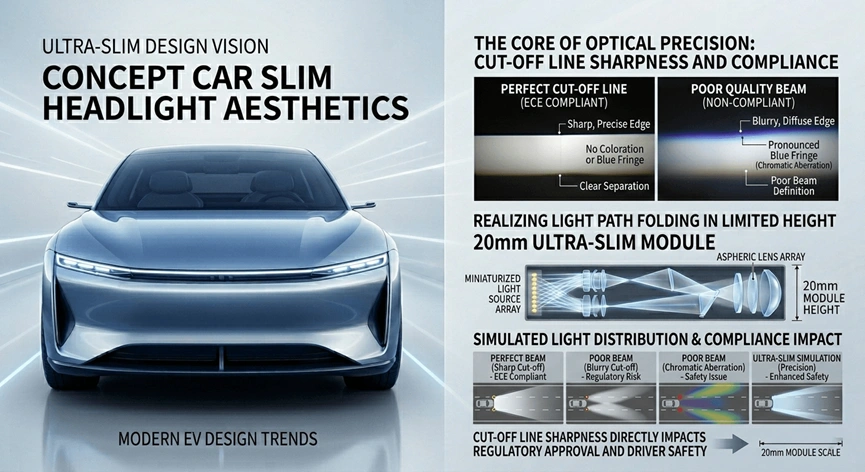
Managing the Cut off Line and Chromatic Aberration

For low-beam applications, the “cut-off line” is the holy grail. Regulatory bodies like the ECE and organizations like the IIHS place immense value on a sharp, glare-free transition. In a compact system, any microscopic imperfection in the lens surface or a slight misalignment in the optical axis results in a “fuzzy” cut-off or distracting blue-fringing (chromatic aberration). Advanced precision automotive headlight lens manufacturing now utilizes multi-stage simulation to predict and correct these aberrations at the nanometer level before the first mold is even cut.

Thermal Stability in High-Density LED Modules

Efficiency isn’t the only casualty of miniaturization; heat is the other silent enemy. High-power LEDs generate significant thermal energy, and in a slim headlight, the lens is positioned closer to the heat source than ever before.

Material Integrity and “Thermal Drift”

When an automotive lens is subjected to the high internal temperatures of a sealed headlight unit, the refractive index of the material can shift, and the physical shape of the lens can subtly deform. This phenomenon, known as thermal drift, can cause the beam pattern to shift or defocus during long drives.

To combat this, R&D teams are increasingly specifying high-Tg (glass transition temperature) polycarbonate or specialized optical-grade silicone for their high-performance automotive optics. These materials ensure that the beam remains stable from the moment the car leaves the garage until it reaches its destination, regardless of the ambient temperature or the duration of operation.

Integrating ADB and Matrix LED Technologies

The industry is rapidly shifting toward Adaptive Driving Beams (ADB) and Matrix LED systems, where the headlight is no longer a static lamp but a dynamic projector. These systems rely on an array of individually controllable LED pixels.

The role of the Matrix LED automotive lens here is critical. The lens must project each pixel with extreme clarity and minimal “crosstalk” between segments. If the optical design is poor, the light from one pixel will bleed into the next, ruining the “glare-free high beam” effect that is the hallmark of ADB technology. This requires a sophisticated multi-lens array where each element is optimized for its specific position in the light field.

From CAD to Road: The Manufacturing Reality

A perfect optical simulation is only as good as the final injected part. For Tier 1 suppliers, the “real world” challenges of injection molding—such as sink marks, weld lines, and internal stresses—can degrade the performance of even the most brilliant automotive optics lens design.

Achieving a nano-level surface finish is non-negotiable. Any scattering caused by surface roughness will increase “stray light,” which creates glare for oncoming drivers and reduces the perceived quality of the brand. This is why partnering with a manufacturer that understands the nuances of custom automotive optics and possesses high-precision tooling capabilities is vital for the successful launch of a new vehicle program.

From CAD to Road The Manufacturing Reality

Conclusion

The future of automotive lighting is a delicate dance between the daring visions of car designers and the rigorous constraints of optical physics. As headlights continue to shrink in size but grow in intelligence, the importance of the secondary optic cannot be overstated.

For Tier 1 engineers, the path forward involves early-stage collaboration with optical specialists who can bridge the gap between a sleek CAD drawing and a road-legal, high-performance reality. By prioritizing precision in automotive lens selection and design, manufacturers can ensure that their vehicles don’t just look like the future—they see it clearly, too.


The CEO Views February 24, 2026
Share this Article
Facebook Twitter LinkedIn Email Copy Link
Previous Article Top 10 Embroidery Digitizing Companies in USA Famous for Professional Work Top 10 Embroidery Digitizing Companies in USA Famous for Professional Work
Next Article 6 Business Ideas in Long Term 6 Business Ideas in Long-Term Care and Wellness, Based on Your Passion
cryptocurrency industry outlook 2026

Cryptocurrency Industry: What to Expect in 2026?

January 30, 2026
Innovative Resume Design Tactics for Modern Professionals
Micro Blog

Innovative Resume Design Tactics for Modern Professionals

The CEO Views By The CEO Views November 19, 2024
The Best Instagram Viewer for Creators
Digital Marketing

The Best Instagram Viewer for Creators: Manage Reputation and Engagement

The CEO Views By The CEO Views October 16, 2025
Softvative
ENTREPRENEUR VIEWS

Softvative: Enabling Digital Transformation Across Globe

The CEO Views By The CEO Views February 26, 2024
Linda McMahon
Micro Blog

Linda McMahon’s Net Worth: The Secret Behind Her Wealth

The CEO Views By The CEO Views November 21, 2024

Creating a More Eye-Friendly Workspace

March 3, 2026

Crypto Casinos in 2026: Regulation, Adoption, or Total Disruption?

March 3, 2026

Why Your 9-to-5 Is More Profitable When Your Home Is on Wheels

March 3, 2026

How Industrial Humidifiers Keep Facilities Running Smoothly

February 27, 2026

You Might Also Like

Junk Car Market Analysis Supply, Demand & Pricing Trends
Automotive

Junk Car Market Analysis: Supply, Demand & Pricing Trends

6 Min Read
Tata Punch and the Growing Appeal of Micro SUVs in India
Automotive

Tata Punch and the Growing Appeal of Micro-SUVs in India

6 Min Read
Run Flat Tires Limits, Pros, Cons, and Fit
Automotive

Run-Flat Tires: Limits, Pros, Cons, and Fit

13 Min Read
How to Sell Your Ferrari for the Best Price
Automotive

How to Sell Your Ferrari for the Best Price

5 Min Read
Small logos Small logos

© 2026 All rights reserved. The CEO Views

  • About Us
  • Privacy Policy
  • Advertise with us
  • Reprints and Permissions
  • Business Magazines
  • Contact
Reading: Solving the Technical Paradox of Ultra-Slim Automotive Headlight Optics
Share

Removed from reading list

Undo
Welcome Back!

Sign in to your account

Lost your password?