

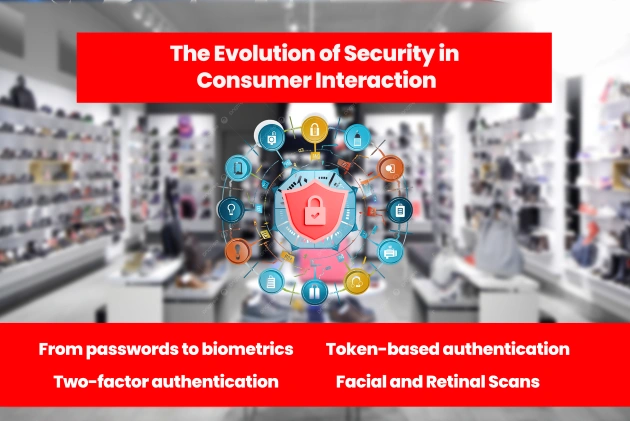
Over the past two decades, data protection technology has undoubtedly advanced in leaps and bounds. And none more so than in the role of customer interaction.
Security companies that specialize in complex security solutions have mushroomed throughout the globe, giving birth to a new era of consumer interaction. Consumer interaction security has transformed from a perimeter-based model to a user-centric and multi-layered approach. This shift from simple passwords to multi-layered security approaches powered by biometrics, AI, and continuous verification changed the way consumerism and customer interaction are kept secure.
The Internet has changed how customers interact with companies. Companies that seek to secure consumer loyalty in today’s ever-evolving business environment must focus on having an excellent product or service line and an outstanding customer service. Responding quickly to consumer concerns is no longer the only criterion of a great customer service experience; modern consumers look for more. As they share a vast amount of personal data with companies across various digital platforms, the security of shared data has become one of their topmost priorities. Hence, companies must ensure they have all possible security measures in place to obtain a high level of consumer engagement.
Why Security Matters in Customer Interaction?
When consumers trust that their online interactions and shared data are secure, they are likely to engage more with a brand. In today’s increasingly connected world, online security has become a matter of concern for consumers and businesses alike. From smartphones to critical infrastructure systems, technology is embedded in every aspect of our lives. While businesses are navigating the era of digital information, let us explore why they should prioritize ensuring consumer security.
-
Social Media Demands More Transparency
As information is constantly spreading across social media, consumers look for companies that are more transparent compared to others. Now, what does it mean by maintaining transparency? It refers to all the information regarding the products, services, or consumer interaction mediums that businesses must share with consumers to win their trust.
-
Poor Security Standards = Poor Customer Services
Organizations that fail to follow the standard security procedures are more likely to lose their customers. With a poor security standard, companies can never enhance consumer trust in this competitive business world. Ensuring legal compliance can help them attract more customers to their business.
-
Cyber Security is the New Buzzword
Data security in consumer communication is crucial for protecting sensitive information from cyber attacks. Businesses today must focus on integrating cyber security practices into their IT infrastructure to ensure all consumer data is protected.
Now that we have understood the importance of security in consumer interaction, let us explore how the concept of data security has changed within the realm over the last two decades.
Users have too many passwords to maintain
Users are required to remember passwords for every aspect of their lives: email, banking, health, work, and personal use. The sheer volume of passwords one person must remember is hard to maintain. In fact, Security Brief suggests that the average person uses about 100 passwords to access different websites and apps.
From passwords to biometrics
Over the past two decades, companies have been wisely shifting towards biometrics rather than passwords. According to the Verizon Data Breach Report, over 80% of all data breaches include stolen or weak authorizations. Thanks to the rise of smartphones, many users now have access to some type of identification, whether it be facial scanning, fingerprint scanning, or retinal scanning.
Saves time and prevents confusion
When users lose or forget a password, it can lead to a tedious reset procedure with multiple steps to authenticate the user. This process is time-consuming and faulty because it depends on the recollection of the user, who may have many passwords in use and find themselves confused. Companies save users from confusion when they base logins on users’ physiological traits instead of users’ memories.
The banking sector is one particular arena where biometric processes will really come into play. At the moment, passwords are the most commonly used method of authentication. But because passwords are easy to forget and prone to phishing and hacker attacks, they are also the least secure.
Two-factor authentication
Two-factor authentication is commonly used on phones. It requires a user to first enter a username and password combination, and then the device performs some type of biometric scan: facial, retinal, or fingerprint. This is a very secure way of logging in, as biometrics cannot be stolen or faked. With this extra layer of security, consumers can keep their internal data and sensitive information safe and secure.
Token-based authentication
Token-based authentication is also a popular choice amongst banks. The step-by-step process can be broken down into four parts.
First, the user logs in with a password to the banking system. Next, the bank checks the username against the password and determines if access should be granted. Third, the bank’s server responds with a specific device for authentication, such as a phone or key. The bank then provides a special token to the user. Finally, this token remains with the user for the duration of the login but will expire when the user logs out or closes the browser.
The one drawback to token-based authentication is if the device (phone or key) were to fall into the wrong hands. Anyone could theoretically access an account if they had login credentials. Therefore, token-based authentication is not entirely foolproof.
Despite limitations, token-based authentication improves user experience, strengthens security, and delivers cross-platform support to consumers.
As it involves many risks to save passwords and unlock token-based authentication, companies must look for more secure methods for users to log in.
Facial and Retinal Scans
Over the past seven years, mobile phone companies have been using facial and retinal/iris scans to unlock phones for users. Samsung’s iris scanners have been unlocking Galaxy phones since 2017. Based on the fact that no two irises are alike, the technology scans the user’s irises to unlock the phone. Only this specific user can ever access the device, which makes it a completely secure option.
Heightened security with fingerprints
Some companies might wish to take up the rising technology, which enables fingerprint authentication. This technology has gained popularity over the past decade with smartphone use and relies on multi-finger security scans.
When the user registers their device, they scan three to four fingerprints to assign themselves specifically to that system. It then encrypts each of the fingerprints to provide optimal security, which eliminates the need for extra passwords. Only that user will have access to that device; anyone else trying to access the system will not pass login credentials.
Companies must be progressive
As technology has progressed, so have phishing and hackers’ methods. Passwords alone are no longer a secure option for keeping data safe. Yet, when combined with other options such as retinal, iris, and fingerprint scans, they can be used securely. Companies must be forward-thinking when considering security methods for their websites.
We, at The CEO Views, are focusing on delivering more than just information on businesses, industries, and other aspects of the business world; we aim to empower readers with detailed insights and augmentation of various trends, innovations, technologies, businesses, leadership, and events influencing business industries.