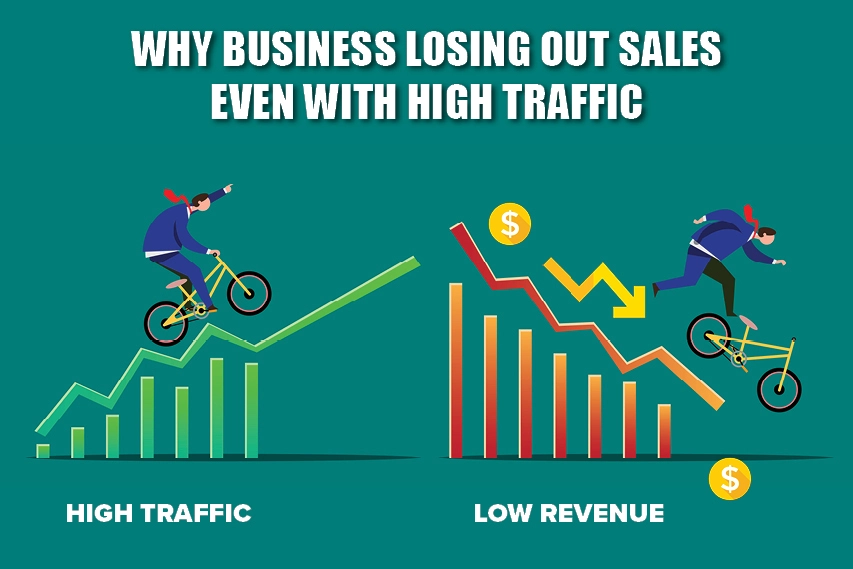
Generating high traffic is a dream come true for many digital managers. But many marketers’ journeys end there, as they often believe that driving more traffic could lead to more sales for their business. But this is not the case. High traffic does not necessarily lead to high sales, and businesses can fail to draw more sales if they are stuck in this loop of traffic generation only.
As a rising business media publication of the United States, The CEO Views has been delivering well-researched and well-documented pieces of information through articles, blogs, news, and profiles to not only connect industry peers but also empower readers with the latest knowledge associated with the business world. By shedding light on topics like this, our business magazine enlightens readers about various aspects of the modern business landscape.
In this article, we aim to explore the subtle connection between web traffic and sales generation, and how businesses, despite recognizing the loose connection between the two, often fall into the trap of high traffic and low sales.
The Thin Line Between High Traffic and High Sales
My business is high in traffic, but why are sales not reaching the desired heights? If you, as a marketer, are asking yourself this question, then this article could help you understand why it is so and what you can do to get out of this loop.
To understand what the core issue is, we need to understand what web traffic is, its importance in business, its connection with sales generation, and why businesses are stuck in the cycle of high traffic and low revenue.
Web Traffic Decoded
Website traffic refers to the people or web users who visit a website. In digital marketing, web traffic is measured through visits, and helps assess the effectiveness of an online business in attracting audiences. With the introduction of e-commerce in 1990, the concept of web traffic was first observed as the most crucial means of determining a website’s popularity. Businesses going for digital marketing services were exposed to this metric, helping them analyze their website’s performance by measuring the number of visits users are making.
Since then, this analysis evolved from counting the number of website visitors to “how long did users stay?” As the metric evolved, marketers quickly realized that bringing in heavy traffic to their website holds no significance if users leave within a few seconds. From there, the concept of ‘bounce rate’ and ‘time on page’ emerged to measure the amount of time users are spending on a web page.
It is with the concept of ‘conversion rate’ that web traffic started connecting with sales. By assessing the percentage of users who purchased products or services after visiting a website through conversion rate, marketing experts are connecting the dots between traffic generation and revenue generation.
Why Web Traffic is Important for Businesses?
Although website traffic is not the only source of measuring a website’s visibility today, it is still a reliable starting point to determine the popularity. So, why is it so important for a business? With digital marketing transforming consumer engagement drastically, staying in the game is a tough row to hoe. If you fail to attract visitors to your website, your website will likely get lost in this storm of competition. Even if your website is well-designed, you won’t be generating much sales or obtaining the end goal if it fails to attract visitors.
Without a heavy traffic flow from the targeted audience, a business will struggle to thrive in the market. Here is why web traffic is important for a business:
- More traffic equals more visitors to a website, which helps in converting visitors to customers.
- Traffic to a website helps in promoting what a business is selling to others.
- As a person’s time spent on your website increases, so does the likelihood of them signing up for your newsletter or promotional content, ensuring a long-term marketing initiative.
Why High Traffic Does Not Always Equal High Sales?
Despite knowing the fact that heavy traffic could lead to high conversion rates, it is not always true for all businesses. Listed below are five reasons why businesses are failing to generate more revenue despite having a large number of visitors to their websites.
-
More People Passing by Does Not Equal More Customers
This is because not all passersby are customers. Many people scroll through a website for several reasons. Some are commuters, others are just browsing with no intention of buying, and many are casual visitors. In such a case, businesses might receive thousands of visits daily, but that does not ensure sales.
-
A Complex Website Leads to Poor Conversion
It is important to note that a poorly designed website would lead to a high bounce rate. This means that if your site looks complex to navigate and involves a lot of filtering and sorting, users might leave your site quickly, leading to lower traffic and eventually lower conversion rates.
-
Mobile Optimization
Mobile devices are used more often for e-commerce shopping, and if your website is not optimized for mobile, users will lose interest in visiting your site. This, in turn, will lead to poor sales generation.
-
Google Ranking
Google ranking of a website holds a lot of significance in modern-day marketing. If your website is lagging in this ranking, users are not likely to pay attention to what you are offering. By working on increasing this ranking through advanced SEO for your site, you can always drive more customers.
-
Complex Checkout Process
Complicated checkouts will hinder sales. Customers who are frustrated with the checkout process on a website are likely to leave. Allowing them to check out without creating an account can lead to high conversions.
Apart from these top 5 reasons, several more reasons cause a business to face lower revenue even with high traffic to a website. Moreover, no matter how many people are scrolling through your site, if it has these poor factors in it, users will not likely show any interest in what you are offering.