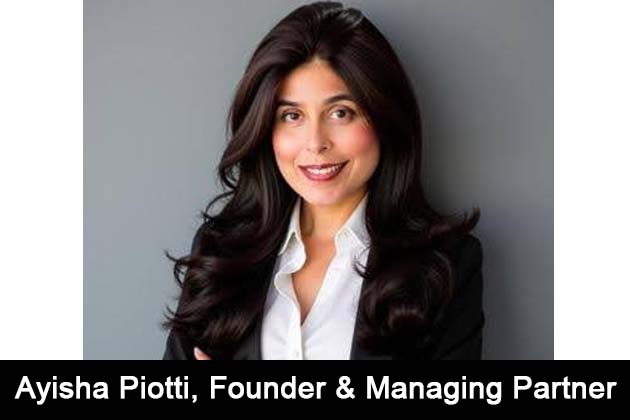
A career spent navigating global policy landscapes and a deeply personal moment of clarity kicked off Ayisha Piotti’s journey into ai governance. the founder and managing partner of reghorizon , Ayisha has built her expertise across the private and public sectors — from the united nations to senior corporate leadership across four continents — working at the frontlines of government affairs, business development, and international diplomacy.
watching her children’s future being written in code, she identified the governance gap in the fast-paced evolution of artificial intelligence. this conviction inspired her to establish reghorizon, a swiss-based ai governance think tank, and partner with ETH zürich’s center for law & economics to launch the ai policy summit in 2019. the need for a neutral and trusted governing platform to navigate ai and its governance sparked her interest in the space. a journey that began seven years ago has led ai policy to the thought leadership domain, validating the conviction that led ayisha to act before the world was ready to listen.
RegHorizon: A Revolution in AI Governance
When it started, AI policy was a niche academic conversation. Today, it lies at the center of geopolitical strategy, corporate risk management, and public discourse — and RegHorizon has grown into a globally recognized AI governance advisory.
Over the years, the company has built a community of over 4,500 members spanning 106 countries. RegHorizon has convened more than 130 institutions for over 80 strategic AI policy dialogues since 2020. In 2025 alone, its annual AI policy summit drew over 1,000 active participants. But the firm’s real impact remained structural. “We have helped position Switzerland as an essential neutral ground for the world’s most sensitive technology diplomacy — facilitating high-stakes discourse between the United States, Europe, and China,” proudly shares Ayisha. It has also launched flagship initiatives, including the Navigating AI podcast, which brings first-hand perspectives from global policymakers, business leaders, and civil society advocates to a worldwide audience.
Shaping the Future of AI
RegHorizon helps organizations see around corners, while building our approach on three pillars:
- Strategic Foresight: Helping organisations identify regulatory trends early, understand the implications of policy developments across markets, and anticipate where governance is headed before it becomes binding.
- Multi-stakeholder Intelligence: RegHorizon sits at the crossroads of government, industry, academia, and civil society across 100+ countries, offering clients an unmatched perspective.
- Capacity Building: Equipping leadership teams with the knowledge and frameworks to make informed decisions in a rapidly evolving environment through executive training and bespoke advisory.
Realizing the Essence of Thought Leadership
To Ayisha, true thought leadership is not about having the loudest voice or the most provocative opinion. It is about seeing clearly what others have not yet noticed, having the courage to act on that insight before consensus forms, and doing so in a way that brings others along. She believes thought leadership carries a responsibility to be honest about uncertainty. At RegHorizon, thought leadership is its operational model. The company implements it through knowledge creation, and inclusive participation. In the AI policy summit, policy insights are generated, debated, and refined with the people who make and implement those policies.
The Navigating AI podcast, regular policy, and advisory work all feed a continuous loop of insight. RegHorizon intentionally includes voices from the Global South, from smaller nations, and from civil society that are usually excluded from the AI governance conversation.
Leveraging Strategic Empathy
Ayisha’s United Nations days provided her with the fluency in multilateral diplomacy — the patience, precision, and cultural intelligence required to navigate complex negotiations across vastly different worldviews. Her experience as a senior corporate leader taught her to make decisions under uncertainty and to translate policy language into strategic action. “My academic journey — spanning the London School of Economics, Tufts’ Fletcher School of Law & Diplomacy, MIT Sloan, INSEAD, and IMD — gave me rigorous frameworks for analyzing the interplay between economics, governance, and technology,” shared Ayisha. All these taught her that leadership is about ‘strategic empathy.’ Her twenty years of cross-sector and cross-continental experience have taught her to manage tensions simultaneously and discover the path that moves everyone forward.
Embracing Innovation
For Ayisha, innovation is about seeing a gap that others have not yet recognized and building something to fill it. With regHorizon, she did the same for AI and its governance. She drives innovation by challenging assumptions. Instead of waiting for the technology to settle, Ayisha pioneered an approach of proactive and adaptive governance. With RegHorizon, her team continues to innovate by staying relentlessly close to the frontier: listening to regulators drafting new rules, to researchers pushing technical boundaries, and to communities affected by AI deployment.
Future Prospects
Ayisha believes that in the next few years, AI governance will become genuinely global, moving beyond the present concentration of rulemaking in the EU and United States to include meaningful participation from Africa, Southeast Asia, Latin America, and the Middle East. The best manifestation of herself in the coming future would be making the existing infrastructure self-sustaining, making the AI Policy summit grow, standardizing RegHorizon’s inclusive governance, and seeing her children grow up in a world where AI is ethically governed.
Inspiring Future Thinkers
The most common mistake aspiring thought leaders make is waiting for permission, waiting for the perfect credentials, waiting for consensus to form before speaking. Ayisha encourages future thought leaders to start before they are ready. While listening before investing in broadcasting can help them genuinely understand the ecosystem, building platforms would help future leaders ensure impact where others can contribute. She thinks that by being comfortable with financial risk and personal uncertainty, they can establish solid foundations.
“The measure of genuine thought leadership is the ecosystem you leave behind: the community you convene, the conversations you make possible, the decisions you help others make with greater clarity.”