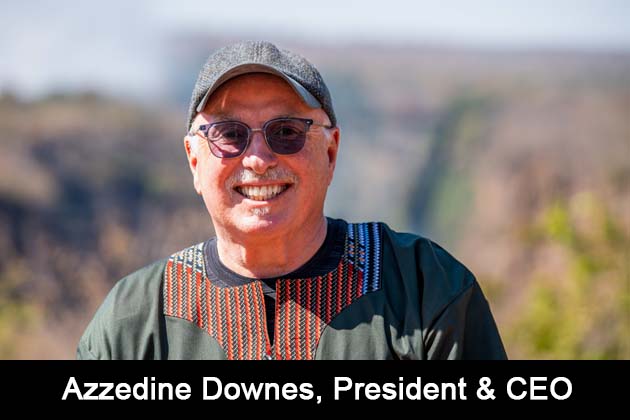
Most leaders operate within systems. Azzedine Downes has built his career challenging them. At a time when biodiversity loss is accelerating precipitously and human-wildlife conflict is intensifying, Downes recognized early that the problem was not simply ecological—it was structural. Conservation and human development were being treated as separate worlds, each advancing solutions that rarely overlapped. That disconnect, he believed, represented a real barrier to progress. “On one side, there were people focused on animal welfare and wildlife conservation; on the other, people working in development—economic growth, education, health services—and the two rarely intersected,” he explains.
What drove him forward was a conviction that helped fundamentally reframe the entire challenge: there are no animal problems—only human ones. And solving them requires rethinking how systems, communities, and priorities align.
A Journey Not of Degrees, But of Experiences
Downes’s leadership has been shaped less by titles and more by lived experience. Growing up across countries, cultures, and languages, he developed an early ability to adapt, observe, and listen—often before fully understanding the environment around him. These experiences instilled not only resilience, but a deep respect for perspective. While his academic foundation—including a Master’s degree in administration, planning, and social policy from Harvard—provided structure, it was his real-world exposure that reshaped how he understood leadership.
Leading IFAW (International Fund for Animal Welfare), navigating complex global challenges, and being recognized with multiple honors including the Order of the California Condor, reflect milestones along the way. But for Downes, these are not endpoints—they are signals of progress in a much larger journey. Leadership, as he sees it, is not about recognition. It is about staying committed to solving difficult problems, even when the path forward is uncertain or unpopular.
Stepping Outside the Comfort Zone
For Downes, thought leadership is not about expertise alone—it is about the willingness to move beyond it. It requires stepping into spaces that may seem unrelated or uncomfortable, challenging assumptions, and engaging with ideas that do not fit neatly within traditional boundaries. In conservation, this has meant confronting economic systems, social dynamics, and policy frameworks that are often treated as separate conversations.
True thought leadership, he believes, demands openness—to criticism, to complexity, and to the discomfort that comes with questioning established norms. It also requires creating environments where others can do the same. “When you lead this way, innovation isn’t an abstract goal,” Downes says. “It becomes part of the organization’s DNA.”
Challenging Conventional Thinking
Not all ideas are immediately accepted—especially the ones that matter most. Within IFAW and beyond, Downes has faced resistance to perspectives that now seem increasingly self-evident. One such example was his assertion that wildlife is not only impacted by climate change but is also part of the solution. At the time, the idea was dismissed as a distraction from more “serious” climate discussions. But over time, that thinking evolved. Today, biodiversity is widely recognized as central to climate resilience. This shift underscores a defining aspect of Downes’s leadership: the willingness to challenge conventional thinking, even when it invites skepticism. Progress, in his view, often begins at the edge of discomfort.
Redefining Conservation: People and Animals Together
One of Downes’s most significant contributions to the field has been advancing a more integrated approach to conservation—one that recognizes the interdependence of people and wildlife. Through initiatives like IFAW’s Room to Roam, this thinking has begun to influence policy and practice at scale. The premise is straightforward but transformative: species such as elephants require freedom of movement across landscapes that are increasingly shared with human communities. Rather than treating this overlap as a conflict to be managed, Downes has reframed it as a system to be designed.
This has led to a fundamental shift in investment—from symbolic community engagement to meaningful, sustained support for the people living alongside wildlife. Communities are no longer peripheral to conservation; they are central to its success. Equally important is IFAW’s focus on women’s leadership. Rather than simply including women in existing structures, the organization is helping to build new ones—where their leadership is foundational, not supplementary.
Doing the Right Thing First
At the core of Downes’s leadership philosophy is a principle that is both simple and demanding: do the right thing first—fill out the paperwork later. This is not a rejection of process, but a prioritization of purpose. It reflects a belief that ethical clarity should guide action, especially in complex environments where delays can carry real consequences. Empathy plays a critical role in this approach. Much of IFAW’s work takes place in communities facing extreme challenges—poverty, risk, and, in some cases, loss of life due to human-wildlife conflict. Maintaining empathy in these contexts is not optional; it is essential. It ensures that decisions are grounded not only in strategy but in humanity. Because ultimately, the goal is not just coexistence—it is dignity, safety, and shared progress.
A Legacy of Humanity and Clarity
For Downes, legacy is not defined by scale alone, but by meaning. On a personal level, it is about leaving the world better for his children—demonstrating that responsibility and compassion are not abstract values but lived commitments. Professionally, it is about reshaping how conservation is understood and practiced. He hopes to be remembered not for a single initiative, but for a shift in perspective: that individual lives matter, that communities are essential partners, and that meaningful change is possible without compromising ethical foundations.
Advice to Future Thought Leaders
Downes’s advice to aspiring leaders reflects the same principles that have guided his own journey: be generous, stay curious, and remain willing to challenge yourself. The most lasting impact, he believes, often comes from small, consistent actions—mentoring others, listening deeply, sharing knowledge, and supporting people without expecting immediate return. At the same time, he encourages future leaders to step beyond their comfort zones, question established thinking and embrace failure as part of growth.
“Thought leadership, for me, is about constantly learning, constantly challenging your own beliefs and approaches, and being willing to have difficult conversations,” he says. Because in the end, real leadership is not about having the right answers—it is about having the courage to ask better questions, and the conviction to act on them.
“Thought leadership, for me, is about constantly learning, constantly challenging your own beliefs and approaches, and being willing to have difficult conversations.”
— Azzedine Downes, President & CEO