Developing young talent is one of the most rewarding parts of Career Mode. Watching a raw academy prospect grow into a world class star is what separates a long term save from a few quick kickoff matches. Yet many saves hit the same frustrating wall. Highly rated wonderkids stall, growth slows down, and potential feels wasted.
This guide breaks down how development actually works, what truly matters behind the scenes, and how to consistently turn youth prospects into elite players over multiple seasons.
Understanding the foundation of player development
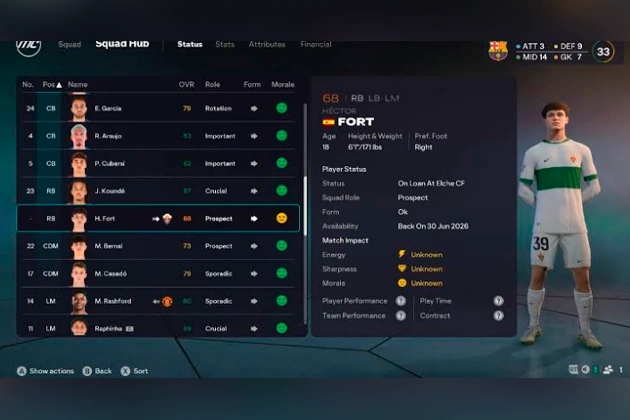
At its core, player growth is tied to how fast the development bar fills. That bar determines when a player gains an overall point, unlocks new attributes, or adapts to new roles. While age and potential matter, they are far less important than most people assume. The biggest influence by far is the coaching system. Many managers prefer to buy FC 26 players early in the season to secure high-potential talents before their value rises.
Coaching is not just a background feature. It is the engine that drives growth.
How the coaching department really works

In FC26, coaches are split into four departments: attack, midfield, defense, and goalkeeping. Every player at the club is assigned to one of these departments based on their main position, not the role they play on the pitch.
A five star defensive coach trains every center back, left back, and right back at the club. That applies to senior players and fifteen year old academy prospects alike. The same logic applies to midfielders, attackers, and goalkeepers.
This leads to an important detail. Players are always trained by the department linked to their primary position, even when played elsewhere. A center back deployed as a defensive midfielder still benefits from defensive coaches, not midfield ones. This allows for some surprisingly powerful optimization.
Stacking coaches for maximum growth
The number of stars in a department directly affects development speed. A fully staffed department can almost double how fast players grow compared to having no coaches at all.
This creates opportunities to heavily specialize. Filling the defensive department with elite coaches means defenders will grow incredibly fast, even when training for new positions like CDM or striker. It is entirely possible for a traditional center back to learn a striker role in under two years purely because of strong coaching, good form, and match experience.
This system allows for creative squad building. Players with hybrid attributes can be molded into elite performers simply by placing coaching resources in the right area. Tall defenders can become dominant target forwards. Fullbacks with technical ability can transition into midfield roles while still benefiting from defensive coaching.
Coaching is not just helpful. It is the single most important factor in long term development.
Position training and why it matters
Position training does more than unlock roles. It actively accelerates growth. Training a new position fills the development bar rapidly, especially when supported by strong coaching.
Even players who would never realistically change roles can be retrained surprisingly quickly. This does not mean they must permanently switch positions. The growth gained during training remains even after reverting to the original role.
Using position training strategically allows steady improvement without sacrificing realism or balance.
Match XP and how to use it properly
Match XP is the second major growth factor. It comes from minutes played and performance ratings. The more often a player plays and the better they perform, the faster the bar fills.
For senior players, this is straightforward. Regular starts combined with average ratings above seven provide a noticeable boost. Excellent form improves growth by roughly twenty percent compared to average form. Poor form slows it down by a similar margin.
Youth players work differently.
Youth tournaments and their real value
Academy players only gain match XP through Rush tournaments. These short competitions allow up to five players on the pitch at once. Performance matters far more than winning. Two ten out of ten performances are enough to reach the maximum match XP boost.
With smart rotation, seven or eight academy players can receive full match XP in a single fifteen minute tournament. This results in around twenty to thirty percent faster growth.
That said, the feature is time consuming and repetitive. Setting youth development speed to high provides a similar benefit without requiring manual play. For long saves, adjusting the setting is often the more practical option.
Form and its hidden influence
Form and match XP are closely linked. Strong performances improve form, which then boosts development speed. There are five form tiers: excellent, good, okay, poor, and bad.
Anything above a seven rating counts as excellent. Anything below six is considered bad. The difference between excellent and okay is noticeable but not massive, roughly twenty percent faster growth. Coaching still outweighs form by a large margin.
The key takeaway is consistency. Regular minutes with decent performances are enough. Chasing perfect ratings is not necessary.
How fast players can really grow
When combining top tier coaching, regular minutes, and solid form, growth becomes dramatic. Players under these conditions can develop roughly twice as fast as those without coaching who never play.
In practical terms, some young players can gain five overall points per season. That pace is far higher than older games and makes long term planning extremely rewarding.
Age plays a role, but a smaller one than expected. Younger players grow slightly faster, but the difference between an eighteen year old and a late twenties player is only around ten percent.
The truth about loans
Loans are unpredictable. Unless a player is loaned to a league with deep simulation enabled, match XP and form are not properly calculated. Growth becomes randomized.
Some players return massively improved. Others barely change. There is no reliable way to control it.
Loans also carry risk. Every time a player changes clubs, including going out on loan and being recalled, their potential can shift. In FC26, this change can range up to three points in either direction. A single loan spell can quietly reduce a wonderkid’s ceiling.
Final Thoughts
Player development in FC26 is not mysterious once the systems are understood. Coaches matter more than anything else. Match XP and form help, but only as secondary boosts. Youth tournaments are optional. Loans are risky and unreliable.
The most effective approach is simple. Invest heavily in coaching, specialize departments based on squad goals, give young players consistent minutes, and avoid unnecessary loans. With this setup, development becomes fast, predictable, and deeply satisfying.