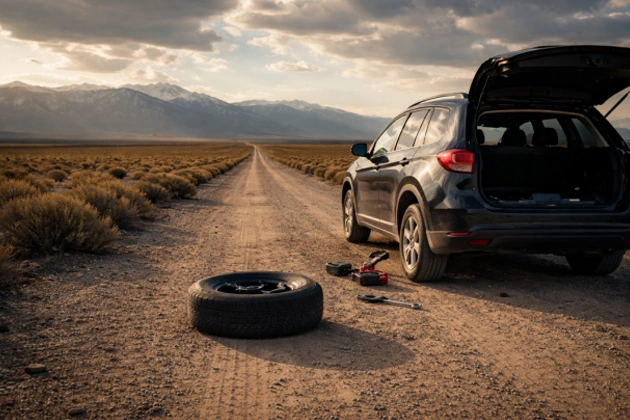
Run flat tires are designed to keep you moving briefly after a puncture, so you can reach a safer place or tire shop. They rely on reinforced construction and a working TPMS to warn you when pressure drops. This guide explains how run-flats work, their real limits, repair realities, and how to decide if they fit your driving.
What run-flat tires are (in plain English)
Run-flat tires are not “airless” tires. They still need air pressure like any standard tire. The difference is what happens after the tire loses pressure.
A conventional tire that loses air can collapse quickly, deform, overheat, and sometimes damage the wheel if you keep driving. A run-flat tire is engineered to resist collapse long enough to let you maintain control and reach a safe stopping point.
Think of run-flats as an emergency mobility system built into the tire. They are designed to prevent the worst-case scenario—being forced to stop immediately in a dangerous place—while giving you time to make a controlled plan.
How run-flat tires work
There are two main run-flat approaches. Most drivers encounter the first.
Self-supporting run-flats (most common)
These use reinforced sidewalls that can temporarily carry the vehicle’s weight when pressure drops. That reinforcement is also why many run-flats feel firmer over potholes and rough roads: the sidewall is intentionally stiffer.
Support-ring systems (less common)
Some run-flat systems use an internal support ring mounted to the wheel. If air pressure drops, the vehicle rides on the ring. These are less common for everyday passenger cars.
Why TPMS matters more with run-flats
A key “gotcha” with run-flats is that they can look normal even when deflated, at least from a quick glance. That means you can’t rely on eyeballing the tire the way you might with a standard tire.
That’s why a working TPMS (Tire Pressure Monitoring System) is critical. If your TPMS warning comes on, treat it as actionable information—not a suggestion.
Direct answer (voice-search style):
Do run-flat tires require TPMS?
In real-world use, yes. Because a run-flat may not visibly sag, TPMS is how most drivers learn they’ve lost pressure before they push the tire beyond its safe limits.
How far and how fast can you drive on a run-flat tire?
People want one number. The honest answer is: there’s a typical range, and then there’s your reality.
Direct answer (featured-snippet style):
How far can you drive on run-flat tires after a puncture?
Many run-flat tires are designed to travel a short emergency distance at reduced speed (often cited as up to about 50 miles / 80 km). The exact limit depends on the tire model, load, road conditions, and the type of damage—so always follow your tire maker and vehicle manual.
Direct answer:
How fast can you drive on a run-flat after pressure loss?
You should reduce speed and drive conservatively. Many run-flat systems reference a reduced speed limit (often around 50 mph / 80 km/h), but your tire’s guidance is the authority.
What changes your real-world “run-on” window
Your safe margin usually shrinks when any of these apply:
- Heavy passengers/cargo (more load on the damaged tire)
- Continuing at highway speeds (more heat buildup)
- A larger puncture or rapid deflation
- Hot pavement, rough roads, long downhill braking (heat factors)
- Driving a long distance before you noticed the TPMS warning
Practical mindset: once you’re in “run-flat mode,” your goal is not to finish errands. Your goal is to reach a safe stop and get inspected.
What to do when the TPMS light comes on (run-flat edition)
This is where most articles stay vague. Here is the simple, safe playbook.
The 5-minute action checklist
- Reduce speed smoothly. Avoid hard braking and sharp steering.
- Create space. Increase following distance and avoid sudden lane changes.
- Choose safety over convenience. Aim for a well-lit, flat area if possible.
- Confirm the warning. Check which tire and how low the pressure is.
- Do a quick visual check only if it’s safe. Look for sidewall damage, bulges, shredded rubber, or a large embedded object.
- Drive to service via the shortest safe route. Keep speed down and avoid potholes.
When to stop immediately (even if you have run-flats)
Stop and call for roadside help if you notice:
- Strong vibration or repeated thumping
- Smoke or a burning smell
- Visible sidewall tear, bulge, or shredded rubber
- Loss of steering stability or the car pulling aggressively
Run-flats reduce risk, but they don’t turn a severely damaged tire into a safe tire.
Pros of run-flat tires
Run-flats are popular for one big reason: they give you an emergency buffer when your tire loses air.
Benefits that matter day-to-day
- Safer decision window: You can get off the highway and stop somewhere safer.
- Convenience: Less roadside tire-changing in rain, heat, or traffic.
- Designed for “no spare” vehicles: Many OEM setups skip a spare to save space and weight.
- Clear emergency path: TPMS warning → reduced speed → short route to service.
Cons of run-flat tires (the tradeoffs buyers should know)
Most dissatisfaction comes from mismatched expectations.
The realistic downsides
- Ride comfort can be firmer due to reinforced sidewalls.
- Replacement costs are often higher than similar non-run-flat tires.
- Availability can be uneven by region and size.
- Repairability is often stricter, especially if you drove on the tire while low/flat.
- No spare anxiety: If your vehicle has no spare, severe damage can still strand you.
Can run-flat tires be repaired?
This is one of the most important ownership questions.
Direct answer (featured-snippet style):
Can run-flat tires be repaired?
Sometimes, but many punctures lead to replacement—especially if the tire was driven underinflated or at zero pressure. Repairability depends on puncture location, internal condition, and manufacturer/installer policy.
A simple repair decision tree
Use this before you waste time arguing at the counter.
Repair is usually NOT recommended if:
- The damage is on the sidewall or shoulder
- The tire was driven meaningfully underinflated or flat
- There’s visible deformation, unusual wear, or signs of heat damage
Repair may be possible if:
- It’s a small puncture in the tread area
- You noticed the TPMS early and limited driving
- A qualified shop can dismount and inspect the tire and your tire maker permits repair
Why many shops refuse run-flat repairs
From the shop’s perspective, internal damage can be difficult to prove “not present” after a tire has been driven on while deflated. A conservative replacement recommendation is often about safety and liability, not just upselling.
Run-flat vs regular vs self-sealing vs spare kit (quick comparison)
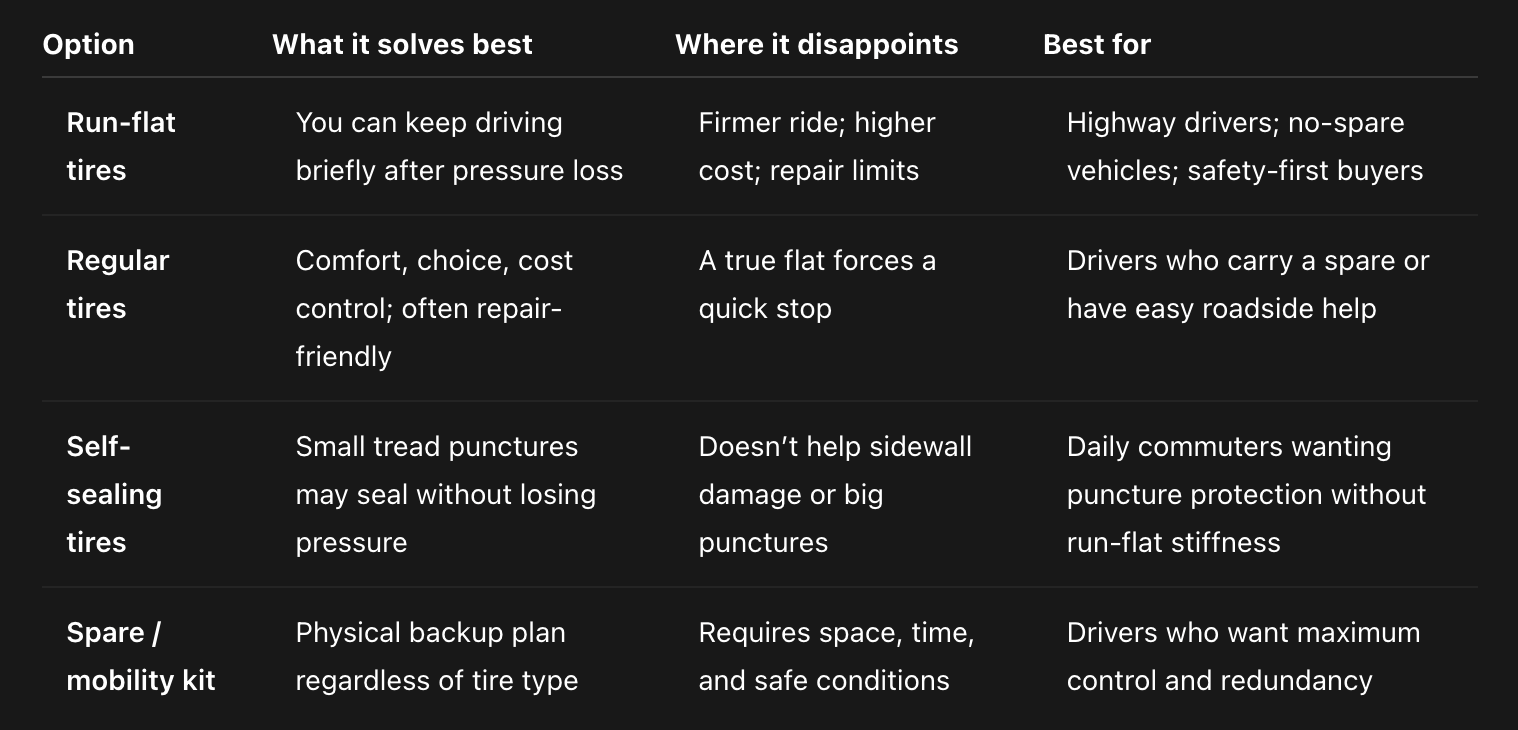
You’re not just choosing a tire—you’re choosing a “flat strategy.”
Are run-flat tires worth it? A buyer decision framework
“Worth it” is situational. Here’s a straightforward way to decide.
Run-flats are usually worth it if you…
- Drive high-speed roads often and want a safer exit plan
- Drive late at night or in areas where stopping is risky
- Have a vehicle designed around no spare and want the intended setup
- Prefer convenience and safety buffer over maximum ride comfort
Run-flats may not be worth it if you…
- Prioritize a softer, quieter ride
- Want maximum tire options and easier repair policies
- Live where run-flat inventory is limited and downtime is costly
- Prefer standard tires plus a spare or a proven mobility kit
Direct answer:
Should you buy run-flat tires?
Choose run-flats when safety and convenience during a puncture matter more than comfort and replacement cost—especially if your car is designed around not having a spare.
Ownership tips that extend run-flat life (and reduce regret)
Run-flats reward early detection and disciplined maintenance.
Practical tips that pay off
- Treat TPMS alerts as urgent. The sooner you react, the more options you keep.
- Check pressures monthly. Underinflation increases heat and uneven wear.
- Rotate and align on schedule. Uneven wear makes wet traction worse and shortens tire life.
- Avoid potholes when possible. Reinforced sidewalls can still be damaged by hard impacts.
- Have a backup plan even with run-flats. Keep roadside assistance info, and consider a compact mobility kit.
Common mistakes that ruin run-flats
- Ignoring TPMS because the tire “looks fine.”
- Continuing highway speeds after a puncture.
- Assuming run-flats are always repairable.
- Driving far beyond the emergency window.
- Switching off run-flats without adding a spare/kit strategy.
FAQ
Can you drive on a flat tire if it’s a run-flat?
Yes—briefly and within the tire’s emergency limits, so you can reach a safe place or service. If there’s severe vibration, sidewall damage, smoke, or loss of control, stop immediately.
How far can you drive on run-flat tires?
Many are designed for a short emergency distance (often cited as up to about 50 miles / 80 km), but your tire model, load, speed, and damage determine the real limit. Follow your vehicle manual and tire maker guidance.
Do run-flat tires need air?
Yes. Run-flats still require proper inflation for normal driving, handling, and tire life.
Can you patch a run-flat tire?
Sometimes—if it’s a small tread puncture and the tire wasn’t driven far while deflated. Many shops recommend replacement if the tire ran underinflated/flat.
Can you replace run-flats with regular tires?
Often yes, but many run-flat vehicles don’t have a spare. If you switch, you should add a spare, mobility kit, or roadside plan.
Why do run-flats feel harsher?
Their sidewalls are reinforced to support the vehicle during pressure loss. That stiffness can transmit bumps more than standard tires.
Key takeaways (quick summary list)
- Run-flat tires are an emergency mobility solution, not a normal driving mode.
- TPMS is critical because a run-flat may not look obviously flat.
- After a puncture, slow down, choose the shortest safe route to service, and avoid heat buildup.
- Repairability is often more limited than with standard truck tires, especially if you drove while flat.
- Run-flats are best for drivers who prioritize safety buffer and convenience—especially on no-spare vehicles.
Conclusion
Run-flat tires can be a smart choice when your priority is staying safe and in control after a puncture—especially if your vehicle is built around not carrying a spare. The tradeoff is comfort, cost, and sometimes stricter repair outcomes. If you’re considering run-flats, treat the decision as choosing a complete flat-tire strategy: confirm TPMS is working, understand your tire’s emergency limits, and plan how you’ll handle severe damage.