Americans with Disabilities Act (ADA) compliant signage represents more than an accessibility consideration for modern businesses. It functions as a critical component of an effective risk‑mitigation strategy. A single improperly mounted sign or missing tactile element can trigger federal penalties, yet many facility managers remain unaware of the technical precision these regulations demand until litigation arrives. Learn more about the benefits of implementing ADA-compliant signage.
The Growing Financial Risk of Noncompliance
The financial consequences of ADA signage violations extend beyond expectations. The Department of Justice may assess civil penalties for ADA violations under 28 CFR Section 6.504, with dollar amounts adjusted annually for inflation, in addition to potential settlement, legal, and remediation costs.
Geographic risk varies significantly across regions. Certain states function as hot spots for litigation, with California, New York and Florida leading in lawsuit volume. California alone saw nearly 6,000 ADA-related lawsuits filed in 2021. This concentration creates increased exposure for businesses operating in these jurisdictions, where plaintiff attorneys actively identify and pursue noncompliant facilities.
Common ADA Signage Errors and How to Avoid Them
ADA signage violations often come from small but repeated issues across design, installation and oversight. A common failure is incorrect placement of tactile signage, which must be mounted so that the baseline of the lowest tactile character is between 48 and 60 inches above the finished floor or ground surface.
Different sign types follow different accessibility requirements. Duncan-Parnell manufactures ADA-compliant signage and provides general placement guidance. According to Duncan-Parnell, “classification maintains wayfinding accessibility while keeping signs aligned with federal intent rather than overapplication.” Knowing in advance whether you need room identification signs or directional/informational signs helps manufacturers determine the correct design scope and fabrication process needed for compliant signage.
At scale, large national retailers operating multi-site portfolios illustrate how signage problems can multiply across large property networks. Many such organizations have faced ADA-related accessibility actions and have implemented remediation programs to improve signage and overall accessibility across their locations.
Rather than a single error, signage noncompliance is usually a buildup of small gaps that become costly when discovered through complaints or litigation. Regional code variations can further complicate compliance. For example, the California Building Code, Section 11B-703.2.4, requires slightly wider characters in signage than the federal baseline. Understanding location-based compliance requirements will help improve accessibility for workers and visitors and reduce compliance risk.
Building a Defensible Strategy With Compliant Signage
To improve accessibility and reduce legal risks, create a proactive strategy for your business’s ADA-compliant signage. This involves auditing your site, partnering with braille and tactile signage suppliers to navigate regulations, and developing a clear wayfinding plan.
The following guidance enables the creation of effective custom ADA signs for businesses that 75k merge brand identity with full compliance:
-
- High contrast and non-glare finish: All ADA-compliant signage must have a non-glare finish and feature high contrast between the characters and the background for readability.
- Tactile and braille standards: Work with braille and tactile signage suppliers to ensure signs for permanent spaces include tactile characters and Grade 2 braille placed below the tactile text.
- Correct mounting and placement: Even custom ADA signs for businesses fail compliance if installed incorrectly. Signs must be mounted at a specific height and location, typically beside the door’s latch side, with required clear floor space and approach maintained.
- Compliant fonts: Use simple, easy-to-read, upper case sans-serif fonts that meet ADA proportion and stroke requirements. and standardized pictograms to ensure universal understanding and legibility.
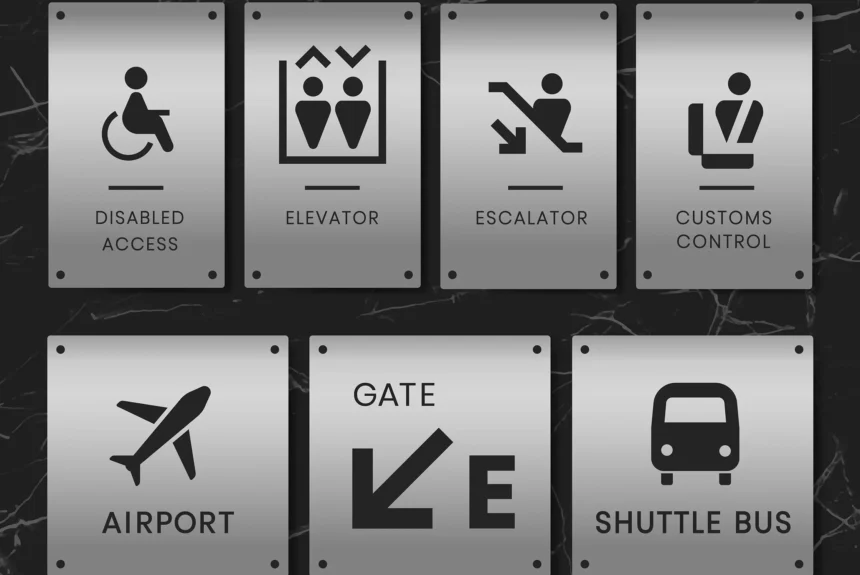
- Pictograms: Ensure pictograms have a field height that’s a minimum of 6 inches. This field should be text free. A text descriptor should appear below the pictogram field using compliant fonts.
Frequently Asked Questions About ADA Signage Liability
Here are some common questions about ADA-compliant signage.
How important is sign placement for ADA compliance?
Sign placement is critical. Tactile signs must be installed according to specific requirements, including mounting the baseline of the lowest character between 48 and 60 inches above the finished floor. Incorrect placement can result in noncompliance even if the sign itself meets all other standards.
Can ADA-compliant signage help reduce legal risk?
Yes. ADA-compliant signage can help businesses reduce liability exposure by meeting accessibility requirements and avoiding common compliance failures. A proactive approach that includes proper design, placement and ongoing compliance reviews is often less costly than addressing violations after they lead to complaints or litigation.
Business Protection Starts With Proactive Compliance
Custom ADA signs for businesses function as both a legal obligation and a strategic practice. The risks carry financial weight, the technical requirements demand specialized expertise and reactive approaches prove consistently more expensive than proactive strategies. Businesses that treat accessibility as an integrated operational component can build sustainable compliance and reduce long-term liability exposure.