Whether you’re running a small warehouse or managing a large-scale distribution center, choosing the right forklift is one of the most important operational decisions you’ll make. The wrong machine can slow down your workflow, rack up maintenance costs, and even create safety hazards. The right one, however, becomes a seamless extension of your operation — boosting productivity and protecting your bottom line.
This guide breaks down exactly what to consider when matching a forklift to your business size and needs.
Why Business Size Matters When Choosing a Forklift
It might be tempting to simply buy the most powerful forklift on the market and call it a day. But bigger isn’t always better — and in the world of material handling, that mindset can be costly.
A small retail operation doesn’t need the same lifting capacity as an industrial steel warehouse. Oversizing means you’re paying for power you’ll never use, burning more fuel, and potentially creating safety risks in tighter spaces. Undersizing, on the other hand, leads to overworked machines, frequent breakdowns, and operational bottlenecks.
The goal is fit — a forklift that matches your load requirements, workspace dimensions, floor type, and the volume of work your team handles daily.
Step 1: Assess Your Load Requirements
Before anything else, you need to understand what you’re lifting. This means identifying:
- Maximum load weight — What is the heaviest load your forklift will regularly carry? Always factor in a safety buffer of 10–20% above your typical maximum.
- Load dimensions — Width, height, and depth all matter. An unusually wide or tall load affects stability and the type of attachment you may need.
- Load center — The load center is the distance from the front of the forks to the center of gravity of the load. Most forklifts are rated at a 24-inch load center, but if your loads are unusually deep, this changes your effective capacity significantly.
Small businesses (e.g., local distributors, small warehouses, retail stockrooms) typically deal with loads under 5,000 lbs. A standard counterbalance forklift or a reach truck in the 3,000–5,000 lb capacity range is usually sufficient.
Mid-size businesses (e.g., regional logistics companies, manufacturing plants) often handle loads between 5,000 and 15,000 lbs and may need specialized equipment like reach trucks, order pickers, or higher-capacity counterbalance forklifts.
Large enterprises (e.g., ports, steel manufacturers, bulk distribution centers) regularly move loads exceeding 15,000–50,000 lbs and require heavy-duty or rough terrain forklifts built for that scale.
Step 2: Evaluate Your Workspace
The physical environment where your forklift will operate is just as important as what it’s lifting. Consider the following:
Indoor vs. Outdoor Operation
Indoor operations typically require electric forklifts. They produce zero emissions, operate quietly, and are safe for enclosed spaces. They’re ideal for food-grade facilities, pharmaceutical warehouses, and any environment where air quality matters.
Outdoor or rough terrain environments call for internal combustion (IC) forklifts powered by propane, diesel, or gasoline. These machines handle uneven ground, inclines, and outdoor conditions that would wear down an electric model quickly.
Aisle Width
Aisle width is a major factor that many businesses underestimate. A standard counterbalance forklift needs roughly 11–12 feet of aisle space to operate effectively. If your warehouse has narrower aisles, you’ll need a narrow-aisle or very-narrow-aisle (VNA) forklift — such as a reach truck or turret truck — which can operate in aisles as tight as 5–6 feet.
Flooring and Surface Conditions
Smooth concrete floors are friendly to most forklifts. But if your facility has cracks, ramps, dock plates, or transitional surfaces, you need a machine with adequate ground clearance and appropriate tire types (cushion tires for smooth floors, pneumatic tires for rougher terrain).
Step 3: Match the Forklift Type to Your Operation
There are several core forklift types, each designed for specific use cases:
Counterbalance Forklifts — The classic forklift design. Versatile, easy to operate, and available in electric or IC versions. Best for businesses that need a do-it-all machine with standard aisle requirements.
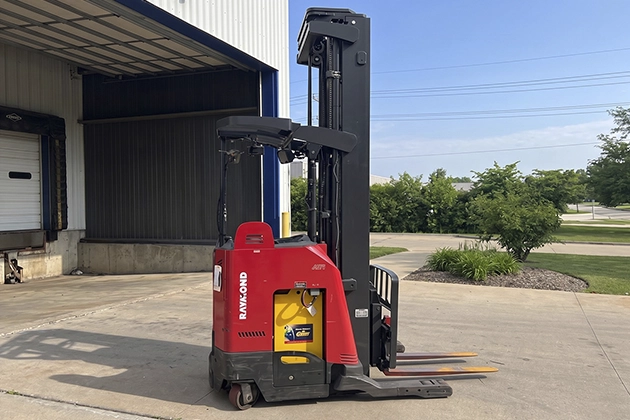
Reach Trucks — Designed for narrow-aisle warehouses with high racking. The forks extend forward to reach into racking without moving the entire machine. Ideal for mid-to-large warehouses maximizing vertical storage.
Order Pickers — The operator is elevated with the forks to pick individual items from racking. Best for e-commerce and retail fulfillment centers where picking accuracy and speed are priorities.
Pallet Jacks (Powered Walkie or Rider) — Lower cost and perfect for ground-level pallet movement. Suited for small businesses, loading docks, and operations with minimal racking.
Rough Terrain Forklifts — Built with large pneumatic tires and high ground clearance for outdoor job sites, lumberyards, construction sites, and agriculture.
Side Loaders and Telescopic Handlers — Specialized machines for handling long or awkward loads, or for work on construction sites requiring extended reach.
Step 4: Think About Fleet Size and Utilization
A solo forklift might be all a small business needs. But as your operation scales, you should think carefully about fleet composition.
A single-shift small warehouse might only need one or two machines. A 24/7 distribution center, however, needs to account for machine downtime, battery charging cycles (for electric models), and redundancy in case of breakdown.
Also consider: if your team uses forklifts intensively (6–8+ hours per day), electric forklifts may require multiple battery packs or fast-charging infrastructure. Propane forklifts offer quicker “refueling” and are often preferred in high-utilization environments.
Step 5: Factor in Total Cost of Ownership
The sticker price of a forklift is just the beginning. Total cost of ownership (TCO) includes:
- Fuel or electricity costs
- Preventive maintenance
- Tire replacement
- Operator training
- Parts availability and repair costs
This last point deserves special attention. When a forklift breaks down, the cost isn’t just the repair — it’s the downtime, missed shipments, and scrambling for alternatives. Choosing a reputable brand with strong parts availability makes a significant difference in long-term reliability.
For example, Raymond forklifts are widely recognized for their build quality and longevity in demanding warehouse environments. Keeping your Raymond equipment running at peak performance is straightforward when you have access to genuine replacement parts. If you need Raymond forklift components, click here to browse a comprehensive catalog of Raymond forklift parts to keep your fleet in top shape.
Step 6: Don’t Overlook Operator Safety and Ergonomics
The best forklift for your business is also the safest one for your team. Look for features like:
- Clear sightlines from the operator seat
- Intuitive controls that reduce operator fatigue
- Stability systems (especially important for high-lift operations)
- Ergonomic seating and suspension for operators logging long hours
OSHA requires that all forklift operators complete certified training before operating a powered industrial truck. Factor training time and cost into your decision, especially if you’re transitioning to a new forklift type
Choosing the right forklift isn’t just a procurement decision — it’s a strategic one. The machine you select will shape your warehouse layout, influence your staffing, affect your energy bills, and determine how smoothly your operation runs day to day.
Take the time to audit your loads, measure your aisles, consult your operators, and think long-term about maintenance and parts support. When you make a well-informed choice upfront, you avoid costly mistakes and set your business up for efficient, safe, and scalable operations for years to come