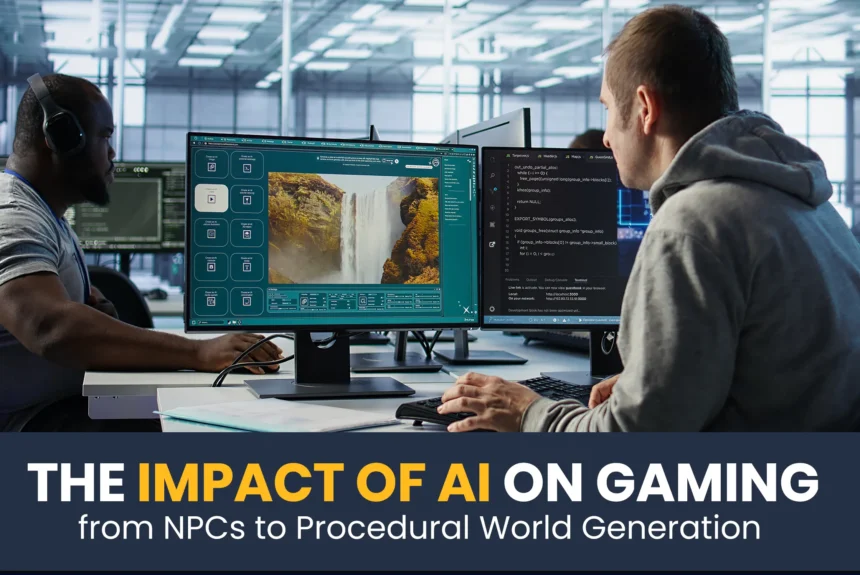
The gaming industry has always been shaped by technological breakthroughs, from 3D graphics and online multiplayer to cloud gaming and virtual reality. Today, another major transformation is underway as artificial intelligence application becomes increasingly important across game design, development, testing, storytelling, and player experiences.
Developers are using AI to create characters that respond more naturally, generate expansive environments, personalize gameplay, detect cheating, and streamline production. As these technologies mature, AI is no longer simply a background tool used by developers. It is becoming part of the way games are designed, played, and experienced.
The growing role of AI in modern gaming
Artificial intelligence has been part of video games for decades. Early games used relatively simple rules to control enemies and create predictable challenges. A non-player character might follow a fixed path, attack when the player entered a specific area, or retreat after losing a certain amount of health.
Modern AI is considerably more advanced. Machine learning, neural networks, generative AI, and procedural generation techniques are allowing developers to build systems that can react to player behavior and create content at a much larger scale.
The global video game industry is already enormous. According to Newzoo, the global games market generated more than $180 billion in annual revenue in recent years, with billions of players worldwide. With such a large audience and increasingly complex games, studios are under constant pressure to deliver richer experiences while controlling development costs and production timelines.
This is where AI can make a difference. Instead of manually designing every element, developers can use intelligent tools to automate repetitive tasks, analyze player behavior, generate content, and support creative teams.
Smarter NPCs are making virtual worlds feel alive
One of the most visible applications of AI in gaming is the development of smarter non-player characters, commonly known as NPCs.
Traditionally, NPC behavior was based on predetermined scripts. A guard might patrol a specific area, notice the player, and start an attack. While effective, these systems could become predictable after repeated gameplay.
AI-powered NPCs can potentially respond to situations in more dynamic ways. Characters can analyze the environment, react to player actions, cooperate with other characters, and change their behavior based on what is happening around them.
Games such as The Last of Us Part II demonstrated how sophisticated AI can make enemy encounters more believable. Enemies can communicate with each other, search for players, and respond to changes in the environment. Similarly, Red Dead Redemption 2 created a world where NPCs follow daily routines and react to the player’s actions, contributing to the feeling of a living environment.
The next stage is conversational AI. Developers are experimenting with systems that allow players to communicate with virtual characters using natural language rather than selecting from a limited list of dialogue options.
Companies such as NVIDIA have demonstrated technologies designed to enable AI-powered digital characters, while startups and game studios are exploring large language models to create more flexible conversations.
This could change role-playing games significantly. Instead of following a fixed dialogue tree, a player might ask a character a question in their own words and receive a contextually appropriate response.
Procedural generation can create worlds at unprecedented scale
Another major area where AI is influencing gaming is procedural content generation. Procedural generation is not new. Games have used algorithms to automatically create levels, maps, items, and environments for years. Minecraft, for example, generates enormous landscapes using algorithms, allowing players to explore virtually limitless worlds.
AI can take this concept further by helping systems generate more complex and context-aware content.
Developers can use AI-assisted tools to create terrain, textures, buildings, objects, quests, and other elements. Instead of manually designing every component, creators can establish rules and parameters that guide automated systems.
This approach can be particularly valuable for open-world games. Creating a massive virtual environment traditionally requires teams of artists, designers, programmers, and writers working for years. AI-assisted procedural generation could help studios produce larger worlds while allowing human creators to focus on important creative decisions.
However, AI-generated content still requires oversight. A procedurally generated world may be technically impressive but lack the artistic consistency and storytelling quality that players expect. Human designers remain essential for deciding what makes a world interesting, meaningful, and emotionally engaging.
AI is transforming game development itself
Beyond what players see on screen, AI is changing how games are produced.
Game development involves thousands of repetitive tasks, including testing, debugging, animation, asset creation, localization, quality assurance, and balancing. AI tools can assist developers by identifying bugs, analyzing code, generating test cases, and automating certain workflows.
AI can also analyze player data to identify where people struggle or lose interest. If a large number of players abandon a particular level, developers can investigate whether the difficulty is too high or whether the gameplay is not engaging enough.
This is one reason AI in game development is becoming an important industry discussion. The technology does not necessarily replace developers. Instead, it can act as an assistant that reduces repetitive workloads and gives creative teams more time to concentrate on design and innovation.
According to a 2024 Game Developers Conference survey, generative AI was already being used or explored by a significant portion of game development professionals, although attitudes toward the technology remained mixed. Developers have raised concerns about copyright, job displacement, quality, and the use of training data.
The debate highlights an important reality: AI adoption in gaming is growing, but the industry is still determining how these tools should be used responsibly.
The Games Making AI Come Alive
- The Last of Us Part II: Naughty Dog used advanced AI systems to make enemies behave more realistically. Enemies can communicate with one another, search for the player, and react to the loss of their allies. This creates more dynamic and emotionally intense combat encounters.
- Minecraft: The game is one of the best-known examples of procedural world generation. Algorithms automatically create enormous landscapes containing mountains, caves, oceans, forests, and villages. This demonstrates how procedural systems can produce expansive environments without designers manually building every part of the world.
- Red Dead Redemption 2: Rockstar Games created highly detailed NPC behaviors that contribute to the game’s living world. Characters follow routines, interact with their surroundings, and respond to player actions, showing how AI-driven behaviors can make open-world environments feel more believable.
- Middle-earth: Shadow of Mordor: Monolith Productions’ Nemesis System created personalized rivalries between players and enemy characters. Orcs could remember previous encounters, survive battles, gain power, and return with different personalities and relationships with the player. The system became a major example of how AI-driven character behavior can create unique gameplay experiences.
- Alien: Isolation: The game’s alien uses AI systems to create unpredictable encounters. Instead of simply following a fixed path, the creature searches for the player and responds to the player’s behavior, making each encounter feel different.
- Left 4 Dead: Valve’s AI Director dynamically adjusts the game’s pacing by controlling enemy encounters and item placement. It analyzes how players are performing and helps create a changing rhythm of tension and action rather than delivering exactly the same experience every time.
- No Man’s Sky: Hello Games uses procedural generation to create a massive universe containing billions of procedurally generated planets. The game demonstrates how algorithmic systems can produce enormous amounts of explorable content at a scale that would be extremely difficult to create manually.
- NVIDIA ACE: NVIDIA has demonstrated AI-powered digital characters designed to interact with players through natural language. These technologies show how generative AI could move gaming beyond pre-written dialogue toward more interactive conversations with virtual characters.
- Google DeepMind’s SIMA: DeepMind developed an AI agent capable of following natural-language instructions and performing tasks across different video games. This research demonstrates the potential for general-purpose AI agents to understand game environments and interact with them.
Personalized gaming experiences
One of the most promising industry-specific use cases for AI is personalized gameplay. Every player is different. Some prefer challenging combat, while others enjoy exploration and storytelling. AI can analyze player behavior and help games adapt accordingly.
For example, an AI system could identify that a player is struggling with a particular boss and subtly adjust difficulty. Another player who quickly masters the same encounter could face a more demanding challenge.
Sports and racing games can also use AI to create more competitive opponents. Instead of simply increasing an enemy’s speed or health, AI could study how a player behaves and adjusts the opponent’s strategy.
In multiplayer games, AI can also assist with matchmaking by considering player skill, behavior, and performance. This can help create more balanced matches and potentially improve player retention.
The esports industry is another area where AI is becoming increasingly relevant. AI-powered analytics can examine gameplay patterns, identify strategies, and help teams understand their strengths and weaknesses.
Players can also stay ahead of trends in esports by exploring the best dota 2 betting sites for 2025, helping them be among the first to learn about new opportunities.
AI-generated storytelling could reshape interactive narratives
Storytelling is another area where AI could have a major impact. Traditional games often rely on carefully written scripts and branching dialogue. While this approach produces high-quality narratives, it also limits the number of possible outcomes.
AI could enable more dynamic storytelling in which characters remember previous interactions and respond differently based on the player’s choices.
Imagine entering a fantasy village where every character has an AI-supported personality and memory. If a player helps a villager early in the game, that character might later offer assistance. If the player betrays them, the relationship could change.
Such systems could make each player’s experience more unique. However, maintaining narrative quality will remain a challenge. Games need consistent characters, meaningful story arcs, and coherent worlds. Uncontrolled AI-generated dialogue could create contradictions or break immersion. As a result, many developers are likely to use AI as a storytelling support tool rather than giving it complete control.
AI is changing game testing and quality assurance
Testing is one of the most time-consuming parts of game development. Large games can contain millions of possible player interactions, making it difficult for human testers to identify every potential problem. AI agents can potentially play games repeatedly, exploring different paths and identifying unusual behaviors.
For example, an AI testing system could repeatedly attempt to navigate a level and discover that players can become trapped in a particular location. It could also identify collision problems, unusual glitches, or unexpected interactions.
This could significantly improve quality assurance while reducing the time needed to test complex environments.
AI can also help developers balance games. By analyzing large amounts of gameplay data, systems can identify weapons that are too powerful, characters that are rarely selected, or levels where players consistently struggle.
The rise of AI-assisted graphics and asset creation
Generative AI is also influencing how visual assets are produced. Artists can use AI-assisted tools to explore concepts, create prototypes, generate textures, and accelerate repetitive production tasks. This can be particularly useful during the early stages of development when teams need to test multiple visual directions quickly.
The technology could be valuable for smaller studios that do not have the resources of major publishers.
At the same time, the use of generative AI in art has generated controversy. Some artists and developers are concerned about copyright and whether AI systems have been trained using creative work without proper permission.
The future of AI-generated game assets will therefore depend not only on technical progress but also on industry standards, legal frameworks, and ethical practices.
What the future of AI-powered gaming could look like
The long-term impact of how AI is changing video games will likely extend far beyond smarter enemies and automatically generated maps.
Future games could feature worlds that continuously evolve based on player behavior. Characters may remember interactions across hundreds of hours of gameplay. Quests could be generated dynamically, while AI systems create personalized challenges for individual players.
Cloud-based AI could also allow games to access powerful models without requiring every player’s computer or console to perform the heavy processing locally.
The combination of AI, virtual reality, augmented reality, and advanced graphics could create highly immersive digital environments. Players might interact with virtual characters through voice, gestures, and natural conversation rather than traditional menus and dialogue systems.
At the same time, the industry will need to address important questions about privacy, copyright, employment, transparency, and creative ownership.
A new era for interactive entertainment
Artificial intelligence is becoming one of the most influential technologies in the gaming industry. From intelligent NPCs and procedural world generation to automated testing, personalized gameplay, AI-assisted development, and dynamic storytelling, its influence is expanding across nearly every stage of game creation.
The technology is not likely to eliminate the need for human creativity. Instead, its greatest value may come from combining machine capabilities with human imagination. Developers can use AI to handle repetitive work, analyze complex information, and explore possibilities that would otherwise require enormous amounts of time.
As studios continue experimenting with new applications, players are likely to see games become more responsive, expansive, personalized, and unpredictable. The real opportunity lies in using technology to create experiences that feel more human, not less.
Ultimately, artificial intelligence application will continue to shape the future of gaming by giving developers new ways to build interactive worlds and giving players experiences that are increasingly tailored to how they play, explore, and connect.
FAQs
- How is AI changing the gaming industry?
AI is transforming gaming by enabling smarter NPCs, adaptive gameplay, procedural content generation, automated testing, personalized experiences, and more dynamic virtual worlds. - How does AI make NPCs smarter?
AI allows NPCs to respond to player actions, understand their surroundings, communicate with other characters, and adapt their behavior instead of following only fixed scripts. - What is procedural world generation in gaming?
Procedural world generation uses algorithms and AI-assisted systems to automatically create game environments, landscapes, levels, and other content, allowing developers to build large and diverse worlds more efficiently. - What are some real examples of AI in video games?
Games such as The Last of Us Part II, Red Dead Redemption 2, Minecraft, Alien: Isolation, Left 4 Dead, and Middle-earth: Shadow of Mordor demonstrate different approaches to AI-driven NPC behavior, procedural generation, adaptive gameplay, and dynamic interactions. - Can AI create personalized gaming experiences?
Yes. AI can analyze player behavior and adjust difficulty, challenges, enemy strategies, matchmaking, and other gameplay elements to create experiences that better suit individual players. - Will AI replace game developers and designers?
AI is more likely to support rather than completely replace game developers. It can automate repetitive tasks and assist with testing, content creation, and development, while human creators remain essential for storytelling, creativity, design, and artistic direction. - What is the future of AI in video games?
The future could include more intelligent characters, dynamically generated quests, evolving game worlds, natural conversations with NPCs, and highly personalized gameplay experiences powered by advanced AI systems.
The CEO Views shares the stories of leaders who are creating change and shaping the future. From important career moments to the ideas behind their success, each story explores their journey, leadership, and vision. It also highlights the personal experiences and values that have shaped them as leaders.