From an academic and business perspective, a PESTLE analysis of a business reveals how the political, economic, technological, legal, and environmental conditions of a geographical location influence the operations, growth, and success of businesses operating within the location. Whether there is an economic uncertainty in the USA, a natural disaster affecting daily life in the country, its volatile political environment, or regulatory disruptions, business leaders must remain steadfast in the face of any uncertainty to ensure successful business navigation.
Chief Executive Officers, or CEOs, being the ones at the helm, bear the responsibility of not only determining the direction of their businesses but also helping them navigate through all external and internal complexities to stay resilient in times of uncertainty. By following their footsteps, organizational team members become more accountable, productive, resilient, and strategic in whatever they do.
A Tour to the Uncertain Economic World of the USA
According to The World Economic Forum, uncertainty is one of the defining characteristics of the global economy, as geopolitical tensions and geo-economic shifts challenge economic assumptions. The September edition of the Chief Economists’ Outlook in 2025 highlighted that the global economy had entered a “new era of heightened uncertainty.” Another economic research paper has identified that “elevated policy uncertainty in the United States and Europe in recent years may have harmed macroeconomic performance.”
The unpredictability associated with this unforeseeable economic condition is one of the key issues businesses face in the USA. A Deloitte report shows that since September 2024, the USA has experienced a rapidly changing economic and policy environment, raising assumptions about where the economy might end up. As of August 2025, the tariff rate was above 10%, and it has been assumed that this rate may rise further to 15% by the first quarter of 2026.
Artificial intelligence is having a significant impact on the U.S. economy, increasing the level of business investment. Initially, real business fixed investment in the second quarter of 2025 grew at an anualized 1.9%, which was later revised up to 7.3%. This growth rate is expected to moderate from 4.4% to 4% in 2026.
Due to the AI-driven gains in equity prices, consumer spending is expected to be stronger in 2026. However, high tariffs impact consumer prices, raising the core personal consumption expenditure (PCE) price index to 3% in 2026. As consumers’ purchasing power erodes, the real consumer spending drops to 1.6% in 2026, lower than the anticipated 2.6% in 2025.
Despite lower tariffs and stronger business investment, the US economy grew at a slower rate in 2025. It is not until 2026 that the effects of the differentiated tariff rates reflect more clearly in the inflation data. With increased inflation, the Fed will likely take a balanced approach to monetary policy.
Amidst this economic disruption in the USA, the resilience of leaders and businesses is put into question, as business leaders grappled with the challenges of steering the business ship through the volatile regulatory, policy, and economic landscape of the USA. This is where business leadership comes into play, ensuring a strategic, actionable approach to business decision-making and operational excellence.
Leading Amidst Uncertainty: What Leaders Can Do to Thrive?
Business leaders can navigate uncertainty by staying connected to their businesses’ guiding principles and objectives. The better a leader tackles the challenges of uncertainty, the better their business emerges. To weather an economic storm, business executives can adopt transparency and clear communication to solve problems together with employees. By anchoring to the business’s mission, vision, and purpose, great leaders can effectively overcome uncertain challenges and align with business values.
In today’s global environment, uncertainty is a defining feature of the business landscape. Navigating economic uncertainty requires a robust and visionary leadership that can inspire and support teams through challenges. As per a report by The World Economic Forum, organizations that build resilience better position themselves to innovate, grow, and create value.
The question is not how businesses should combat disruption by building resilience, but rather how to build systems that adapt and thrive. Resilience has become imperative to business success, and not merely a defensive strategy against specific challenges. Business leaders are empowered to encounter financial crises, geopolitical instability, supply chain disruptions, pandemics, and rapid technological advancements.
According to The World Economic Forum, growing political polarization and shifts are altering long-term policy direction. Organizations cannot rely on familiar markets to provide economic stability. They must be able to operate across multiple economic, political, and technological scenarios to attain sustainability in this competitive business landscape. This can be achieved through business executives, particularly CEOs, who are skilled and prepared to make hard decisions and push their boundaries to do what has not been done.
Making a business future-ready means integrating business resilience across the organization and constantly evaluating the environment to identify changes. Resilience was once a defensive strategy. However, today, it must become an active mindset for executives to bring probabilistic thinking and a willingness to upgrade with change together. To ensure resilience, leaders must conduct scenario analyses, build systems and data capabilities, proactively engage with stakeholders, and evaluate potential outcomes in tangible terms. These practices make leaders informed to take disciplined decisions to secure performance and help turn uncertainty into a source of competitive edge.
Building a Resilient Business
In a business world, where uncertainty is the only constant, resilience should be intentionally orchestrated into organizations, investment strategies, and cultures. By investing in talent development, business leaders build agility to make organizations adaptable to change. While identifying potential weakness areas within an organization, business executives also identify future growth areas to unveil opportunities amidst risks.
Resilient cultures don’t eliminate risks; they find ways to absorb them. Sounds confusing? Let us have a clear look at the concept. Resilience is an operating system that leaders do not approach as a recovery act, but as an intentional design principle embedded into organizational processes, people, and culture.
Resilient leaders do not restore what they once had. Instead, they reinvent what to do next. A Forbes study reveals that “leadership today is less about stability and more about elasticity.” It includes leaders’ ability to adapt, stretch, and rebound without breaking. A business with high elasticity is enabled to make clear decisions, accelerate feedback loops, and have adaptable operating systems. Innovation escalates this mission of building resilience for leaders, who prioritize innovation over traditional risk mitigation.
Leadership as the Anchor in an Unstable Economy
According to the World Bank, global growth declined sharply through 2024-2025, while the International Monetary Fund (IMF) warned about persistent uncertainty that suppresses investment and hiring decisions globally. For businesses, this environment not only hinders forecasts but also strains supply chains, tests organizational morale, and pressures margins. Business survival now depends less on size and more on leadership clarity.
In the face of uncertainty, resilient organizations do not emerge by chance; they are created deliberately by leadership strategy. Research by McKinsey & Company reveals that companies with adaptable and decisive leadership are 2.5 times more likely to outperform their competitors during economic downturns. CEOs who prioritize scenario planning, transparent communication, and agile decision-making enable teams to respond faster during changes.
Economic instability also alters internal dynamics. Budget constraints lead to difficult trade-offs, increased workforce anxiety, and deprioritized innovation risks. This is where leadership strategies play a stabilizing role. PwC’s Global Crisis Survey indicates that employees are three times more likely to trust organizations whose leaders communicate openly during uncertainty, directly influencing retention and productivity.
Economic uncertainty complicates operations in subtle but compounding ways. But evidence suggests that leadership strategy can counteract these challenges. A Harvard Business Review analysis shows that companies with resilient leadership models maintain stronger performance by prioritizing adaptability, cross-functional collaboration, and empowered decision-making, even amid persistent volatility.
CEOs play a central role in shaping this resilience. According to Deloitte, organizations with adaptive leadership cultures are more likely to sustain innovation and productivity during economic stress.
Crucially, resilient leaders also rethink performance metrics. Instead of chasing short-term efficiency alone, leaders focus on organizational endurance, diversifying revenue streams, safeguarding core capabilities, and strengthening partnerships. When met with intentional leadership, economic uncertainty becomes a catalyst for smarter decision-making and cultural cohesion. Hence, resilience is not built through optimism but through preparedness. CEOs who treat uncertainty as a strategic constant, rather than a temporary obstacle, develop organizations capable of navigating volatility with confidence, speed, and purpose.
CEO Strategies that Helped Businesses Navigate 2025’s Uncertainties
-
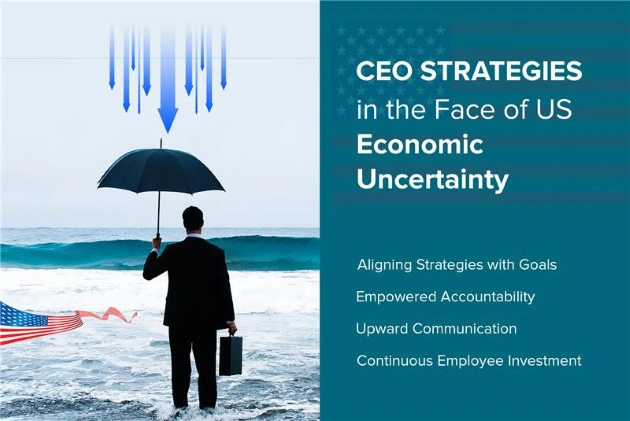
Aligning Strategies with Goals
American CEOs kept their business strategies aligned with the business goals, while facing challenges in navigating their companies through the tariff and policy volatility of 2025. As the senior leader of an organization, a CEO must ensure that their solutions support strategic decision-making. By translating strategies into objectives, CEOs ensure alignment with business priorities. Strategies that are aligned with company goals also keep teams on track.
-
Empowered Accountability
CEOs of large organizations in the U.S. have communicated company goals and KPIs on a public platform during the economic downturn, encouraging employees to be innovative and identify solutions. When everyone sees the goals, the workforce remains motivated to contribute to the business’s success.
-
Anchoring to the Organizational Mission, Vision, and Purpose
As stated earlier, while overcoming challenges, CEOs must stay connected to the company’s guiding principles. Among all the U.S. CEO strategies of 2025, anchoring with businesses’ mission, vision, and purpose remained the most effective strategy for CEOs to deal with uncertainties. By leading with vision, reaffirming the mission with employees, and clearly communicating decisions, American CEOs ensure all remains aligned with the organizational values.
-
Upward Communication
Upward communication by CEOs creates a culture where employees feel heard and valued, putting their trust in employers. By cultivating a healthy work environment, CEOs have increased employee engagement in many US companies. In times of recession, most employees worry about their job security. By understanding how they feel, CEOs can allow them to speak up and share their views.
-
Continuous Employee Investment
Talent development is the key to business success, especially in times of uncertainty. Even during a recession, CEOs have recognized their staff for their achievements and retained them by continually investing in their development.
The CEO Views, as a reputable U.S. business magazine, has been contributing to the knowledge development of business enthusiasts, with its updated, well-researched, and creatively crafted articles, blogs, and news reports.