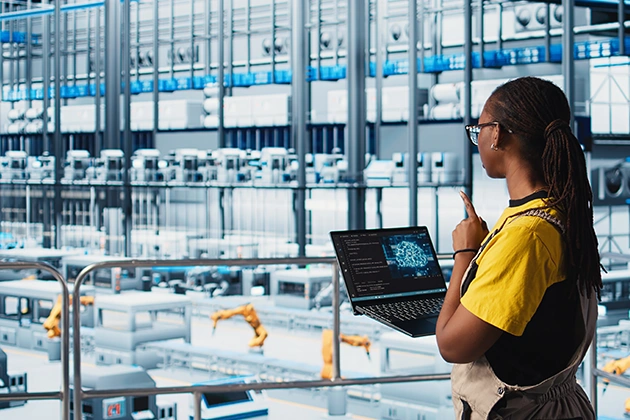
Walk into almost any manufacturing facility today and you’ll see advanced machinery, robotics, connected sensors, and sophisticated planning systems. On the surface, it looks like a fully modernized operation.
But behind the scenes, many manufacturers are still battling a persistent problem: data silos.
Production data sits in one system. Quality metrics live in another. Maintenance logs are stored elsewhere. ERP, MES, PLM, supply chain software, and IoT platforms often operate independently, each holding valuable—but isolated—information.
In an era defined by Industry 4.0, real-time decision-making, and supply chain volatility, disconnected systems are no longer just inconvenient. They’re a competitive liability.
The Hidden Cost of Siloed Systems
Data silos rarely emerge intentionally. They are usually the result of years of incremental technology adoption:
- A new MES to improve shop floor visibility
- An ERP upgrade to support financial consolidation
- A specialized quality management system
- IoT sensors added to monitor machine performance
Each investment may solve a specific problem. But without integration, they create new barriers.
Operational Blind Spots
When systems cannot communicate seamlessly, decision-makers lack full visibility. Production planners may not see real-time machine downtime. Maintenance teams may not have access to quality deviation data. Supply chain leaders may rely on outdated inventory snapshots.
These blind spots lead to:
- Reactive decision-making
- Increased downtime
- Excess inventory or stockouts
- Missed delivery commitments
In fast-moving manufacturing environments, latency is costly.
Manual Workarounds and Inefficiency
In siloed environments, employees often compensate manually—exporting spreadsheets, re-entering data, and emailing reports between departments.
This creates:
- Redundant labor
- Data entry errors
- Version control issues
- Slower response times
Over time, these inefficiencies compound, reducing agility and profitability.
What Integration Platforms Actually Do
A modern manufacturing integration platform acts as a connective layer across systems, applications, machines, and data sources. Rather than replacing existing tools, it enables them to communicate effectively.
Unified Data Flow
Integration platforms connect:
- ERP systems
- MES platforms
- SCADA systems
- Quality management software
- Supply chain applications
- IoT devices and sensors
They standardize data formats and enable real-time or near-real-time data exchange across systems.
This means a production delay recorded on the shop floor can instantly update scheduling, procurement forecasts, and customer delivery timelines.
Real-Time Visibility Across the Enterprise
With integrated systems, dashboards can reflect synchronized data across departments. Leaders gain access to:
- Live production metrics
- Machine health indicators
- Inventory levels
- Order fulfillment status
- Quality deviations
This unified visibility allows organizations to move from reactive problem-solving to proactive optimization.
Scalable and Flexible Architecture
Unlike rigid legacy integrations, modern platforms are built with APIs, cloud infrastructure, and modular architecture. This flexibility allows manufacturers to:
- Add new machines or systems without major reconfiguration
- Expand across facilities
- Integrate acquisitions more quickly
- Adapt to evolving technology stacks
Scalability is critical in a landscape where digital transformation is continuous, not one-time.
From Data Collection to Actionable Intelligence
Collecting data is no longer the challenge. Interpreting and acting on it is.
Enabling Advanced Analytics
Integrated data environments provide clean, consistent inputs for analytics and AI tools. Manufacturers can apply predictive models to:
- Forecast equipment failures
- Optimize production schedules
- Reduce energy consumption
- Improve yield rates
- Identify quality trends early
Without integration, analytics initiatives often stall due to inconsistent or incomplete data sets.
Supporting Predictive Maintenance
Predictive maintenance is one of the clearest examples of integration’s value. Sensor data from equipment must connect with maintenance records, production schedules, and spare parts inventory systems.
When systems are integrated:
- Maintenance teams can schedule interventions during low-production windows
- Spare parts can be pre-ordered automatically
- Downtime can be minimized
This shift from reactive to predictive maintenance significantly improves overall equipment effectiveness (OEE).
Breaking Down Organizational Silos
Technology silos often mirror organizational silos. Integration platforms help address both.
Aligning Production and Supply Chain
When production output data flows directly into supply chain systems, procurement teams gain real-time insight into material consumption and demand shifts.
This improves:
- Inventory accuracy
- Supplier collaboration
- Working capital management
- On-time delivery performance
Cross-functional alignment becomes easier when everyone is working from the same data foundation.
Enhancing Quality and Compliance
Quality events should not remain confined to quality departments. When non-conformance data integrates with production and engineering systems, root cause analysis becomes faster and more precise.
Regulatory compliance also benefits from comprehensive audit trails and synchronized documentation across systems.
Accelerating Digital Transformation
Industry 4.0 initiatives often begin with ambitious goals: smart factories, autonomous operations, AI-driven optimization. Yet many transformation efforts stall due to fragmented infrastructure.
Integration platforms provide the foundation required for digital maturity.
Supporting Smart Factory Initiatives
Smart factories rely on continuous data exchange between machines, analytics engines, and business systems. Integration platforms enable:
- Machine-to-system communication
- Edge-to-cloud connectivity
- Real-time feedback loops
Without this connective layer, advanced automation strategies struggle to deliver measurable value.
Enabling Multi-Site Standardization
Manufacturers operating multiple facilities often face inconsistent systems and processes across sites. Integration platforms can standardize data flows and reporting structures, enabling:
- Comparable KPIs across plants
- Centralized performance monitoring
- Best practice replication
This consistency strengthens enterprise-wide governance and performance management.
Reducing Risk in an Uncertain Environment
Global supply chain disruptions, geopolitical instability, and demand volatility have exposed the importance of operational resilience.
Integrated data ecosystems support resilience by:
- Providing early warning signals of disruption
- Allowing rapid production reallocation
- Improving scenario planning accuracy
- Enabling real-time collaboration with partners
When systems are connected, organizations can pivot faster and with greater confidence.
Conclusion
Modern manufacturing is too complex, too data-intensive, and too fast-moving to operate in silos.
Machines generate constant streams of performance data. Supply chains shift rapidly. Customers expect reliability and transparency. Leaders require timely insights to steer operations effectively.
A manufacturing integration platform transforms isolated systems into a unified, intelligent network. It turns raw data into coordinated action. It replaces manual workarounds with automated workflows. And it creates the foundation for sustainable digital transformation.
Breaking down silos is not simply about technology alignment. It is about enabling manufacturing organizations to operate as cohesive, agile enterprises—where information flows freely, decisions happen faster, and performance improves continuously.
In the connected era of manufacturing, integration is not optional. It is the engine that keeps everything moving forward.