
“Most Influential CEOs to Watch 2026”
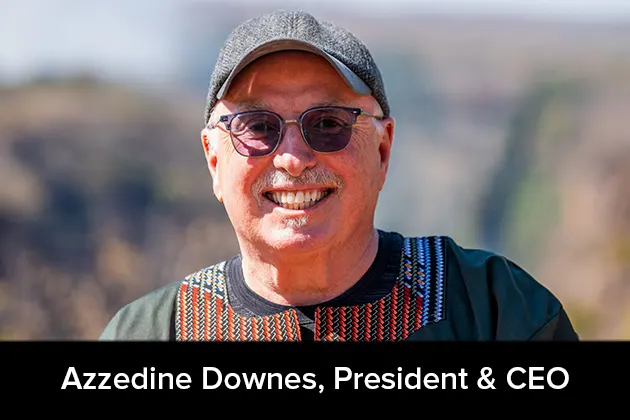
There’s a difference between leading an organization and reshaping the way an entire field thinks. Azzedine Downes has spent his career doing the latter.
Shaped by a life lived across borders, languages, and cultures, Downes brings a perspective that resists simplicity. His guiding principle—do the right thing first, and fill out the paperwork later—is not just a philosophy; it is a discipline of action in a world that often defaults to delay.
At a time when climate change, biodiversity loss, and social inequality are no longer abstract risks but confirmed realities, Downes has positioned IFAW (International Fund for Animal Welfare) as a force that operates at the intersection of hope and action. Under his leadership, the organization has expanded across four continents, secured critical elephant habitat in Kenya, launched its first office in the Middle East, and strengthened global enforcement efforts through collaboration with INTERPOL’s Environmental Crime Program. More importantly, it has helped redefine conservation itself—shifting the narrative from protection alone to coexistence, where people and animals can thrive together.
A Journey Shaped by Perspective
Downes’s early life was defined by movement—across countries, cultures, and languages, often before he had fully settled into the last. Navigating unfamiliar environments required more than adaptability; it demanded curiosity, humility, and the ability to listen before acting.
Those experiences now underpin his leadership style. Rather than directing from the top, Downes focuses on creating alignment—bringing people together around a shared purpose and giving them the space to contribute meaningfully. For him, leadership is less about control and more about unlocking potential. “Becoming CEO wasn’t a single defining moment,” he reflects. “It was the accumulation of experiences, the lessons learned from setbacks, and the willingness to lead with both conviction and humility.”
Leadership Built on Learning
Before joining IFAW, Downes built a career that exposed him to the complexity of global development and human systems. His work with USAID in the Middle East and later as Acting Regional Director for the U.S. Peace Corps in Eurasia and the Middle East region, reinforced a critical lesson: solutions rarely succeed unless they reflect the realities of the people they are meant to serve. He joined IFAW in 1997 and ultimately became President & CEO in 2012. Early in his tenure, he recognized a fundamental limitation—progress would stall if the organization only engaged those who already agreed with it. His response was to deliberately widen the circle. He began bringing together “unusual suspects”—partners who would not traditionally sit at the same table. From seamstresses in Malawi to auction houses in China, these unlikely collaborations now form a network that supports conservation efforts in more than 40 countries.
In 2023, Downes reflected on these cross-cultural experiences in his personal memoir, The Couscous Chronicles, a personal account of identity, leadership, and navigating complexity.
Principles That Drive Impact
For Downes, leadership is not defined by structure or process—it is defined by outcomes. At the center of his approach is a simple but often overlooked truth: conservation is ultimately about both animals and people. This belief shapes how IFAW works with communities that live alongside wildlife—not as stakeholders to be managed, but as partners in designing solutions that last. He notes the fundamental importance of empathy and its role in the momentum of progress. It shows up in listening carefully, respecting lived realities, and ensuring that those closest to the challenges are part of shaping the response.
In a world where global challenges can feel paralyzing, Downes sees his role as helping others focus—cutting through complexity to identify what can actually be done, and then actually doing it, something which is often met with surprise.
Turning Purpose into Progress
Under Downes’s leadership, IFAW has translated intent into measurable, on-the-ground impact. The organization’s expansion has been both strategic and deliberate, extending its reach while deepening its effectiveness. A landmark example is the 16,000-acre land agreement with Maasai communities in Kenya—protecting critical migration corridors for wildlife while supporting sustainable livelihoods for the people who depend on that land. At the same time, partnerships with international enforcement bodies, including INTERPOL, have strengthened the global fight against wildlife crime—addressing not just symptoms, but the systems that enable exploitation.
Through this integrated approach—combining science, community engagement, and policy influence—IFAW continues to push conservation beyond traditional boundaries. “Our focus on innovative partnerships, community engagement, and evidence-based action has enabled us to create lasting impact in more than 40 countries,” Downes explains.
Impact Beyond Metrics
While results matter, Downes believes the true test of leadership lies in how those results are achieved. His approach is grounded in steadiness—the ability to remain calm in moments of uncertainty and to focus attention on what can be influenced. Patience, in this sense, is not passive; it is a strategic choice that allows for better decisions.
Equally important is creating an environment where people can grow. By encouraging initiative and valuing thoughtful risk-taking, Downes has cultivated a culture that is both resilient and adaptive. It is this combination—clarity of purpose and strength of culture—that enables IFAW to operate effectively in a rapidly changing world.
The Modern CEO Blueprint
For Downes, leadership today requires more than expertise—it requires sound judgment, self-awareness, and a strong ethical foundation. Patience and empathy are essential but so are trust and humility. These are not soft skills; they are the mechanisms that allow leaders to navigate complexity and build credibility. A CEO must be able to remain composed when everything around them is shifting, while still making decisions that are grounded in long-term impact rather than short-term pressure.
Navigating Today’s Leadership Challenges
One of the most persistent challenges in leadership today is resistance to change. In a world that is evolving rapidly, helping others recognize—and adapt to—that change is both necessary and difficult. At the same time, younger generations are carrying a growing sense of uncertainty about the future. Balancing ambition with that weight requires a different kind of leadership—one that acknowledges reality without becoming overwhelmed by it. For Downes, the answer lies in focus. Break complexity into action. Identify what can be done. Move forward.
Innovation with Intention
Innovation, in Downes’s view, is not about chasing novelty—it is about solving real problems in practical ways. Creating space for experimentation is critical but so is maintaining accountability. Failure is useful only if it leads to learning and better decisions. Effective innovation requires working within constraints—budgets, teams, and systems—while still finding ways to push forward. It is this balance between creativity and discipline that turns ideas into impact.
Looking Ahead
As he looks toward the future, Downes is less focused on scale and more focused on continuity. His priority is ensuring that the next generation of leaders is prepared—not just to manage complexity, but to shape it. Building that capacity means investing in people, strengthening systems, and maintaining clarity of purpose. In time, he hopes to shift his own focus toward broader thought leadership, contributing to global conversations on conservation and the evolving relationship between people and the natural world.
Advice to Future Leaders
For those stepping into leadership, Downes offers guidance that is deceptively simple: invest in others. Be generous with your time. Share what you know. Create space for people to grow beyond you. “I push my team to question assumptions, break out of traditional silos, and take thoughtful risks,” he says. Because in the end, leadership is not defined by how much you control—it is defined by what continues to move forward because of you.
“I push my team to question assumptions, to break out of traditional silos, and to take thoughtful risks.”
— Azzedine Downes, President & CEO