

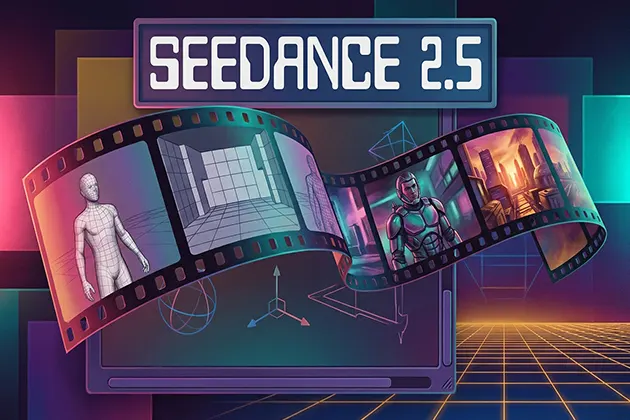
Video production has always had a price of entry. Equipment, editing skills, shoot days, post-production time — most of that cost sits between the idea and the finished product. The Seedance 2.5 AI video generator is part of a growing category of tools designed to reduce that gap, not by lowering the quality bar, but by removing the steps that don’t need to be there.
For brands, marketers, and independent creators, that matters. Content demand isn’t slowing down, and the teams producing it aren’t getting larger. Something has to give, and AI video generation is increasingly where that pressure gets absorbed.
How AI video generation actually changed
For a long time, AI video tools were more demo than tool. The outputs were interesting to look at but not something you’d put in front of a client or publish under a brand name. Motion was choppy, scenes didn’t hold together, and the gap between what you described and what the tool produced was wide enough to be a problem.
That’s changed. Newer systems handle motion consistency and scene logic noticeably better. When a user describes a setting or a visual sequence, the output tracks more closely to the intent. Transitions feel less random. Objects and characters behave more consistently across frames. These aren’t cosmetic improvements — they’re the difference between a tool that’s useful in production and one that only works in controlled demonstrations.
The Seedance 2.5 AI video generator reflects this shift. It’s built to interpret detailed creative instructions and produce structured visual sequences from them, which makes it a practical option rather than an experimental one.
What it means for content teams
Marketing teams and content creators face a specific problem: the volume of content required to stay present across platforms is high, and the resources available to produce it are usually fixed. Something has to move faster without costing more.
AI video tools address this at the production level. A team working on a campaign can generate several visual directions from a single brief, review them in parallel, and decide which one is worth developing further. That evaluation used to happen after a shoot. Now it can happen before one, which changes what gets greenlit and what gets cut before anyone spends money on it.
The Seedance 2.5 AI video generator fits into this kind of workflow without requiring a complete overhaul of how teams already work. It produces visual drafts that can be reviewed, adjusted, and refined. The creative decisions — tone, narrative, audience fit — still come from the people on the team. The tool handles the production layer underneath those decisions.
For smaller teams and solo creators, the benefit compounds. Producing, reviewing, and publishing consistent video content through traditional methods is genuinely difficult at small scale. AI generation makes it possible to maintain output without adding headcount or budget.
Where it’s being used
Digital marketing is the most obvious application. Brands need video for product introductions, social campaigns, customer communication, and platform-specific content — often in multiple formats for multiple audiences. AI-assisted production helps teams create those variations without treating each one as a separate production project.
Social media creators use the Seedance 2.5 AI video generator to keep up with posting schedules without burning out on production. Generating a rough visual from a written idea is faster than building it from scratch, and editing an existing output is easier than starting from a blank timeline. For creators managing several channels simultaneously, that speed adds up quickly.
Education is another area where text-to-video generation is finding real use. Explaining a process visually tends to land better than describing it in text, and AI tools make that option available to educators and course creators who don’t have a production background or budget. A written script becomes a video without requiring any specialist skills in between.
Internal communications is a less obvious but growing use case. Presentations, training materials, and company updates are increasingly expected in video format. AI generation makes that feasible for teams that wouldn’t otherwise have the capacity to produce video content internally.
Storytelling still requires human judgment
Better tools don’t change what makes video worth watching. The idea has to be clear. The message has to connect with a specific audience. The pacing has to work. None of that comes from a prompt — it comes from the person behind it.
What AI video generation changes is how quickly you can test whether an idea works visually. The Seedance 2.5 AI video generator can produce a draft of a concept fast enough that you can evaluate it, react to it, and adjust your direction before committing to a full production. That feedback loop has real value in creative work, where the cost of going down the wrong path is often several days of wasted effort.
The tools are increasingly designed to work alongside creative judgment rather than replace it. Creators use AI-generated drafts as starting points, then shape them according to the actual goals of the project. That’s a reasonable division of work, and it’s the model that tends to produce the best results.
What comes next
The direction of development in AI video is toward more control, not less. Better prompt interpretation, more consistent visual rendering, finer control over pacing and style — these are the improvements that make the tools more useful for professional work, not just interesting experiments.
The Seedance 2.5 AI video generator sits at a point where the technology is capable enough to use in real workflows today. Creators and teams who build familiarity with it now are developing an advantage that will carry forward as the tools improve. The learning curve is manageable, and the time savings scale with how much content you produce.
The broader shift is about who can make video. For most of the medium’s history, quality production required significant resources that most individuals and small teams didn’t have. AI generation is changing those requirements. The tools handle more of the production. The creative thinking — the ideas, the strategy, the audience understanding — still comes from the people using them. For creators who already have footage and want to build out a longer sequence, a PixVerse video extender can also be useful for expanding video content without starting the production process from scratch.
That’s a trade most creators and organizations will find worth making.