Few London postcodes carry the quiet prestige of Primrose Hill. Tucked between Regent’s Park, Camden and St John’s Wood, this pocket of NW3 has spent decades drawing founders, executives and international investors who value discretion, a genuine village feel, and fast access to the City and the West End. For a busy leader that mix is rare: a calm base for downtime that still sits minutes from the boardroom.
Prices reflect the demand. The average flat sold for over £1 million in the past year, and a semi-detached house averaged £3.37 million, according to KFH data drawn from HM Land Registry. At this level the purchase is rarely simple. Understanding the market, planning around Stamp Duty, and assembling the right advisory team separate a smooth acquisition from an expensive misstep. This guide sets out what a serious buyer needs to know before committing.
Key Takeaways
- Primrose Hill values climbed 11.9% over the past year, with detached houses averaging almost £11 million.
- Stamp Duty on a £2.38 million terraced house is about £199,900 at standard rates, or roughly £319,100 as an additional dwelling.
- Most stock is period property, so a full RICS building survey (Level 3) is strongly advisable before exchange.
- In a discreet, low volume market, a specialist local agent with real NW3 knowledge is critical.
- Overseas buyers face a further 2% Stamp Duty surcharge above all other applicable rates.
Why Primrose Hill Appeals to Business Leaders and Investors
The appeal sits at the intersection of location, scarcity and atmosphere. Primrose Hill is one of the few inner-London neighbourhoods that genuinely feels like a village, with independent bookshops, artisan delis and boutique restaurants lining Regent’s Park Road and Gloucester Avenue, yet it sits within minutes of the centre via Chalk Farm and Swiss Cottage.
The park is a significant draw in its own right. It forms part of the Royal Parks estate and offers some of the most photographed panoramas of the London skyline, from St Paul’s Cathedral across to Canary Wharf. For families, the catchment includes the Outstanding-rated Primrose Hill Primary School, alongside proximity to leading independent schools. That blend of green space, schooling and walkability commands a consistent premium.
The buyer profile is genuinely international. Much of the activity runs quietly through the specialist estate agents Primrose Hill vendors trust, with the best homes changing hands before they ever reach the open market. Plaza Estates, founded in 1972 and focused solely on central London property, notes that the area draws both UK-based high-net-worth individuals and overseas purchasers, particularly from Europe, the Middle East and North America, attracted by understated prestige and relative value against Mayfair or Knightsbridge.
Primrose Hill blends discreet luxury with a real sense of community, a combination most prime London postcodes struggle to replicate.
Understanding the Primrose Hill Property Market
This is a low volume, high value market. Annual transactions are modest for an area of its size, so when good stock appears, particularly freehold period houses on the best roads, it moves quickly and discreetly.
Property types span four broad categories, each with distinct price points and buyer profiles.
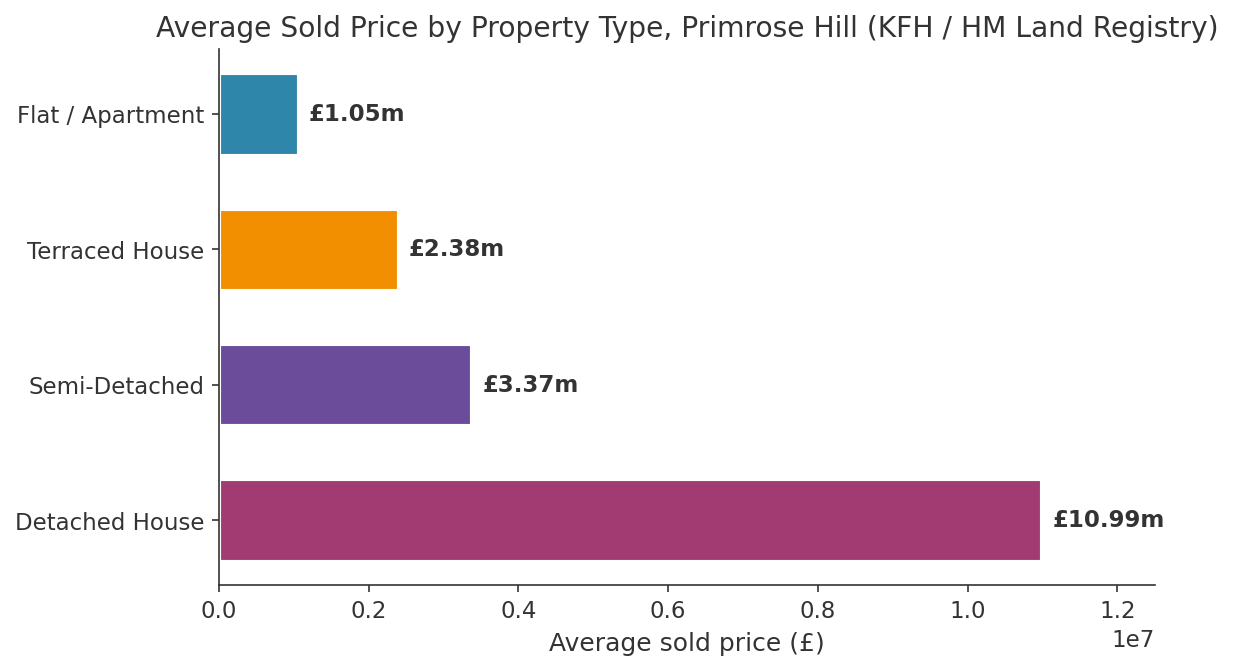
Figure 1: Average sold prices by property type in Primrose Hill. Source: KFH / HM Land Registry.
| Property type | Average sold price | Typical buyer profile |
|---|---|---|
| Flat / Apartment | £1,047,777 | Professionals, downsizers, pied-a-terre buyers |
| Terraced house | £2,384,400 | Families, upsizers from nearby areas |
| Semi-detached | £3,366,000 | High-net-worth families, investors |
| Detached house | £10,987,554 | Ultra-high-net-worth, trophy asset buyers |
Sold values rose by 11.9% in the last year (KFH), a meaningful uplift that reflects both real demand and the chronic undersupply of quality freehold stock. Roads such as Elsworthy Road, Fitzroy Road and Chalcot Square rank among the most prestigious in NW3, and houses there with south-facing gardens and original period detail carry a clear premium above the average.
For investors weighing prime London against other property plays, the draw here is capital preservation and scarcity rather than yield. A house in this postcode behaves differently from income-led options such as senior living REITs, where predictable occupancy drives the return; it is closer to a trophy asset that holds value across cycles.
| Buyer tip: Primrose Hill runs largely as an off-market community, and many of the best homes sell privately before they reach the portals. Registering early with a specialist agent, and being specific about your requirements, sharply improves your access to the strongest stock. |
Structuring the Finances: Liquidity, Mortgages, Bridging and Stamp Duty
At these price points buyers are frequently cash purchasers, or private banking clients using those facilities rather than conventional high-street mortgages. Specialist residential products do exist for prime property, typically at loan-to-value ratios of 70 to 75%, subject to income, assets and lender criteria.
Timing often matters more than headline rate. Many executives want to buy before selling an existing home, and short-term finance can keep an acquisition moving without a chain. Where speed counts, specialist bridging loan providers can fund a purchase ahead of a sale, preserving the certainty that off-market vendors prize.
The largest upfront cost beyond the price itself is Stamp Duty. With revised thresholds in force from April 2025, the liability on prime property is substantial.
| Purchase price band | Standard SDLT rate |
|---|---|
| Up to £125,000 | 0% |
| £125,001 to £250,000 | 2% |
| £250,001 to £925,000 | 5% |
| £925,001 to £1,500,000 | 10% |
| Above £1,500,000 | 12% |
Buyers acquiring a Primrose Hill home as a second residence or investment pay a 5% surcharge above the standard rates across every band, a change effective from October 2024. It applies from the first pound and cannot be avoided on an additional dwelling. Overseas buyers who have not spent at least 183 days in the UK during the previous 12 months pay a further 2% non-resident surcharge on top of everything else, which can push the effective marginal rate to 19% on amounts above £1.5 million.
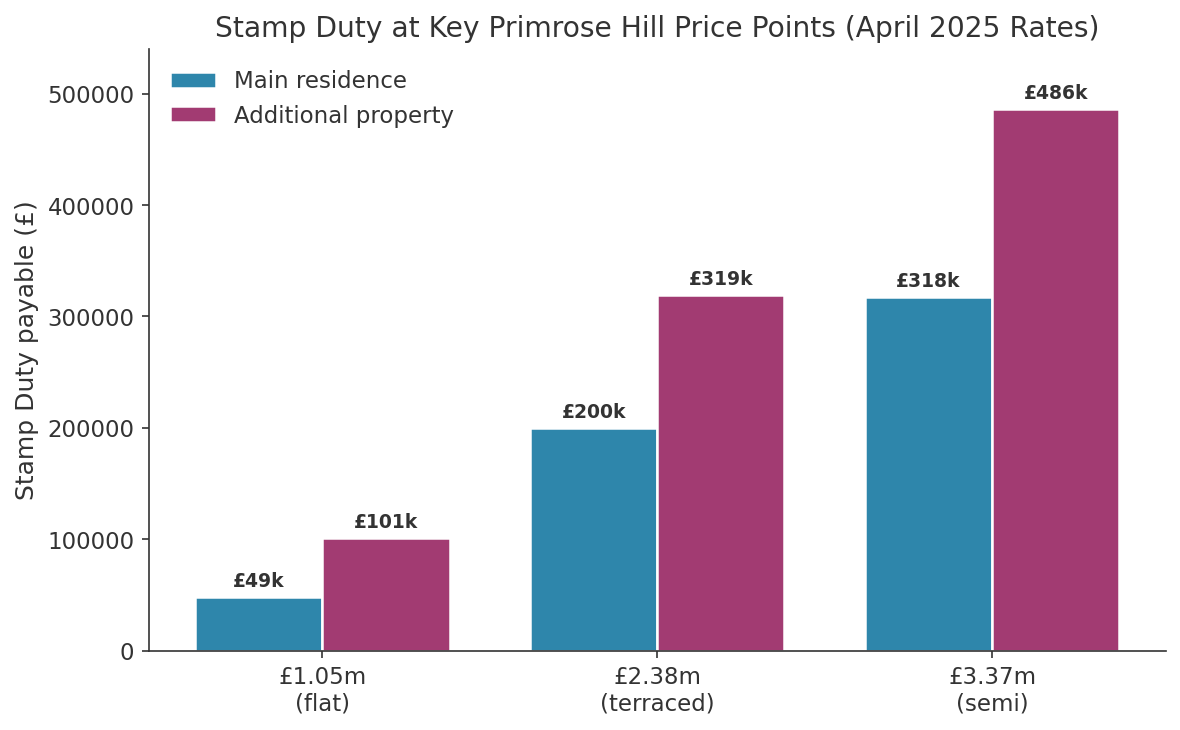
Figure 2: Stamp Duty payable at key price points, main residence versus additional property (April 2025 rates). Source: HMRC.
| Stamp Duty warning: Bought as an additional property, that terraced house at £2.38 million carries a Stamp Duty bill of roughly £319,100, about £119,200 more than the same purchase as a main residence. Overseas buyers pay more again. Always model your full liability before agreeing a price. |
For precise figures at any price point, the HMRC Stamp Duty Land Tax calculator is the authoritative source.
Choosing the Right Agent in Primrose Hill
In a market defined by low volumes and heavy off-market activity, the calibre of your agent is genuinely consequential. Instructing a firm with deep roots across NW3 and NW1, and a verified network of vendors, private buyers and corporate tenants, opens doors that never appear on the portals.
Plaza Estates, an independent agency established in 1972 that concentrates only on central London, has worked the Primrose Hill area and its surroundings for more than five decades. That focus means its staff carry local knowledge a generalist office simply cannot match. Understanding how the sector operates from the inside also sharpens your brief; even a primer on how to get into the real estate business clarifies what genuine expertise looks like next to a polished pitch.
We have used Plaza Estates for many years for all our property requirements, sales, letting and management, and are delighted with the results and service they consistently deliver.
Verified client review, Plaza Estates
When briefing an agent, be precise from the outset. Specify road type, minimum square footage, garden orientation, lease length for flats, and any off-street parking need. The narrower your requirement, the faster a knowledgeable agent can match you to relevant stock, including homes that have not yet been formally marketed.
| Agent tip: Ask any prospective agent how many Primrose Hill homes they have sold in the past 12 months, and at what achieved-to-asking-price ratio. In a specialist market, recent transaction history is the most reliable signal of genuine local expertise. |
Due Diligence: Surveys, Searches and Leasehold
Primrose Hill is predominantly a period property market. Victorian and Edwardian terraces, Regency townhouses and early twentieth-century mansion blocks make up most of the available stock, and the age and character of these buildings make thorough due diligence essential rather than optional.
For the majority of purchases here, a RICS Home Survey Level 3, also called a Building Survey, is the appropriate choice. It is the most comprehensive option and examines the full structural condition of a property, including roofing, damp, subsidence and any unauthorised alterations.
| Survey type | Recommended for | Approximate cost |
|---|---|---|
| RICS Level 1 (Condition Report) | Modern, newly built homes in good condition | £300 to £600 |
| RICS Level 2 (Homebuyer Report) | Conventional properties without obvious issues | £400 to £1,000 |
| RICS Level 3 (Building Survey) | Period, older or significantly extended homes | £800 to £2,000+ |
For help selecting the right level, the Royal Institution of Chartered Surveyors publishes clear guidance across all residential surveys.
Most flats in the area are leasehold, and before making any offer you should establish four things:
- Remaining lease length: anything below 80 years becomes markedly more expensive to extend and harder to mortgage.
- Annual service charge: on premium mansion blocks this can reach £15,000 to £30,000 or more.
- Ground rent: confirm it is not escalating in ways that hurt mortgageability.
- Planned major works: review the reserve fund and any Section 20 notices for upcoming expenditure.
| Leasehold warning: Under the Leasehold and Freehold Reform Act 2024, leaseholders have enhanced rights to extend leases and challenge unreasonable service charges. Even so, the cost of extension can be significant, so verify the lease length and likely extension cost before you submit an offer. |
The Purchase Process: From Offer to Completion
Under the law in England and Wales, no transaction is legally binding until exchange of contracts. Either party can withdraw without penalty up to that point, which makes the pre-exchange period both important and, at prime prices, occasionally fraught.
A typical purchase runs between 10 and 16 weeks from offer accepted to completion, though leasehold cases and complex chains can extend that considerably.
| Stage | Typical timeframe | Key action required |
|---|---|---|
| Offer accepted | Day 0 | Instruct solicitor immediately; confirm mortgage status |
| Searches ordered | Week 1 to 2 | Local authority, drainage and environmental searches |
| Survey commissioned | Week 1 to 3 | Book the Level 3 survey; review the report carefully |
| Mortgage offer issued | Week 3 to 6 | Lender valuation required before a formal offer |
| Enquiries resolved | Week 4 to 10 | Solicitor resolves queries on title, lease and searches |
| Exchange of contracts | Week 10 to 14 | 10% deposit paid; completion date fixed and binding |
| Completion | Week 12 to 16 | Balance transferred; keys released; SDLT due in 14 days |
Exchange of contracts is the milestone that matters. Until that point your purchase is not secured, however far the process has run, so push to exchange as quickly as sound due diligence allows.
Video: A step-by-step walkthrough of the prime London buying process, including private-treaty sales and the solicitor’s role (https://www.youtube.com/watch?v=0dCRBQjJOiA). Useful viewing for anyone new to this market.
Negotiating at Primrose Hill Price Levels
Negotiation at this end of the market works differently from the wider capital. Most vendors are under no financial pressure to sell quickly, and off-market sellers in particular weigh discretion and certainty of completion above headline price.
The strongest positions in this market are clear:
- Cash-buyer status removes mortgage risk and allows a faster exchange.
- A chain-free position keeps the deal free of dependencies.
- A flexible completion date lets you work around the vendor’s timeline.
- A pre-instructed solicitor signals that you are ready to transact.
| Negotiation note: In a low volume market, agents often know both parties personally. Conducting talks professionally, and avoiding aggressive low-ball offers, preserves the goodwill that matters enormously if complications surface during conveyancing. |
Frequently Asked Questions
What is the average house price in Primrose Hill?
Averages vary sharply by type. Flats average around £1,047,777, terraced houses £2,384,400 and semi-detached properties £3,366,000, while detached houses average close to £11 million. Prices grew 11.9% last year, according to KFH sold-price data.
Do I need a specialist solicitor for a Primrose Hill purchase?
Yes. At prime London prices you should instruct a solicitor or licensed conveyancer with proven experience in high value central London transactions. Leasehold matters, title complexities and occasional restrictive covenants in period homes all call for specialist rather than generalist handling.
How much Stamp Duty applies to a £2 million home in Primrose Hill?
On a £2 million main residence completed after April 2025, Stamp Duty is about £153,750. If the property is an additional dwelling, the 5% surcharge lifts the total to roughly £253,750. Non-resident buyers add a further 2% above all other rates.
Can overseas buyers purchase in Primrose Hill?
Yes. There are no restrictions on non-UK nationals buying homes in England or Wales. However, buyers who spend under 183 days a year in the UK pay an extra 2% surcharge. Anti-money-laundering and source-of-funds checks apply to everyone.
How long does buying in Primrose Hill typically take?
From an accepted offer to completion, expect 10 to 16 weeks for a straightforward deal. Leasehold purchases, complex title or a longer chain can stretch that to 20 to 24 weeks. Instructing your solicitor the day your offer is accepted is the single most effective way to keep momentum.
Is Primrose Hill freehold or leasehold?
Both tenures exist. Most houses, particularly the period terraces and mews homes, are freehold, while the majority of flats are leasehold. Lease lengths, service charges and ground rent terms vary widely and must be verified before any offer.
Final Thoughts
Acquiring a prime Primrose Hill home is among the more rewarding moves in the London market, yet it does not reward impatience or thin preparation. Low transaction volume, a significant Stamp Duty bill, complex period stock and the value of trusted local relationships mean every member of the advisory team counts.
Start from a clear financial position, a realistic Stamp Duty calculation, and an agent with genuine NW3 depth. Commission the right survey for the building, move toward exchange as fast as careful checks allow, and lead negotiations with professionalism and completion certainty as your strongest cards. For decision-makers used to pricing risk quickly, this postcode rewards that discipline: demand consistently outpaces supply, and those who prepare well and act decisively tend to secure the best homes.
References
KFH. Primrose Hill House Prices and Property Data, 2024 to 2025. https://www.kfh.co.uk/north-west-london/primrose-hill/sold-data/
HMRC. Stamp Duty Land Tax rates, April 2025. https://www.tax.service.gov.uk/calculate-stamp-duty-land-tax
Plaza Estates. Primrose Hill Estate and Letting Agents, 2025. https://plazaestates.co.uk/estate-agents/primrose-hill/
RICS. Home Surveys Overview, 2025. https://www.rics.org/profession-standards/rics-standards-and-guidance/sector-standards/real-estate/home-surveys/home-surveys-overview
Zoopla. 5% Stamp Duty Land Tax on second homes, 2025. https://www.zoopla.co.uk/discover/buying/q-a-new-3-stamp-duty-surcharges/
Fact Check: All figures verified against original sources as of July 2026. Property price averages (flat £1,047,777; terraced £2,384,400; semi-detached £3,366,000; detached £10,987,554) and 11.9% annual growth via KFH and HM Land Registry. Stamp Duty rates and thresholds via HMRC (from April 2025). Worked examples recalculated for accuracy: a £2,384,400 purchase is about £199,878 at standard rates and about £319,098 as an additional dwelling. The 5% additional-property surcharge and 2% non-resident surcharge verified via HMRC and Zoopla.