

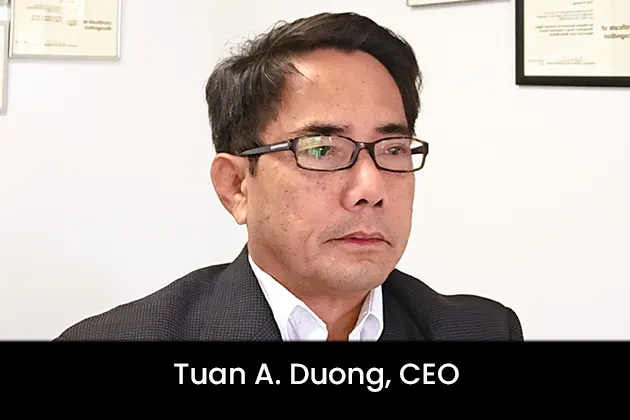
Artificial intelligence is becoming better at processing information, but the next generation of intelligent machines will need to do more than recognize patterns. They will need to perceive their surroundings, learn from new experiences, and adapt as conditions change. This is the challenge Tuan A. Duong, CEO of Adaptive Computation LLC, is addressing through a different approach to AI.
Inspired by the way the human brain processes information, Duong is developing technologies that bring perception, memory, continuous learning, and efficient computing together. His vision is helping Adaptive Computation explore a smarter form of machine intelligence, where systems can learn from their environment instead of simply following fixed instructions.
Finding a New Direction for Machine Learning
The development of artificial intelligence has always been shaped by one fundamental question: how can machines learn effectively? Early neural networks demonstrated the possibilities of machine learning while also exposing its limitations. The well-known difficulty of the perceptron in learning the XOR problem became an important example of the challenges involved in finding suitable solutions through conventional neural network approaches.
For Duong, these challenges point toward an opportunity to look beyond traditional AI methods. Biological systems offer a powerful example of intelligence that can perceive information, retain knowledge, learn continuously, and respond to changing environments.
Adaptive Computation takes inspiration from these principles. Rather than focusing only on traditional weight-based learning, the company looks toward biological building blocks and brain-inspired me chanisms adopted from neuroscience to develop more adaptive systems.
Its work brings machine perception, learning, memory, software, and specialized hardware together. The objective is to create machines that can process useful information efficiently, build knowledge from experience, and continue learning as their surroundings change.
Helping Machines See and Understand
One of Adaptive Computation’s key technologies is its Extended Visual Pathway (EViP), a bio-inspired approach designed to improve machine perception. EViP draws inspiration from the visual pathway of the human brain, along with research into receptive fields and saccadic eye movements. The technology is designed to identify salient features within visual information, helping machines focus on important characteristics rather than processing every piece of information equally.
This approach supports object detection and recognition. According to Duong, EViP enables a single-sample object database to be used for object recognition and has demonstrated strong results in face recognition involving 10,000 or more distractors.
The technology also incorporates real-time feedback. Once an object is detected, the system can continue to detect and track it, creating a form of short-term memory. Instead of treating every new visual input as an independent task, the machine can retain information and use it to understand what is happening next.
From a starting object, the system can also construct a dynamic data library of moving objects within a three-dimensional environment. For Duong, this connection between perception and memory provides an important foundation for machine cognition and adaptation.
Making Machines Learn Continuously
Perception is only the beginning of intelligence. Machines also need to learn from the information they receive.
Adaptive Computation addresses this need through its dynamic supervised learning approach. The technology is designed to receive changing information from short-term memory and convert it into knowledge-based information that can strengthen the machine’s intelligence.
This is particularly important because traditional supervised learning is generally based on prepared data, defined architectures, and labelled datasets. Once training is completed, a model is largely limited by what it has learned. New information canrequire another training process.
Real-world environments are different. Information is constantly changing, and intelligent machines need to respond to new situations without repeatedly startingfrom the beginning.
Duong’s approach is designed to allow new information to build on previous knowledge. The relationship between short-term and long-term learning creates a continuous feedback loop, allowing the system to perceive information, retain it, learn from it, and use that knowledge to respond to future situations.
This is central to Duong’s vision of self-intelligent machines. Rather than building systems that simply perform a fixed task, Adaptive Computation is working toward machines that can continue developing their intelligence through experience.
Delivering Intelligence with Less Power
Adaptive Computation’s approach is also shaped by another major challenge in modern computing: how to deliver high performance without consuming excessive power.
Duong’s experience with JPL/NASA and defence-related programs gave him first-hand exposure to environments where systems had to operate under strict size, weight, and power requirements. Space missions, for example, require computing capabilities that can handle demanding workloads while keeping system resources under control.
Those same challenges are becoming increasingly relevant as AI moves toward edge devices. Intelligent systems operating on mobile platforms, vehicles, security devices, and other edge environments cannot always depend on large amounts of computing power.
Adaptive Computation is addressing this through a cobination of bio-inspired processing, sparse input data, and specialized hardware.
Duong’s work on a Brain-like Intelligence System Based in Pixel Intelligent Processing explored the use of sparse pixel arrays to reduce the intensity of colour data while maintaining equivalent performance. The concept can reduce the amount of information that needs to be processed, creating a more efficient foundation forintelligent computing.
The company is also developing a Hybrid Processing Unit (HPU) based on asynchronous and hybrid in-memory processing. Designed to exploit parallel computation, the HPU aims to provide high-speed processing while using less power. Software and hardware therefore form a connected system. EViP and dynamic supervised learning support perception and adaptation, while the HPU provides an efficient processing architecture. Adaptive Computation also plans to develop a compiler to help its hardware support universal algorithms and different computingarchitectures.
From Technology to Self-Learning Systems
For Duong, the ultimate goal is not simply to develop another AI technology. It is to create intelligent machines that can collect information, learn independently, and adapt to real-world conditions.
He sees potential applications across areas such as IT security, autonomous systems, adaptive navigation, and personalized health technologies. Self-monitoring and diagnostic devices, for example, could benefitfrom intelligent systems capable of continuously processing information and adapting to individual circumstances.
Adaptive Computation is already preparing face and palm recognition systems for edge and cloud-based IT security applications, as well as real-time adaptive navigation systems designed for environments with demanding size, weight, power, and cost requirements.
Looking ahead, the company’s goals include developing a complete self-learning system based on massive parallel learning, with an ambition to reduce training time by at least two orders of magnitude. It also aims to advance its HPU into a high-speed, low-power computing engine and develop a compiler that can support different applications across edge and mobile systems.
Duong’s own path has reinforced his belief in learning from nature. His observations of biological visual pathway configurations led to the development of EViP, with research into biological vision helping guide the technology further.
That philosophy remains at the heart of Adaptive Computation. The company is not trying to reproduce the human brain exactly. Instead, it is drawing lessons from the principles that make biological intelligence effective: selective perception, memory, continuous learning, feedback, and adaptation.
As AI increasingly moves into environments where power, speed, and flexibility matter, this approach offers an alternative to simply making models larger andcomputing systems more powerful.
Under Tuan A. Duong’s leadership, Adaptive Computation is working toward a future where machines can perceive what matters, learn from what they experience, retain useful knowledge, and adapt to what comes next. Its vision is ultimately simple but ambitious: to move artificial intelligence closer to systems that do not merely process the world, but continuously learn from it.
“The future of AI lies not only in processing information faster, but in building machines that can perceive, learn, remember, and adapt.”
— Tuan A. Duong, CEO