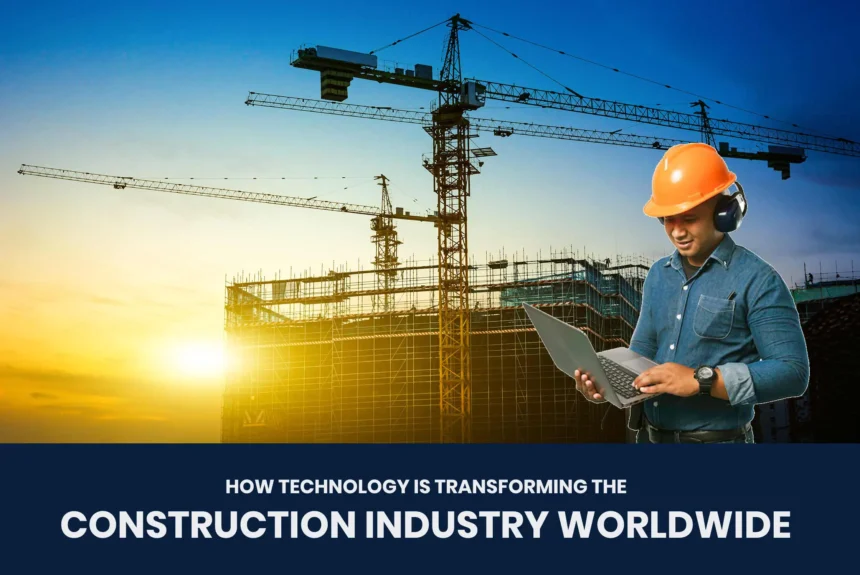
The construction sector, long regarded as one of the world’s most labour-intensive industries, is undergoing a remarkable digital transformation. From artificial intelligence and robotics to drones and digital twins, how technology is transforming the construction industry is no longer a futuristic discussion but a present-day reality.
As projects become larger and more complex, construction firms are increasingly turning to advanced technologies to improve productivity, reduce costs, enhance worker safety, and meet sustainability goals.
According to McKinsey, construction productivity has historically grown at just 1% annually over the past two decades, significantly lagging behind manufacturing.
However, digital technologies are helping bridge that gap by streamlining workflows, improving collaboration, and enabling smarter decision-making. Governments and private developers alike are investing heavily in digital construction solutions to address labor shortages, rising material costs, and increasing demand for infrastructure.
Today, technology is influencing every stage of the construction lifecycle—from design and planning to execution, maintenance, and facility management. The result is a smarter, faster, and more efficient industry poised for long-term transformation.
The Productivity Challenge Driving Innovation Across Construction
Construction projects often face challenges such as budget overruns, delays, safety incidents, and resource inefficiencies. Traditional workflows frequently rely on fragmented communication, manual documentation, and outdated project management methods.
Technology is helping solve these persistent issues through automation, real-time data sharing, and predictive analytics. Cloud-based platforms now allow architects, engineers, contractors, and project owners to collaborate seamlessly regardless of location.
Industry reports indicate that construction companies implementing digital solutions can reduce project delays by up to 20% while significantly improving resource allocation and operational visibility. As competition intensifies, firms that fail to embrace innovation risk falling behind more technologically advanced competitors.
Building Information Modeling: The Foundation of Modern Construction
One of the most influential innovations in modern construction is Building Information Modeling (BIM). BIM creates a detailed digital representation of a building or infrastructure asset, enabling project stakeholders to visualize and coordinate every component before physical construction begins.
Unlike traditional 2D drawings, BIM provides a collaborative environment where architects, engineers, and contractors work from a shared digital model. This reduces design conflicts, improves communication, and minimizes costly rework.
Real-World Example: Crossrail, United Kingdom
The Crossrail project in London, one of Europe’s largest infrastructure developments, extensively utilized BIM technology. Thousands of designers, engineers, and contractors collaborated through shared digital models, improving project coordination across multiple sites.
The project demonstrated how BIM can enhance decision-making while reducing errors and improving construction efficiency.
Benefits of BIM
- Improved design accuracy
- Enhanced project visualization
- Better cost estimation
- Reduced material waste
- Streamlined collaboration
- More effective facility management
As governments increasingly mandate BIM usage on public projects, adoption continues to accelerate across the global construction industry.
Artificial Intelligence Is Revolutionizing Project Management
Artificial intelligence is emerging as one of the most disruptive technologies in construction. By analyzing vast amounts of project data, AI helps companies make informed decisions, anticipate risks, and optimize performance.
Machine learning algorithms can evaluate historical project data to predict delays, estimate costs, identify safety concerns, and improve scheduling accuracy.
Real-World Example: Predictive Scheduling Systems
Several major construction firms now use AI-powered planning software that analyzes weather patterns, labor availability, supply chain disruptions, and project histories. These tools provide predictive insights that help managers proactively address issues before they impact timelines.
Industry-Specific Use Cases of AI
Commercial Construction
AI helps optimize office tower and mixed-use development schedules while improving budget forecasting.
Residential Construction
Home builders use AI to estimate costs, improve procurement processes, and manage subcontractor performance.
Infrastructure Projects
Transportation agencies leverage AI to monitor project risks and optimize maintenance planning.
Industrial Facilities
Manufacturing and energy companies use AI-driven systems to improve equipment reliability and asset performance.
The ability to transform data into actionable insights is making AI a critical competitive advantage for modern construction firms.
Drones Are Delivering New Levels of Visibility
Drone technology has become an indispensable tool on modern construction sites. Equipped with high-resolution cameras and advanced sensors, drones capture detailed site information quickly and accurately.
Traditional surveying methods often require significant labor and time. Drones can complete the same tasks within hours while generating highly accurate topographical maps and 3D models.
Real-World Example: Highway Infrastructure Projects
Infrastructure developers worldwide use drones to monitor highways, bridges, railways, and utility corridors. Frequent aerial inspections allow project managers to identify issues early and maintain accurate progress records.
Benefits of Construction Drones
- Faster data collection
- Improved surveying accuracy
- Enhanced safety
- Lower operational costs
- Better project monitoring
- Improved stakeholder communication
Drone adoption continues to grow as regulations become more supportive and technology becomes increasingly affordable.
Digital Twins Are Transforming Asset Management
Digital twins take BIM capabilities a step further by creating dynamic virtual replicas of physical assets. These digital models continuously update using real-time information collected from sensors, IoT devices, and operational systems.
Unlike static models, digital twins evolve throughout the asset lifecycle, providing valuable insights into performance, maintenance needs, and operational efficiency.
Real-World Example: Smart Airport Operations
Several international airports now use digital twin technology to monitor passenger flow, optimize maintenance schedules, and improve energy efficiency. Construction teams are adopting similar approaches to manage complex infrastructure projects.
Applications of Digital Twins
- Construction progress tracking
- Predictive maintenance
- Facility management
- Infrastructure monitoring
- Sustainability optimization
By combining real-time data with advanced analytics, digital twins help owners maximize the value of their assets long after construction is complete.
Robotics and Automation Are Addressing Labor Shortages
The global construction industry faces a growing shortage of skilled labor. Robotics and automation are helping companies overcome this challenge while improving productivity and quality.
Construction robots can perform repetitive tasks with exceptional precision and consistency. These systems reduce physical strain on workers and improve overall job-site efficiency.
Real-World Example: Robotic Bricklaying
Advanced robotic bricklaying systems are capable of placing thousands of bricks daily while maintaining high levels of accuracy. Similar technologies are being developed for concrete finishing, rebar installation, and demolition work.
Areas Where Robotics Is Making an Impact:
- Bricklaying
- Concrete placement
- Material transportation
- Site inspections
- Demolition
- Repetitive assembly tasks
As technology matures, autonomous construction equipment is expected to become increasingly common across large-scale projects.
3D Printing Is Redefining Construction Possibilities
Few technologies have captured the industry’s imagination quite like 3D printing. Construction-scale printers can create building components and entire structures layer by layer using specialized materials.
This innovative approach reduces waste, shortens project timelines, and expands design possibilities.
Real-World Examples:
- ICON’s 3D-Printed Housing Projects
Texas-based company ICON has become a global leader in construction-scale 3D printing. The company has successfully delivered residential housing projects using automated printing systems that significantly reduce construction time.
- Ireland’s 3D-Printed Homes
Ireland recently completed some of its first 3D-printed housing developments, showcasing the technology’s potential to address housing shortages while improving affordability.
Advantages of 3D Printing
- Reduced material waste
- Faster construction timelines
- Lower labor requirements
- Greater design flexibility
- Improved sustainability
Industry experts believe additive manufacturing will play an increasingly important role in future residential and infrastructure development.
The Internet of Things Is Creating Connected Construction Sites
The Internet of Things (IoT) is enabling construction companies to connect equipment, workers, materials, and project environments through intelligent sensor networks.
These connected systems generate valuable data that improves operational visibility and decision-making.
Industry-Specific Applications
- Worker Safety Monitoring: Wearable devices track worker health metrics, detect hazardous conditions, and alert supervisors to potential risks.
- Equipment Performance Tracking: Sensors monitor machinery utilization, fuel consumption, and maintenance requirements.
- Material Management: Smart inventory systems provide real-time visibility into material availability and usage.
- Environmental Compliance: IoT devices measure dust, vibration, temperature, and air quality to ensure regulatory compliance.
The integration of IoT with AI and digital twins is creating highly intelligent construction ecosystems capable of delivering unprecedented operational insights.
Sustainability Is Becoming a Competitive Advantage
Environmental sustainability is no longer an optional consideration in construction. Governments, investors, and clients increasingly expect projects to minimize environmental impact while maximizing efficiency.
Technology is helping companies achieve these objectives through data-driven design, energy optimization, and waste reduction.
Examples of Sustainable Construction Technologies
- AI-powered energy modeling
- Smart building management systems
- Carbon footprint analysis tools
- Digital twin sustainability monitoring
- Automated waste management systems
Green building certifications and environmental regulations are encouraging broader adoption of sustainable construction technologies worldwide.
Why Industry Knowledge Matters More Than Ever
The pace of technological change is accelerating, making continuous learning essential for construction professionals. New tools, software platforms, and innovations emerge regularly, reshaping how projects are planned and executed.
Many industry leaders rely on best construction technology magazines to stay informed about digital transformation trends, emerging solutions, successful case studies, and industry best practices. These publications provide valuable insights into evolving technologies and help decision-makers identify opportunities for innovation within their organizations.
By staying informed, construction professionals can make smarter investment decisions and better prepare their teams for future industry changes.
The Future of Construction Is Digital
The next decade will likely bring even greater technological disruption to construction. Artificial intelligence, robotics, drones, digital twins, and connected job sites will become increasingly integrated into everyday operations. Emerging technologies such as autonomous equipment, generative design, and advanced analytics will further improve project outcomes and operational efficiency.
Organizations that embrace innovation today will be better positioned to navigate future challenges, enhance productivity, and deliver higher-value projects. As digital transformation continues to accelerate, understanding the latest technologies used in construction project planning, execution, and management will be essential for construction leaders seeking long-term growth and competitive advantage.
The construction industry is no longer simply building structures—it is building a smarter, more connected, and more sustainable future.
FAQs
- How is technology transforming the construction industry?
Technology is transforming the construction industry by improving efficiency, safety, and project management through innovations such as artificial intelligence (AI), Building Information Modeling (BIM), drones, robotics, digital twins, and IoT-enabled devices. These technologies help reduce costs, minimize delays, and enhance collaboration among project stakeholders.
- What are the latest technologies used in construction projects?
Some of the latest technologies used in construction projects include AI-powered project management software, BIM, digital twins, construction drones, 3D printing, robotic equipment, wearable safety devices, and IoT-based monitoring systems. These tools help streamline operations and improve project outcomes.
- How does Building Information Modeling (BIM) benefit construction companies?
BIM enables architects, engineers, and contractors to work from a shared digital model, improving collaboration and reducing design conflicts. It helps enhance project visualization, improve cost estimation, minimize rework, and support facility management throughout a building’s lifecycle.
- What role does artificial intelligence play in modern construction?
Artificial intelligence helps construction companies analyze large amounts of project data to predict delays, optimize schedules, estimate costs, identify safety risks, and improve decision-making. AI-powered tools are increasingly being used to enhance productivity and reduce project uncertainties.
- Why are drones becoming popular in the construction industry?
Drones provide fast and accurate site surveys, aerial inspections, progress tracking, and mapping capabilities. They help construction firms reduce surveying costs, improve safety by limiting worker exposure to hazardous areas, and provide real-time project insights.
- How do digital twins improve construction and facility management?
Digital twins create virtual replicas of physical assets that continuously update using real-time data. They help project teams monitor construction progress, optimize building performance, predict maintenance needs, and improve long-term asset management.
- What are the benefits of robotics and automation in construction?
Robotics and automation help address labor shortages, increase productivity, improve precision, and reduce workplace injuries. Robots can perform repetitive tasks such as bricklaying, concrete finishing, material handling, and site inspections more efficiently than traditional methods.
- Why should construction professionals follow construction technology magazines?
The best construction technology magazines provide insights into emerging trends, innovative tools, successful case studies, industry statistics, and expert opinions. They help construction professionals stay informed about technological advancements and make better strategic decisions for future projects.
The CEO Views is a leading business publication that empowers executives and decision-makers with in-depth insights into global industry trends, visionary leadership, innovation, and emerging technologies. Through expert analysis, research-driven content, and compelling storytelling, the magazine highlights influential leaders, transformative ideas, and forward-thinking strategies that are shaping the future of business and fostering sustainable growth.