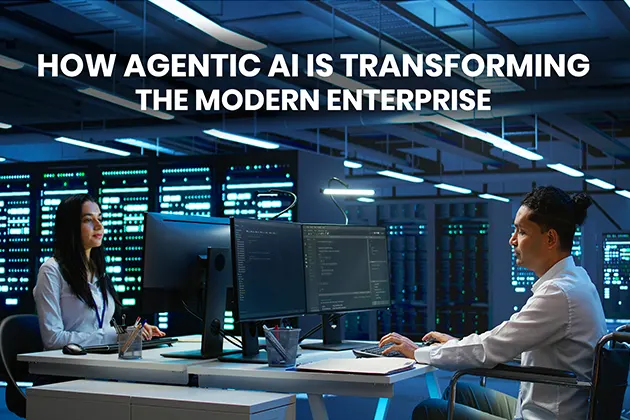
Something fundamental is shifting inside modern enterprises. For many years, digital transformation meant moving systems to the cloud, upgrading software, or adding automation where possible. Now the conversation has changed completely. Businesses are no longer just digitizing processes—they are building systems that can think, decide, and act on their own.
This is where agentic artificial intelligence enters the picture. Unlike traditional tools that wait for instructions, these systems can evaluate situations, make decisions, and carry out actions across workflows. That shift is forcing companies to rethink everything from infrastructure to governance.
An Enterprise IT overhaul for agentic artificial intelligence is no longer a futuristic idea. It is becoming a practical requirement for organizations that want to stay relevant. Legacy systems that once supported business growth are now holding it back. To support intelligent automation at scale, enterprises are rebuilding their IT foundations from the ground up.
Why Traditional IT Architectures Are Struggling
Most enterprise systems were never designed for this level of intelligence. They were built for stability, not adaptability. Data sits in silos, applications don’t communicate smoothly, and decision-making still depends heavily on human intervention.
That model breaks down quickly when AI agents start operating across systems in real time. To keep up, companies are moving toward flexible, cloud-first environments that allow systems to share data instantly and respond dynamically. Architecting your enterprise IT stack for the agentic AI era means breaking old boundaries between applications, data, and infrastructure layers.
Data Is Becoming the Real Engine of Intelligence
If there is one thing that determines how well AI performs inside an enterprise, it is data quality. Many organizations still struggle with fragmented datasets spread across departments. Sales has one version of truth, operations another, and finance something completely different. That inconsistency creates friction when AI systems try to act on information.
The shift now is toward unified data ecosystems. Companies are investing in centralized data platforms, real-time pipelines, and cleaner governance models. Instead of collecting data for reporting, they are building systems that feed intelligence continuously.
Without this foundation, even the most advanced AI models struggle to deliver meaningful outcomes.
Security in a World Where Machines Take Action
As systems become more autonomous, security becomes more complicated—and more important. It is no longer enough to protect networks at the perimeter. Every API, data stream, and automated workflow becomes a potential entry point. That is why many organizations are adopting zero-trust frameworks, where no request is automatically trusted, even inside the system.
AI is also being used defensively. Threat detection systems now analyze behavior patterns in real time; spotting anomalies faster than human teams could.
But there is a catch: the same intelligence that strengthens security can also be exploited. That makes governance and monitoring a continuous requirement, not a one-time setup.
The Workforce Is Quietly Changing
One of the most overlooked parts of this shift is the human side. Employees are no longer just using software—they are collaborating with it. AI assistants are writing code, generating reports, predicting outcomes, and even suggesting business decisions.
This changes job roles in subtle but important ways. Instead of replacing people, AI is reshaping what they do daily. Routine tasks are disappearing, while decision-making, interpretation, and oversight are becoming more valuable.
Companies that invest in training and digital literacy are finding it easier to adopt new systems. Without that support, even the best technology struggles to deliver impact.
Cloud Infrastructure Is No Longer Optional
Cloud computing used to be a competitive advantage, now it is the baseline. Agentic systems require scalability that traditional on-premise setups simply cannot offer. Workloads fluctuate constantly, and AI models demand significant computing power.
That is why hybrid and multi-cloud strategies are becoming the norm. Businesses want flexibility—some workloads run in public cloud environments; others stay private for compliance or security reasons.
Architecting your enterprise IT stack for the agentic AI era also means designing for uncertainty. Systems must scale up or down instantly, without disrupting operations.
Automation That Actually Coordinates Work
Automation is no longer about isolated scripts or basic workflows. It is becoming coordinated and system-wide.
Modern enterprises are connecting AI models with ERP systems, CRM platforms, and internal tools so that actions flow seamlessly across departments.
For example, a customer request can now trigger updates in inventory, billing, and logistics without manual intervention. That kind of orchestration reduces delays and removes friction from operations.
In industries like manufacturing and finance, this is already changing how decisions are made. Speed is becoming a major competitive advantage.
AI in Technology Industries Is Raising the Stakes
Across the technology sector, competition is intensifying rapidly. Companies building semiconductors, cloud infrastructure, cybersecurity tools, and enterprise software are all racing to support the growing demand for intelligent systems.
What makes this different from previous tech cycles is the speed. Innovation cycles are shorter, and enterprises are adopting new tools faster than ever before.
AI in technology industries is no longer a niche focus—it is the central driver of product development, investment, and strategy.
Edge Computing Is Bringing Intelligence Closer to Action
Not all data needs to travel to the cloud anymore. Edge computing allows information to be processed closer to where it is generated. That reduces delay and enables near real-time decisions.
In factories, vehicles, and telecom networks, this makes a noticeable difference. Machines can react instantly instead of waiting for centralized processing.
When combined with AI, edge systems become even more powerful, supporting predictive maintenance, automated responses, and smarter monitoring systems.
Governance Is Becoming a Strategic Priority
As AI systems take on more responsibility, questions around accountability become unavoidable.
Who is responsible when an autonomous system makes a wrong decision? How do you ensure fairness in algorithmic outcomes? How do you explain decisions made by complex models?
These are not theoretical questions anymore. Regulators are already stepping in with stricter rules around transparency, privacy, and data usage.
Enterprises must build governance frameworks alongside their technical systems. Without that balance, scaling AI becomes risky.
Customer Expectations Are Moving Faster Than Systems
Customers are now used to instant responses and personalized experiences. They expect platforms to understand context, remember preferences, and respond in real time. AI makes this possible through recommendation engines, chat systems, and predictive analytics.
But expectations rise quickly. What feels impressive today becomes standard tomorrow. That means enterprises must keep improving customer experience continuously, not occasionally.
Sustainability Is Now Part of IT Strategy
AI systems consume significant computing power. That means higher energy usage and greater environmental impact.
As a result, companies are beginning to rethink how their infrastructure is built. Energy-efficient data centers, smarter workload distribution, and optimized cloud usage are becoming priorities.
Sustainability is no longer separate from technology planning. It is becoming part of core IT decision-making.
The Bigger Picture: Humans and AI Working Together
Despite all the technological change, one thing remains constant—people are still at the center of enterprise transformation.
AI can process information faster and at larger scale, but humans still define direction, purpose, and judgment.
The most successful organizations are not the ones replacing people with machines. They are the ones finding ways for both to work together effectively.
Conclusion: Building Systems That Can Adapt
The shift toward intelligent enterprise systems is not slowing down.
An Enterprise IT overhaul for agentic artificial intelligence is now a strategic necessity, not an optional upgrade. Companies that delay modernization risk falling behind competitors who are already adapting.
At the same time, architecting your enterprise IT stack for the agentic AI era is not just about technology choices. It is about building systems that are flexible, secure, and ready to evolve.
As AI continues to reshape industries, success will depend on how well organizations balance innovation with control, automation with oversight, and speed with responsibility.
In this new environment, adaptability is the real competitive advantage.
FAQ
- What is an Enterprise IT overhaul for agentic artificial intelligence?
It refers to the complete redesign of enterprise IT systems to support autonomous AI agents that can make decisions, execute tasks, and interact across business workflows without constant human input.
- Why do companies need Architecting your enterprise IT stack for the agentic AI era?
Businesses need this shift because traditional IT systems are not built for real-time intelligence, automation, and adaptive decision-making. Modern AI requires flexible, cloud-based, and data-driven architecture.
- How is AI in technology industries changing business operations?
AI is transforming technology industries by accelerating innovation, improving automation, enhancing cybersecurity, and enabling smarter software and infrastructure solutions across enterprises.
- What are the main challenges in adopting agentic AI in enterprises?
The biggest challenges include data silos, security risks, lack of skilled talent, integration with legacy systems, and governance around autonomous decision-making.
- How important is data in an AI-driven enterprise IT system?
Data is critical. Without clean, unified, and real-time data, AI systems cannot make accurate or reliable decisions. Data quality directly impacts AI performance.
- Is cloud computing necessary for agentic AI systems?
Yes, cloud computing is essential because it provides scalability, flexibility, and computing power needed to run large AI models and handle dynamic workloads.
- Will AI replace jobs in enterprise IT environments?
AI is more likely to transform jobs rather than replace them. Routine tasks may be automated, but roles requiring strategy, oversight, and decision-making will become more important.
The CEO Views is a U.S.-based business magazine covering global trends, innovations, and technologies shaping modern business. It provides entrepreneurs, executives, and professionals with research-driven insights and analytical perspectives.
Known for editorial excellence and thought leadership, it highlights emerging ideas, leaders, and strategies, positioning itself as a trusted voice in business media.