

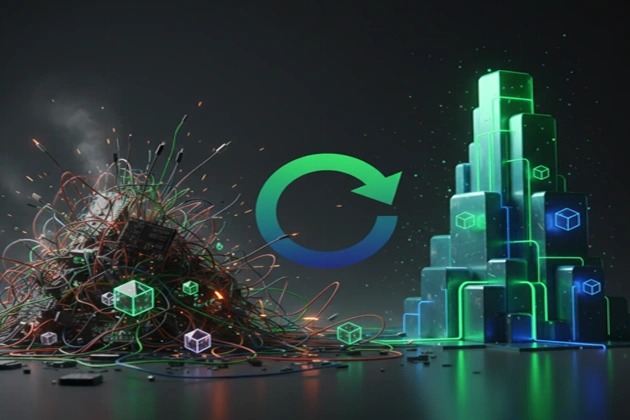
Despite the hype, over 60% of AI initiatives fail to move beyond the demo stage. Most SaaS teams struggle because they treat AI as a stateless feature rather than a robust system. Real-world production requires persistent context, multi-step reasoning, and tight integration with internal tools—things a simple chat box or a basic library can’t handle. Without a structured infrastructure, you’re left with permission leaks, hallucinations, and low user trust.
The year 2026 marks a turning point in enterprise AI. We have moved past the initial excitement of simple chat interfaces and entered the era of the Agentic Workflow. For a CTO or a VP of Engineering, the challenge has shifted. It is no longer about finding a model that can provide a clever answer; it is about building an architecture that can execute a multi-step business process without human supervision, without losing data, and without spiraling costs.
In this exhaustive deep dive, we compare three foundations for building agents: Calljmp, LangChain, and CrewAI. Each represents a different philosophy of software engineering. Understanding these differences is critical for choosing a stack that won’t require a total rewrite in six months.
Calljmp: The Case for a Durable Agentic Runtime
Calljmp represents a fundamental shift in how we think about agents. It moves away from being a “library you call” to being a runtime that executes. It is designed for engineers who treat AI agents as critical backend services, not just side-scripts.
The Durable Execution Revolution
In a traditional backend, if an API call fails or a server blips, the function dies. In Calljmp, every step of an agent’s reasoning is automatically persisted. This is “Durable Execution” — a concept borrowed from systems like Temporal but optimized specifically for the probabilistic nature of LLMs.
- The Checkpointing Advantage: Consider an agent performing a 10-step financial audit. If a network error occurs at step 8, a traditional system restarts the whole task. Calljmp resumes exactly at step 8 with all previous context intact. This eliminates wasted token spend and ensures mission-critical tasks are always completed.
- TypeScript-Native for Modern SaaS: While the AI world loves Python, the Enterprise SaaS world runs on TypeScript. Calljmp is a TS-first platform. Your team gets full type safety, IDE autocompletion, and can use the same unit-testing frameworks they already trust without managing the nightmare of Python environments (venv/poetry/conda).
Solving the “Human-in-the-Loop” Problem
Real-world agents often need human approval. An agent might draft an invoice but shouldn’t send it until a manager approves.
- The Old Way: You write custom database logic to “save” the agent’s state, stop the process, and then try to “re-hydrate” that complex state when the human clicks “Approve.” It’s brittle and hard to maintain.
- The Calljmp Way: The agent simply executes a “pause” command and waits. The runtime handles the suspension. When the signal comes, the agent resumes as if it never stopped. No manual state management required.
Code-First vs. Black-Box Abstractions
Calljmp avoids the “Chain” abstraction. There are no hidden prompts or magical wrappers. You write pure code. This makes debugging as simple as looking at a standard stack trace and ensures that security and compliance teams can audit every single step of the logic.
-
LangChain: The Swiss Army Knife (and Its Abstraction Tax)
LangChain was the first major framework to gain traction. It popularized the idea that “chains” of prompts could solve complex problems. Today, it has evolved into a massive ecosystem including LangGraph and LangSmith.
Core Architecture: The Power of Integrations
LangChain is built on abstractions. It provides a standard interface for models, vector stores, and tools. If you need to switch from OpenAI to Anthropic, or from Pinecone to Milvus, it’s theoretically just a one-line change.
- Where it Shines: Rapid prototyping. If you need a proof-of-concept in 48 hours, LangChain’s vast library of pre-built integrations is unbeatable. It is the ideal environment for R&D teams testing retrieval strategies (RAG).
- The “Demo Trap”: The very abstractions that make it easy to start make it hard to scale. LangChain is “thick.” It wraps standard calls in custom classes, creating a “black box” effect. When a chain fails in production, finding the root cause often requires digging through five layers of framework code.
The Stateless Constraint
LangChain is primarily a library, not a runtime. It doesn’t natively handle the persistence of a running process at the infrastructure level. If your agent is in the middle of a reasoning loop and your Kubernetes pod restarts, that agent’s state is gone. You are responsible for building the persistence layer yourself.
-
CrewAI: Orchestrating the “AI Office”
CrewAI takes a role-based approach. Instead of thinking in “chains,” you think in “teams.” You define a Researcher, a Writer, and a Manager, and let them collaborate.
The Philosophy of Agentic Collaboration
CrewAI is an opinionated framework that focuses on the coordination of intelligence. It is excellent for tasks where the steps aren’t perfectly defined, and agents need to “talk” to each other to find a solution.
- Best Use Case: Complex creative workflows. If your agent needs to perform deep research, synthesize it into a report, and then critique that report, CrewAI’s multi-persona model is very intuitive for business stakeholders.
- The Hidden Costs: Coordination between multiple agents is expensive. Each “hand-off” consumes tokens. Without strict guardrails, multi-agent systems can easily enter “reasoning loops” where they talk in circles, burning your API budget without producing a result.
The Observability Nightmare
Monitoring one agent is hard; monitoring five agents interacting with each other is an operational challenge. Tracking the “truth” across multiple agent memories requires sophisticated observability that isn’t always built-in, leading to high maintenance debt as the system grows.
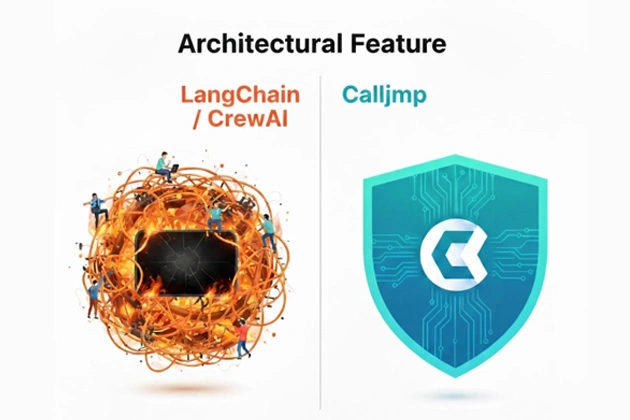
Technical Comparison: Infrastructure vs. Library
| Architectural Feature | Calljmp | LangChain / CrewAI |
| Execution Model | Runtime (managed execution) | Library (invoked by app) |
| State Persistence | Built-in / Durable | External / Manual |
| Error Recovery | Resume from Checkpoint | Retry from Step 0 |
| Developer Experience | TypeScript / Code-first | Python / Abstraction-heavy |
| Observability | Native Audit Traces | Third-party (LangSmith) |
| Async Capability | Native “Wait & Resume” | Manual state management |
Deep Dive: The “Infrastructure Tax” in Dollars
Consider a real-world scenario: An agent is tasked with summarizing 50 legal documents, comparing them against a compliance checklist, and updating a CRM.
- The Stateless Approach (LangChain/CrewAI): The agent starts. At document 40, the OpenAI API returns a 503 error. The script crashes. You restart. You’ve now paid for documents 1-39 twice.
- The Durable Approach (Calljmp): The agent hits the 503 error. The runtime detects the failure and waits. Once the API is back, it resumes at document 40. You pay for each document exactly once.
For an enterprise processing thousands of these tasks daily, the “Infrastructure Tax” of a stateless framework can account for 20-30% of the total AI budget. Calljmp eliminates this tax by design.
Security, Compliance, and the “Black Box” Problem
In high-stakes industries (Finance, Healthcare, Legal), “how” an agent reached a conclusion is as important as the conclusion itself.
- LangChain often hides logic behind nested prompts and pre-built chains. This makes it difficult for security teams to audit the exact flow of data.
- Calljmp treats the agent as code. Every step is an auditable trace. Because it is a runtime, it can enforce global guardrails at the execution level, ensuring that no agent—no matter how creative—can bypass your security protocols.
Summary: Moving Beyond the “Playground”
The choice between these foundations depends on your goals:
- Calljmp is for Production SaaS. Use it when you are shipping AI features to paying customers who demand 99.9% reliability, auditability, and consistent performance. It is the only choice when failure is not an option.
- LangChain is for the Playground. Use it when you are still figuring out your data strategy and need to experiment with every new tool on the market in a low-stakes environment.
- CrewAI is for Research Workflows. Use it for internal tools where human-like collaboration between personas provides more value than architectural uptime.
By moving the “state” and “infrastructure” concerns away from the LLM and into the Calljmp runtime, engineering teams can stop building brittle prototypes and start shipping durable software.
Ready to stop debugging and start shipping? Explore the runtime at calljmp.com