
Since its launch in 2000, Google Ads has revolutionized business marketing, shifting from a broad and disruptive model to highly-targeted, data-driven, and intent-driven campaigns. By reaching customers when they search through search engines, YouTube, and other digital platforms, Google Ads has helped businesses of all scales achieve high PPC ROI (Pay-Per-Click Return On Investment).
Over the years, Google Ads has been through several foundational changes. What once involved granular keyword research, manual bidding, and hands-on optimization gradually shifted to automation, targeted advertising, broad match keywords, and smart bidding. With continuous evolution and the integration of artificial intelligence (AI) into marketing, Google Ads undergone a revolutionary change, helping in planning, tracking, editing, and analyzing advertising campaigns effectively. Google’s AI-powered advertising tools and products help your brand transform its Pay-Per-Click (PPC) approach for higher returns on its marketing investments.
This write-up will try to enlighten you about Google Ads AI and how high-growth brands are leveraging it to boost their ROI on PPC.
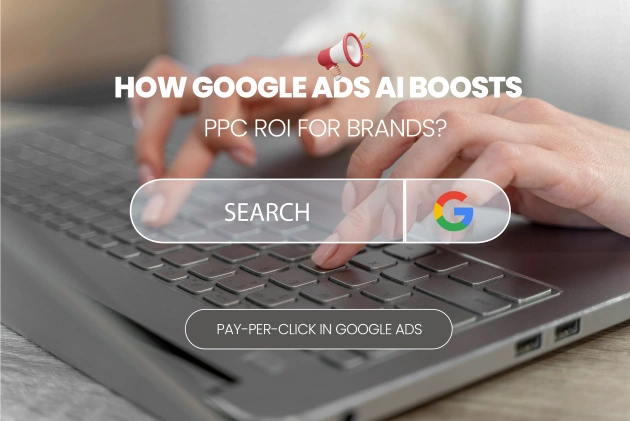
Pay-Per-Click in Google Ads
Paid search ads by Google Ads help companies reach the target audience by running paid ads on their sites or other platforms. Paid ads by Google allow company sites to appear at the top of the search engine results page (SERP). When users search for something in Google, they are presented with a list of results on the SERP, both organic and paid results. But if a company runs a paid ad, it drives traffic to its website. In this case, companies are only charged when a user clicks on the running ad and gets redirected to the business’s site. This approach is known as Pay-per-Click or PPC.
gAI in Google Ads: The New Face of Business Marketing
Google has extensively integrated AI into its search and advertising products. This marks a fundamental reimagining of how users search for information and how businesses reach them. With the Google AI Mode, brands can strategically place paid ads within AI-generated summaries. This fundamentally changes the symbiotic and often conflicting relationship between organic and paid search.
Google upholds a clear vision for search’s future, making it a more interactive, intuitive, and direct experience powered by the advanced Generative AI model, Gemini. Shifting from a list of blue links, Gemini helps provide immediate and synthesized answers. Providing a direct answer to users’ queries helps strengthen user engagement. Google also announced the integration of paid advertising within AI Overviews, the AI-generated write-up that now appears at the very top of the SERP. Search and shopping ads now appear as an integral part of the AI-generated answer. For example, a particular search about a certain product can yield an AI Overview with a sponsored link to a specific brand’s latest models of the product the user was searching for.
Although AI-automation has made it easier to design and manage campaigns, it has given birth to inefficiencies. The biggest of them is the inefficiency of small-scale brands in leveraging this new tech-powered advertising approach. Whereas, high-growth brands are exploring Google Ads AI’s full potential to obtain high returns on investments. Their approach to automation in advertising sets new standards.
PPC and Google Ads AI: A Threat or a Boon?
The success of AI-powered search is threatening both the PPC and SEO communities. Both PPC and SEO strive to increase visibility in a space dominated by AI-generated Google content. Before AI, PPC was a successful strategy for businesses to secure top-of-page ad placements. But with AI Overview, the scenario has changed now. It is seen that when an AI Overview appears on the SERP, the traditional ad placements are pushed down the page, often at the bottom of it. This shift has led to lower Click-Through Rates, increased Cost-Per-Click, and disrupted conversion.
However, to survive and thrive in this new landscape, companies need to bring a fundamental shift in strategy. PPC managers need to evolve and become strategic portfolio managers, demanding a higher level of agility and integration within the paid search realm. PPC advertising services today are prioritizing integration of Google’s AI-powered campaigns. As Google is encouraging advertisers to embrace its own AI-powered campaigns, advertisers must excel in tools like Performance Max and AI Max for Search Campaigns. These ads help in bidding across Google’s inventories and find conversion opportunities through machine learning.
To maximize the potential of Google Ads AI, PPC marketers must audit their brand’s appearance in AI-generated answers, identify high-intent informational prompts, align landing pages with answer-based frameworks rather than ad copy only, and prepare for slower optimization cycles with increased signal quality. The narrative today is not only about chasing clicks, but it is also about shaping a brand’s appearance in AI search results.
The CEO Views aims to connect industry peers with quality, well-researched, creatively engaging content. As a reputable business magazine, we try to cater to all knowledge needs of business owners, entrepreneurs, leaders, professionals, and other professionals, with the latest news, articles, and blogs on relevant business topics.