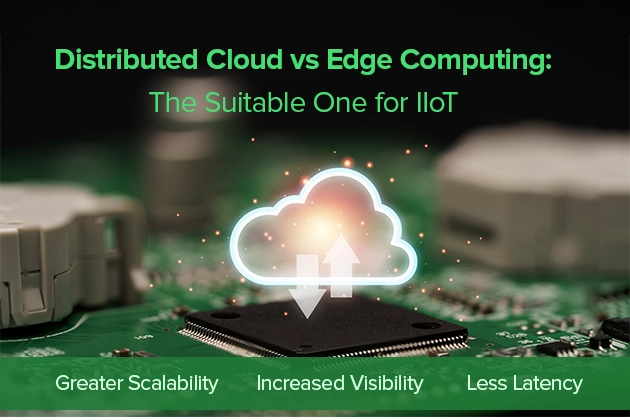
Industrial Internet of Things (IIoT) systems are becoming more distributed due to the continually evolving enterprise infrastructures. Hence, enterprises across industries must choose between distributed cloud vs. edge computing, or determine how the two can be best combined. To build an efficient IIoT platform, businesses must have a detailed understanding of the nuances of these two data management technologies.
Modern Information Technology solutions for industrial applications are increasingly adopting cloud and edge computing to optimize operations through real-time, low-latency data processing, long-term data storage, and advanced data analytics.
Enabling reliable, fast data analysis across industrial operations, edge, and cloud computing offers opportunities for complex data analytics. Experts say cloud and edge computing work best together in multi-cloud and hybrid environments.
Offering a detailed discussion about distributed cloud and edge computing from the lens of IIoT data analytics, this write-up delineates how these technologies contribute to IIoT analytics and which one suits the evolving nature of enterprise infrastructures across industries.
An Introduction to Industrial IoT
Industrial IoT refers to an ecosystem of sensors, devices, associated networking equipment, and applications. These aspects work together to gather, monitor, and analyze data from industrial operations. Through this data analysis, enterprises increase visibility and amplify maintenance and troubleshooting capabilities. Cost reduction, increased efficiencies, and improved security are additional benefits of integrating IIoT systems with the industrial space.
With Industrial IoT, organizations can access an abundance of actionable data from their operations. If properly analyzed, this data helps enterprises control their operations to ensure:
- Improving worker safety
- Maintaining product quality
- Adhering to regulatory compliance
- Increasing production uptime through predictive machinery maintenance
- Accelerating response times
- Enhancing operational efficiencies
Distributed Cloud Computing: What It Is and How It Works?
Distributed cloud is a type of cloud computing. In this model, enterprises harness public cloud infrastructure across multiple geographical locations. This architecture uses multiple clouds to meet performance and compliance needs. It also supports edge computing. Governance, operations, and updates are managed centrally by a single public cloud service provider. Distributed cloud services help organizations achieve application performance and regulatory mandates. Cloud services now reach closer to end users, unlocking new possibilities. As IoT networks and artificial intelligence expand, distributed cloud computing steps in to handle massive data streams instantly, empowering businesses to operate smarter and faster.
In a distributed cloud infrastructure, the entire technology stack of a public cloud provider is distributed to various locations, wherever a customer needs it. This may include on-premises locations of a customer’s private cloud or own data center, or in third-party data centers worldwide, managed from a central control plane. With this distributed cloud architecture, enterprises get more control over data location to meet regulatory requirements. Additionally, it also allows cloud providers to serve data from locations closer to users, improving the performance of cloud applications, databases, and data streaming media.
Benefits of a Distributed Cloud
-
Greater Scalability
A distributed cloud architecture makes the expansion of organizations to edge locations easier, without establishing new data centers.
-
Increased Visibility
Organizations use a single console to manage and regulate activities within a hybrid cloud and multicloud infrastructure that forms a distributed cloud.
-
Less Latency
Distributed cloud services can reduce latency and enhance the responsiveness of applications by taking tasks closer to end users.
-
Enhanced Reliability
Distributed cloud architecture has the inherent capacity of being fault-tolerant and delivering high redundancy. If cloud services in one location go offline, organizations can continue to access cloud services from other distributed locations.
Drawbacks of Using a Distributed Cloud
-
Availability Issues
Various locations in a distributed cloud environment can have different connectivity models and capabilities that may limit bandwidth and upgrade requirements to slower connections, restricting their availability.
-
Security Issues
Managing cloud and data network security can be challenging within a globally distributed cloud infrastructure, driving security issues.
-
Complexity Issues
Unlike centralized cloud computing systems, distributed computing systems are hard to deploy, maintain, and troubleshoot, making it a tough choice for businesses to optimize their business operations.
-
Complicated Backup Systems
Recovering and backing up data from a distributed cloud environment is complicated. As many regulations demand data to stay in specific locations, relying on a distributed cloud architecture can be challenging.
-
High Expenses
Establishing a distributed cloud computing system demands a large investment. Also, to amplify capacity for increasing processing may incur additional expenses to maintain a distributed cloud infrastructure.
Edge Computing: Advantages, Disadvantages, and More
Edge computing is all about moving the computational load towards the edge of the network, instead of using centralized servers to tap into the unexplored computational capacity at the edge nodes, such as switches, stations, and routers. Cloud-based applications use a data center with servers as a central location to process information generated by IoT, tablets, and smartphones for Industrial IoT Data Analytics and big data analytics. This increases demands on the computing infrastructure, creating problems with user experiences. Edge computing came into existence in response to this situation.
Advantages
- Speed: Edge computing reduces the physical distance and time required for data to travel and transfer. By reducing network congestion and increasing responsiveness, this network enhances speed.
- Uninterrupted Connection: As edge computing offers local edge Data Centers for data storage and processing, businesses can depend on reliable connectivity for IoT applications, allowing the usage of low bandwidth and normal operation under limited connectivity.
- Low Latency: Edge computing works with a more distributed network and reduces latency to ensure real-time responsiveness.
Disadvantages
- Security: IoT devices associated with edge computing often lack strong security measures, allowing malicious attacks on sensitive data.
- Complexity: Compared to a centralized cloud architecture, a distributed system is more complex. Edge computing includes various components of new technology, making the communication complex across various interfaces.
- Lack of Robust Infrastructure: Edge computing data centers lack the robust infrastructure that Core Data Centers have.
As edge computing processes data locally at the edge of the network for near-zero latency, distributed cloud computing expands public cloud services to various physical locations. The combined application of both technologies derives the best results for industrial IoT applications.
Edge computing and distributed cloud computing for IIoT data analytics ensure low-latency and real-time processing by analyzing data near the data source. This hybrid approach enhances data security, optimizes bandwidth, and unlocks immediate automated decision-making.
The CEO Views, as a reputable business media publication in the USA, is committed to connecting peers across industries and bridging the knowledge gap across the business realm. The carefully crafted articles, blogs, and profiles of our business magazine empower business enthusiasts to pursue their dreams within the business world.