

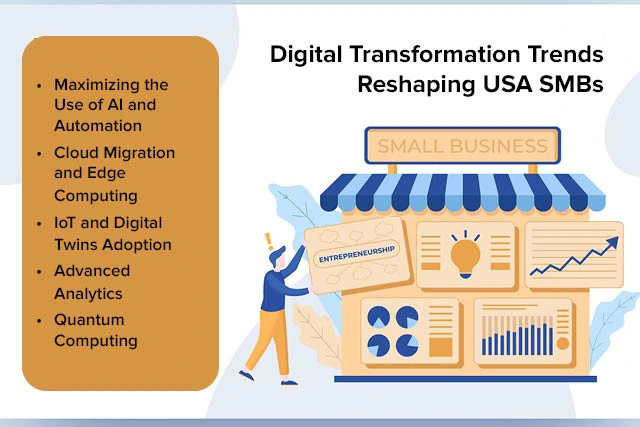
Across industries in the United States, up to 75% of small and medium-sized business (SMB) leaders are heavily investing in cloud computing, artificial intelligence, and cybersecurity tools. Digital transformation for small business USA is no longer a buzzword; it’s a strategic lifeline between thriving in 2026 and falling behind. 78% of the USA small business owners are considering these technologies “game-changers” for competitiveness, not mere efficiency.
In this article, today, we will delineate the significance of digital transformation for small businesses and the top 10 digitization trends they must adopt to thrive in 2026.
Small Businesses Must Embrace Digital Transformation in 2026. Here’s Why?
In a marketplace where nimble decision-making and flawless customer experience set winners apart, digital transformation equips SMBs with tools that were once exclusive to large enterprises. For U.S. SMBs preparing to enter 2026, digital transformation spans more than email and ecommerce; it’s a holistic reinvention of how work gets done, risks get managed, and value reaches customers. Imagine cloud-based collaboration replacing fragmented spreadsheets; AI-powered automation tackling repetitive tasks so owners focus on growth; and next-level cybersecurity fortifying customers’ digital trust.
According to the U.S. Chamber of Commerce, around 96% of SMBs plan to embrace emerging technologies, including AI, in 2026, and 63% of current AI users across SMBs deploy it daily. Its “Empowering Small Business” report highlights that 99% of small businesses in the USA utilize at least one technology platform. The report further reveals that 84% of small businesses plan to increase their use of technology platforms. 77% of SMBs using AI reported that limiting the technology would negatively impact their growth, bottom line, and operations.
Today’s trends, from AI integration to advanced cybersecurity, reflect that small enterprises can no longer afford to lag. Research has also shown that investments in these areas directly correlate with revenue growth, operational speed, and customer retention. But the promise of digitalization isn’t abstract — it’s measurable.
SMBs adopting cloud analytics and automation report faster decision-making, improved operational efficiency, and customer engagement that scales at a rate impossible with manual processes alone. From financial software that instantly reconciles accounts to CRM platforms revealing patterns in buyer behavior, these technologies unlock agility and insight.
Cybersecurity, being a crucial part of modern business operations, has become sacrosanct for SMBs to adopt for better operational security and strengthened consumer trust. As they rely on more digital tools, they also become targets of cyber threats. Proactive security models like Zero Trust and AI-driven threat detection aren’t “nice to have” — they’re critical, especially when every breach could mean hefty financial losses and eroded customer trust. Apart from cybersecurity solutions, financial software and other digital financial tools are transforming how SMBs manage cash flow, forecasting, and compliance.
AI and automation, low-code development platforms, and multi-cloud architectures are creating a new digital infrastructure that scales with business needs, and not budget size. For small business owners, embracing these trends means better insights, customer experiences that rival larger competitors, and leaner operations, essential attributes in a marketplace driven by speed, personalization, and resilience. In 2026, successful SMBs won’t just use digital tools — they’ll build business models around them, blending innovation with resilience to weather economic shifts and tap new growth opportunities.
Top 10 Digital Trends for USA SMBs to Follow in 2026
Although small businesses continue to be concerned about supply chains, inflation, and interest rates, the contribution of technology in helping SMBs save time and resources while providing more tailored services to beat market competition cannot be denied. By adopting these top 10 trends, SMBs would continue to contribute to the US economy extensively in 2026.
-
Empowering Security with Advanced Cybersecurity Solutions
Cybersecurity solutions for small business USA move beyond just password management. As digitalization comes with cyberattack risks, protecting consumer data and business systems has become more crucial than ever for small businesses. Cyber threats are continuously evolving, and hackers are leveraging artificial intelligence to exploit systems and identify loopholes. To combat these AI-driven cyber threats, small businesses must respond fast with cutting-edge security tools. New laws and regulations of data privacy are surfacing, and by adopting automation compliance with these regulations, SMBs could prevent penalties and build customer trust.
-
Maximizing the Use of AI and Automation
With Generative and Agentic AI dominating the 2025 business landscape, SMBs in 2026 must focus on maximizing the use of AI to stay competitive in the marketplace. From content creation to autonomous transactions, AI is surprisingly transforming business operations.
-
Cloud Migration and Edge Computing
As cloud computing improves operational flexibility and enables remote work, nearly all small businesses in the USA rely on cloud-hosted software to execute daily operations. By leveraging hybrid and multi-cloud approaches, SMBs could balance cost, security, and performance. Also, with edge computing, they are ensuring improvements in system hardware and operational speed. This distributed IT model eliminates the need to send everything to cloud data centers.
-
Integrating AI and Cloud Computing in Financial Software
Whether it is data analysis or finance management, digitalization is allowing AI, automation, and cloud computing to integrate with financial software. The USA SMB sector has paved the way for AI-powered financial software for small business to manage their finances smartly and efficiently.
-
No-Code & Low-Code Development
The majority of small businesses lack large development and specialized teams. In such a case, no-code and low-code (LCNC) platforms leverage simple visual tools, enabling non-technical staff build dashboards, apps, and workflows. With LCNC, SMBs can accelerate digital transformation without heavy investment in app and website developers.
-
IoT and Digital Twins Adoption
IoT and Edge computing are revolutionizing connectivity by processing data close to its source, instead of relying on centralized cloud infrastructure. Industries, including manufacturing and healthcare, leverage edge computing for real-time decision-making, operational efficiency, and enhanced security. With these technologies, SMBs can locally process data and eliminate the cost of relying on centralized data centers.
-
Leveraging Ultra-Fast Connectivity with 5G and 6G
As 5G networks dominate mainstream adoption and 6G development advances, they continue to revolutionize data transfer, communication, and enable autonomous vehicles, immersive technologies, and smart cities. Leveraging this ultra-fast connectivity, small businesses can allow digital transformation trends to achieve their full potential.
-
AIOps
All-in-one platforms (AIOPs) revolutionize IT operations by integrating Artificial Intelligence (AI) and Machine Learning (ML) into their operations. By automating complex workflows and enabling intelligent decision-making, Modern AIOPs deliver actionable insights to reduce downtime and improve operational efficiency by up to 40%.
-
Advanced Analytics
Big Data analytics is an integral part of modern-day business. Whether it is a small or a large company, businesses leverage prescriptive and predictive insights to optimize strategies, drive growth, and enhance customer experiences. Through this technological adoption, SMBs unlock data accessibility across all organizational levels.
-
Quantum Computing
By transforming theoretical research into practical business applications, quantum computing is delivering unprecedented computational capabilities to transform healthcare, finance, and other industries. SMBs can explore quantum algorithms for drug discovery, complex simulations, and advanced cryptography, which are difficult with traditional computing.
The CEO Views has been catering to the needs of delivering valuable business information to the industry peers, making knowledge sharing viable for them. While keeping diverse business areas at its center of publication, our business magazine ensures our readers not only stay ahead of industry trends but also stay connected through a single platform for information sharing.