As the modern workplace environment continues to evolve, organizational employees are being prioritized to achieve optimal success. Employee productivity, being the key to organizational success, is also being prioritized to ensure companies stay ahead of the curve. To effectively monitor their performance, companies are relying on various employee tracking tools and techniques.
Supervising productivity isn’t always easy; however, it is one of the best ways to see if everything is functioning normally, and that’s something that can definitely affect the success of your company. A strategic approach to employee productivity monitoring involves evaluating their attendance, goals, daily work reports, the challenges they encounter, identifying training requirements, and offering them what they need to enhance their overall performance. The purpose behind employee performance monitoring is to align individual goals with company objectives, enable data-driven decisions on rewards, boost productivity, and ensure appraisals.
Namely, a recent study has shown that approximately 30% of workers have lied to their boss at least once, and forty percent of that group of people were entry-level workers. That’s a devastating fact; hence, it’s always recommended to develop strategies that will help you monitor them. If you’re not sure what the best options are, below we will uncover everything!
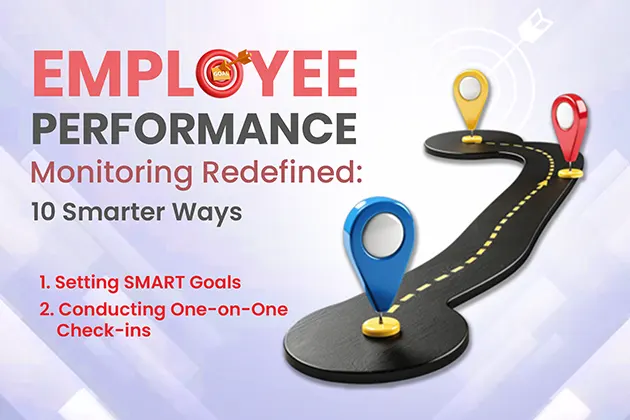
10 Smart Ways To Supervise Your Employees’ Performance
1. Setting SMART Goals
Are you looking for a strategic approach to employee performance monitoring? Then setting some clear SMART Goals could be a starting point for you. SMART is the abbreviated form of ‘Specific,’ ‘Measurable,’ ‘Achievable,’ ‘Realistic,’ and ‘Time-bound’ in goal setting. By determining some specific, measurable, attainable, realistic, and time-bound goals for employees to attain, managers can track their progress in meeting them.
2. Opt For a Monitoring Software for Employees
Since business owners and managers are not able to constantly watch over their workers, this is definitely an extremely helpful solution. So what does employee monitoring software do? It was designed to track the activity of your team members and what they do on their computers.
Furthermore, special services gather, assess, and store data about the visited web pages, running apps, search queries, and external storage devices utilized during the workday. Besides this, these services are also able to control the activities of your employees on social networks, chats in messengers, and the emails they are sending and receiving.
3. Google Forms And Sheets
Even though this may not be the latest invention when it comes to tracking, it’s definitely a great tool, especially if you’re dealing with remote workers or part-time employees. Here, you can make very simple Google Forms that your team members will be able to easily fill out every day (or when they’re working).
In these designated fields, they can accentuate their work hours and let you know when the job is done. If you integrate all that info into a single file, you will be able to track both the progress and budget for the weeks to come. Luckily, it’s so easy to use!
4. Implementing the 360 Degree Feedback System
The 360 degree feedback system is a comprehensive performance appraisal method that collects multi-rater and anonymous inputs from an employee’s supervisors, peers, sometimes customers, along with a self-assessment. This approach is fundamentally used for employee development. It offers a holistic view of competencies of employees to ensure self-awareness and identify training needs. Implementing this feedback system could help you address drawbacks and reward good performances of your employees.
5. Conducting One-on-One Check-ins
Scheduling weekly or monthly check-ins to discuss project progress, address challenges, and deliver support could ensure better reviewing of the workflow. A comprehensive evaluation of the workflow allows managers to better monitor the workforce while they conduct their daily tasks.
6. Say YES To Social Media
You have to realize that not every single person is open to communication; hence, with these types of people, you will not be able to easily become friends or at least get to know them better. That’s why you should definitely consider adding them to any of the social media platforms you are using.
Not only will they help you get to know your employees better, but it is going to make things much simpler when it comes to tracking them. You will be able to see whether they are spending their work hours on their profiles, which can potentially impact their productivity and work quality.
Now, if you notice that they are posting things on their profiles during work hours, yet they are still getting the job done, then you shouldn’t worry about it too much. As long as everything is functioning properly and confidentiality isn’t being breached, there’s no reason for concern.
Productivity loss is something nobody ever wants to experience because it can cost a company both resources and money. Therefore, if you want to ensure things are running smoothly, follow these useful tips!
7. Enterprise Mobility Ensures Improved Employee Performance Monitoring
Enterprise mobility allows workers to work from anywhere while offering IT teams with tools to track device usage and amplify employee performance. By monitoring device usages by employees, businesses can encourage them to be more productive and perform well.
8. Adopting Personalized Employee Development Plans
By investing in training, upskilling, and mentoring opportunities, businesses can tailor employee development plans as per the individual needs of each employees. This not only ensure individual upskilling of workers but also boosts their morale, productivity, and retention. Through personalized employee development plans, companies can strengthen individual employees to acoeve their career goals.
9. Rewarding Promptly
Employees work best when they are rewarded well. By implementing recognition programs that celebrate big wins and daily achievements, managers can heighten employee morale and motivate them to perform well. This recognition program acts as a tool to evaluate employee performance and reward as per performances.
10. Embracing Data-Driven Performance Trends
By analyzing performance metrics, such as project completion rates, turnover, and quality scores, in a timely manner, business leaders identify trends and underperformance early. It also helps the address the root causes behind the poor performances of employees.
The CEO Views keeps readers at the forefront of business development, decision-making, technological advancements, innovations, and other business aspects. Our business publication is committed to being the connecting point between the knowledge requirements of business owners, entrepreneurs, leaders, and business aspirants.