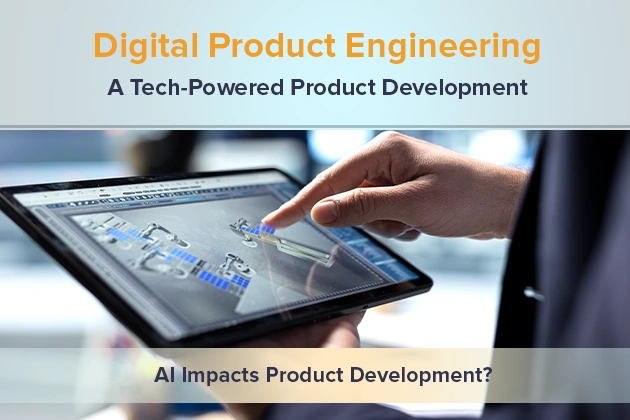
Where digitization is more than just a transformative strategy, it continues to push boundaries as a process that necessitates tech integration at various operational levels. Businesses today prioritize delivering innovative, cost-effective, and market-ready solutions as fast as possible to stay ahead of the competition. Digital product engineering services are designed to optimize product development by integrating technology throughout the product development lifecycle. Through this comprehensive development process, digital product engineering brings product, technology, user experience design, software architecture, development, testing, deployment, and continuous improvement under one roof.
From conceptualization to launch, technology in product development extends beyond the traditional aspects of product design, testing, development, and deployment. Incorporating engineering principles across the product lifecycle is at the core of product engineering. A tech-powered product development leverages digital tools, including artificial intelligence (AI), simulation software, automation, and cloud computing, to innovate, design, test, and launch products more efficiently and quickly. With smarter tools and automation, product development teams deliver innovative products faster and with high precision. Technology has taken creativity and personalization to the next level in modern product development, harnessing advanced technology either through internal integration or outsourcing. Through services designed to develop digitally powered products or services, businesses often deploy specialized digital products and services with the help of external partners.
Through this blog, we have evaluated the concept of digital product engineering (DPE) and how AI is reimagining digital product development to help businesses stay competitive.
Digital Product Engineering and Artificial Intelligence
As the significance of digital products continues to increase, businesses observe a growing trend in digital product engineering. Companies that are lagging in rapid product innovation are likely to lose their market position. Hence, having a digital product that continuously evolves and generates business value is no longer optional; it has become essential. So, where do businesses start from to ensure a successful product development?
Digital Product Engineering is often considered the compass to navigate your journey to digital product development, aligned with your business objectives. Let’s explore what digital product engineering is and how it is reshaping modern product development by leveraging technologies.
What is Digital Product Engineering?
It is the process of developing innovative digital solutions that solve real-world problems, ensuring an exceptional user experience. From software to applications, digital product engineering embraces processes such as ideation, conceptualization, design, development, testing, deployment, and continuous product optimization. Developed through agile and iterative methodologies, this process sets the foundation for rapid prototyping and continuous improvement. Allowing the requirements to evolve throughout the development process, DPE prioritizes adaptive planning.
How AI Impacts Product Development?
While talking about AI, the first thing that comes to mind is ‘automation.’ AI tools help product designers evolve a new product concept into a prototype. Since its integration into core business processes, product designers have experimented with how this technology could be best incorporated into product development. According to an IBM study, AI-powered systems have transformed the way organizations develop products, automate repetitive tasks, streamline workflows, and help unlock a data-driven approach to product development.
AI product development tools generate new product ideas that use complex algorithms, generative AI models, and prototypes. From research to iteration, AI tools can do wonders for your product development. Generative AI product development tools help in conducting market research, the first stage of the product development lifecycle. For instance, some organizations are experimenting with AI assistants integrated into product management software. These tools help analyze customer feedback in real-time, helping managers identify areas for new product development.
Furthermore, Gen AI tools can help them take insights from research and convert them into new product ideas that suit the market. AI tools also guide product designers turn a concept into a prototype faster, automating repetitive design and prototyping processes. Through AI-powered simulation tools, teams can predict how customers will use product designs and prototypes. ML-powered simulations compare each product design and understand how they are likely to perform in markets.
Automation helps optimize the test and build phase, producing thousands of prototype variations tested against each other for performance. After the completion of the test phase, product managers leverage AI to validate choices, user experience, and sustainability to evaluate a new product. During the last phase of launch and iteration, AI executes continuous improvement by gathering real-world data and ensuring organizational competitive advantage. ML algorithms can also highlight any anomaly in the data to help spot potential issues faster and detect meaningful changes in market trends and user behavior.
Standing at the intersection of business and business insights, we, at The CEO Views, empower business readers with knowledge, skills, news, and insights on trends, business concepts, technology, and innovation to navigate the global business landscape. Whether it is product development or process optimization, our business magazine brings to notice the latest developments within the business sector.