The U.S. market of self-driving cars and trucks is estimated to grow at a CAGR rate of 44.50% from 2025 to 2034. North America dominated the self-driving cars and trucks market, with the largest share volume of 45% in 2024. The U.S. market volume is estimated to grow by $4,051.55 thousand units by 2034. With the growing adoption of self-driving vehicles in the country, the market is projected to bloom in the coming years. Amidst such growth in the industry, the Zoox mishap has raised questions about the safety and reliability of self-driving vehicles.
Prioritizing the emergence of news delivery at the earliest and providing detailed insight into recent happenings, The CEO Views has been committed to empowering readers with the latest information. As a connecting force between industry peers, our magazine delivers news and insights on industry events, trends, technologies, innovations, and businesses.
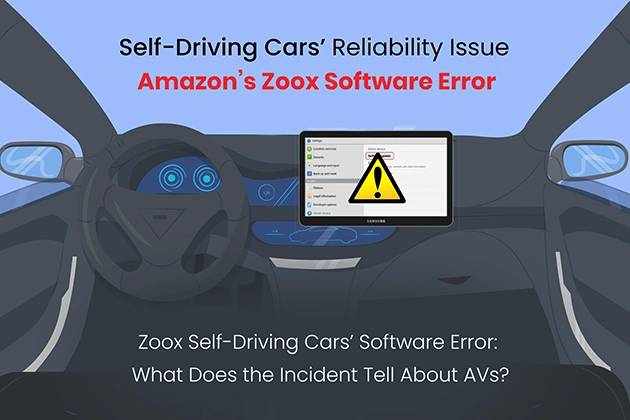
Amazon’s Zoox Software Malfunction: What You Should Know?
On December 23, 2025, Amazon’s self-driving department Zoox announced a recall of 332 self-driving robotaxis. As confirmed by the National Highway Traffic Safety Administration, vehicles sometimes cross the yellow center line or stop in front of oncoming traffic near intersections due to a malfunction in the vehicle software. Although Zoox clarified addressing the issue through a software update, it opened an investigation after a Zoox robotaxi took a wide right turn and partially crossed into the opposing travel lane, and temporarily stopped in front of the oncoming travel lane.
The company identified 62 examples of its robotaxis crossing the lane line, either fully, partially, or unnecessarily, as a result of an Amazon self-driving car software error. The company commented, “We have proactively identified some instances where our vehicles were making maneuvers that, while common for human drivers, didn’t meet our standards.”
In May 2025, a Zoox robotaxi without any passengers was in a car crash with a passenger car in Las Vegas. After this incident, Zoox withdrew 270 vehicles and conducted a software update to enhance its vehicles’ ability to track nearby pedestrians and prevent movement when someone is close. The National Highway Traffic Safety Administration closed a probe into 258 Zoox vehicles concerning a braking issue after Zoox issued a recall for a software update to eliminate unexpected hard braking.
In August, NHSTA certified Zoox vehicles for demo use and closed a probe that was started by the U.S. safety regulator in 2022 to ensure the company’s compliance with federal requirements. Over Zoox’s automated driving systems (ADS) software error, the company has provided a free upgrade of its ADS software.
In light of this scenario, many automobile manufacturers in the country have recalled self-driving vehicles over software issues. Alphabet’s robotaxi unit Waymo also recalled its autonomous vehicles (AVs) after Texas officials claimed that the vehicles illegally passed school buses at least 19 times. To address this issue, NHSTA opened a probe in October into Waymo vehicles near school buses.
Zoox Self-Driving Cars’ Software Error: What Does the Incident Tell About AVs?
Robotaxi companies like Tesla, Zoox, and Waymo are embracing various approaches to vertical integration. Each company is developing its own ADS. Zoox built its own ADS, a bi-directional vehicle in which passengers sit facing each other. However, the most crucial operating cost of a robotaxi service is the expense of developing a safe and functional ADS. Major robotaxi companies in the U.S. have already spent billions on engineering and testing in the last decade. Once the ADS stabilizes, it reduces engineering costs. But a mature ADS requires refinement and upgradation.
As the road users’ behavior and the built environment will continually evolve, robotaxis will encounter novel edge cases. Despite continuous research & development, finance, and time invested in refining AVs and robotaxis, they still encounter ongoing operational issues, specifically affecting human safety. Cases like Zoox’s self-driving car software error and similar events highlight two clear failures of AVs. One is the failure of technology or the ADS. An ADS failure indicates that the AI is failing to detect the presence of a human in a safety-compromised situation. The second is the management failure of the AV manufacturing companies, as they are failing to comply with policies and regulatory reporting requirements. By observing these failures, we can identify the complacency within a complex human-machine system, demanding close attention to details to ensure safety.
Companies developing AV technology are trying to attain a commercial edge over one another. They want to effectively market self-driving technologies and services to obtain a higher return on their investment. But at what cost? The question undoubtedly points toward the safety issues that these companies fail to address while promoting their AVs. The Zoox ADS software update is an example of the highlighted need for AV manufacturers to become more meticulous in developing ADS to avoid road clashes by self-driving cars.