In January 2017, C-4 Analytics prepared to introduce its new Automotive In-Market (AIM) platform at the National Automobile Dealers Association (NADA) convention, connecting a century-old lesson in advertising with the emerging possibilities of automotive digital marketing.
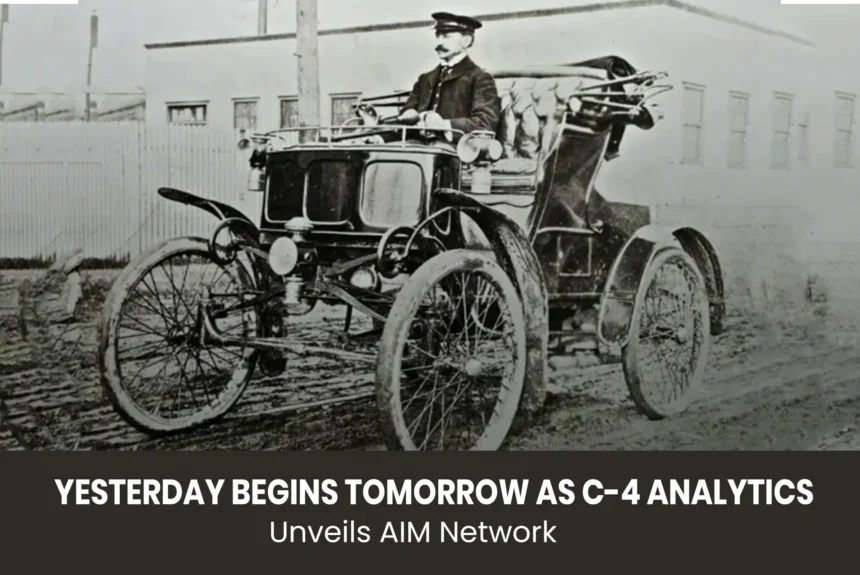
The inspiration came from an advertisement for the Winton Motor Carriage that appeared in Scientific American in 1898. C-4 Analytics used the story to explain a simple principle that remained relevant in the digital age: advertising works best when it reaches the right potential customer in the right environment with a message that speaks to that customer’s needs.
An Advertising Lesson That Began in 1898
The story started with Alexander Winton and the Winton Motor Carriage Company. In 1898, Winton advertised its horseless carriage in Scientific American. C-4 Analytics described the publication as a highly technical newspaper read by wealthy industrialists and researchers interested in technology and patents. That made the publication a logical place to reach people who might be receptive to an unfamiliar and expensive invention.
The decision was particularly significant because Winton’s automobile was not an inexpensive purchase. According to the C-4 Analytics account, the car sold for $1,000, while the average daily wage in 1898 was $2.43. The company calculated the historical price at approximately $27,479.23 in contemporary dollars. In other words, Winton was not attempting to reach every person who could see an advertisement. It was placing its message in front of a narrower audience with the means and interest to consider the product.
That strategy appears to have produced a tangible result. Robert Allison of Port Carbon, Pennsylvania, purchased a Winton after seeing the advertisement in Scientific American. The Smithsonian confirms that Allison purchased the first production Winton that the company sold, while historical records place the transaction on March 24, 1898.
C-4 Analytics viewed that episode as an early example of targeted automobile advertising. More than a century later, the company wanted to apply the same basic principle to the digital marketplace.
The Problem C-4 Analytics Wanted to Solve
By 2017, the challenge was no longer finding a publication whose readers were likely to be interested in automobiles. Consumers were spread across an enormous digital environment.
Someone considering a vehicle could visit a dealership website, browse a manufacturer’s site, compare listings on automotive marketplaces, read reviews and search for incentives. A dealership could potentially advertise across many of those environments, but simply being present did not guarantee that its advertising would reach people who were genuinely preparing to purchase.
C-4 Analytics argued that the harder problem was identifying groups of relevant buyers cost-effectively and reaching them at the appropriate time. The company said its new AIM platform was developed to target specific automotive audiences rather than relying on keywords or attempting to define an individual buyer through conventional targeting.
This distinction was central to the AIM concept. The platform was intended to focus on consumers who had demonstrated behavior associated with vehicle shopping. C-4 Analytics specifically cited people who had visited dealership specials pages, visited sites such as AutoTrader or Cars.com, or requested an e-price from a competing dealership.
From Websites to Shoppers
One of the most important ideas behind AIM was that dealerships did not necessarily need to purchase advertising directly from every automotive website where shoppers were researching vehicles.
C-4 Analytics said the platform could tap into previously inaccessible data streams from major online automotive shopping, listing and review sites. The company’s 2017 announcement stated that AIM could provide dealerships with groups of in-market customers without requiring them to negotiate individually with those third-party automotive sites for access to their customer and data sets.
This represented a different way of thinking about digital advertising. Instead of asking only where a potential buyer was browsing, AIM focused on identifying the shopper and following that audience beyond the original automotive site. C-4 Analytics later described AIM as an automotive data platform and ad network that could allow dealers to reach shoppers who had visited third-party automotive sites as they continued browsing elsewhere online.
The practical goal was straightforward: bring qualified shoppers back toward the dealership rather than leaving the relationship entirely with third-party shopping platforms.
A Real 2017 Example of In-Market Targeting
C-4 Analytics’ own 2017 case material provides a useful example of how the company’s broader targeting philosophy was being applied.
- In a Nissan Rogue display advertising campaign, C-4 Analytics used narrowed Polk Data to target in-market buyers specifically interested in Nissan SUVs. The campaign also tested a larger 300 x 600 display advertisement against a similarly targeted Nissan Altima ad running in the same placement. The results provide concrete numbers rather than simply describing the value of targeting.
- The Nissan Rogue 300 x 600 advertisement generated 12,302 impressions and 24 clicks between January 19 and January 31. The comparable Altima advertisement generated 6,186 impressions and five clicks. C-4 Analytics said the larger Rogue advertisement therefore received approximately twice the impressions and substantially more clicks than the comparison advertisement.
The case is important because it demonstrates two separate elements of the company’s approach: audience targeting and creative testing.
The campaign was not simply aimed at a broad population. It used data to focus on people seriously shopping for Nissan SUVs, then tested different ad formats to determine which performed better.
What AIM Meant for Dealership Marketing
For dealerships, the AIM concept had several potential applications. A dealer promoting a vehicle special could seek consumers who had already shown interest in the relevant vehicle category.
A dealer competing for shoppers considering another brand could use audience data to reach consumers who were already researching vehicles. A dealership could also use targeted display advertising to keep its inventory and offers visible after a shopper had visited an automotive research or listing website.
These examples are consistent with the audience-focused proposition C-4 Analytics presented in 2017. They are not claims that every AIM campaign produced the same outcome. Rather, they illustrate how the platform was designed to be used: identify relevant shoppers, deliver advertising to them and bring them into a dealer’s own digital environment.
That distinction matters because the company was not positioning AIM as another general advertising placement. It was presenting it as an audience and data solution.
The Broader Shift in Automotive Advertising
The AIM launch also reflected a larger change taking place in the automotive industry.
Traditional advertising often depended heavily on selecting a publication, station, program or geographic market and purchasing exposure there. Digital advertising introduced the possibility of making decisions based on consumer behavior.
That did not eliminate the importance of placement. Instead, it changed the relationship between placement and audience.
A dealership could still care about where an advertisement appeared, but it could increasingly ask another question: who is seeing it?
This is where automotive advertising strategies began moving toward more sophisticated audience selection. For C-4 Analytics, the opportunity was to combine automotive shopping behavior with digital advertising so that dealerships could focus their budgets on consumers showing stronger purchase signals.
Why the 1898 Story Still Mattered
The connection between Winton’s advertisement and AIM was more than a historical comparison.
In 1898, Winton understood that placing an automobile advertisement in front of an appropriate audience could be more valuable than simply reaching a larger audience. Scientific American gave the company access to readers who were educated, technologically interested and more likely to appreciate the possibilities of the new automobile.
In 2017, the environment was radically different, but the underlying marketing problem was surprisingly similar. The audience had moved from the pages of a technical publication to websites, search engines and online marketplaces. Instead of identifying a suitable publication, marketers could use digital signals to identify consumers who were already demonstrating an interest in vehicles. The technology had changed. The principle had not.
Tomorrow Looks Surprisingly Familiar
C-4 Analytics’ planned AIM unveiling at NADA 2017 represented the company’s attempt to bring that principle into the digital automotive marketplace. Its argument was that modern dealerships needed more than advertising exposure. They needed access to relevant shoppers and the ability to reach those shoppers beyond the automotive websites where their research began.
The company’s own Nissan Rogue case study offered a contemporaneous example of data-driven targeting in practice, while the AIM announcement explained how the company intended to extend that philosophy through an audience-based advertising network.
There is a certain symmetry to the story. Winton’s 1898 advertisement sought out people who were likely to understand and afford an unfamiliar new technology. C-4 Analytics’ 2017 AIM platform sought out people who were already demonstrating interest in purchasing a familiar technology: the automobile.
The tools were different, the media were different and the scale was dramatically different. But the fundamental question remained the same: Who is most likely to buy, and how can an advertiser reach that person effectively?
That question explains why the AIM Network was significant at NADA 2017. It placed audience intelligence at the center of the dealership advertising conversation and offered a digital interpretation of a lesson that had been demonstrated nearly 120 years earlier.
The future of automotive advertising, in that sense, was not abandoning the past. It was making the same idea smarter. And at the heart of that idea were in market automotive audiences: consumers whose demonstrated shopping behavior could help dealerships focus advertising on people already moving toward a purchase.
FAQs
- What is the AIM Network by C-4 Analytics?
The AIM Network was a data-driven automotive advertising platform introduced by C-4 Analytics in 2017 to help dealerships reach consumers showing signs of vehicle-buying intent. - When did C-4 Analytics unveil the AIM Network?
C-4 Analytics unveiled the AIM Network at the National Automobile Dealers Association (NADA) convention in 2017. - How did the AIM Network identify potential automotive buyers?
It used automotive shopping signals, including visits to dealership specials pages, automotive marketplaces such as AutoTrader and Cars.com, and requests for e-prices from competing dealerships. - Why was the AIM Network important for dealerships?
It offered dealerships a way to focus advertising on consumers who were already demonstrating interest in purchasing a vehicle instead of relying solely on broad audience targeting. - What was the Nissan Rogue advertising example?
C-4 Analytics used Polk Data to target consumers seriously shopping for Nissan SUVs. The Nissan Rogue 300 × 600 advertisement generated 12,302 impressions and 24 clicks during the reported campaign period. - How did automotive advertising change with data-driven targeting?
Data-driven targeting allowed dealerships to consider consumer behavior and purchase intent when developing campaigns, making advertising more focused than simply targeting broad geographic or demographic groups. - What is the main idea behind C-4 Analytics’ AIM Network?
The central idea was to identify in-market automotive audiences and help dealerships reach those shoppers with relevant advertising as they moved through the vehicle-buying journey.
The CEO Views goes beyond business headlines to explore the people, ideas, and decisions shaping today’s industries. Through thoughtful leadership stories, company profiles, and industry perspectives, it highlights the journeys, challenges, and achievements behind businesses creating meaningful change.