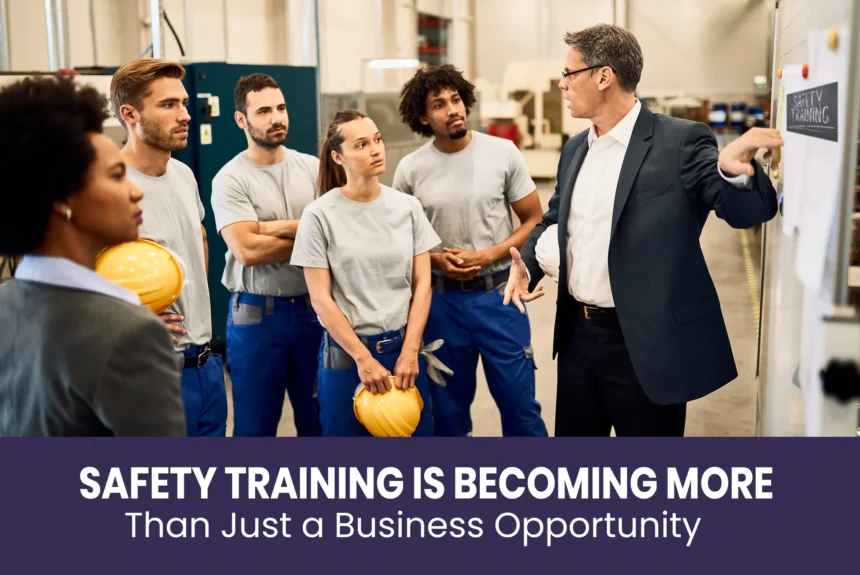
For years, safety training was treated as something businesses had to do because regulations, insurers, or internal policies demanded it. Today, that thinking is changing. Safety training business opportunities are growing because employers are not simply looking for certificates anymore. They want accessible training, qualified instructors, practical skills, convenient scheduling, and programs that fit the realities of their industry. At the same time, individuals are increasingly looking for certifications that can help them qualify for jobs or meet workplace requirements.
This combination is turning safety training into a service market with room for specialized providers, local businesses, corporate training companies, and technology-enabled platforms.
The demand is not difficult to understand; workplace incidents remain a significant concern even as injury rates improve. The U.S. Bureau of Labor Statistics reported 2.5 million nonfatal workplace injuries and illnesses among private-industry employers in 2024. The total recordable case rate was 2.3 cases per 100 full-time equivalent workers, the lowest rate in the series going back to 2003.
That does not eliminate the need for training. If anything, it creates a market for providers that can help companies maintain safer workplaces while making the learning process easier.
The Business Case Starts with a Recurring Need
One of the most attractive characteristics of the safety training market is that demand does not necessarily end after one course. Employees join and leave companies, certifications expire, workers move into new positions, equipment changes, regulations and industry practices evolve, companies open new locations and hire larger teams.
Each of these situations can create another training requirement. That gives training providers an opportunity to build recurring relationships rather than depending entirely on one-time customers.
Consider a 100-person manufacturing company, it may initially approach a provider for a specific safety course. Once that relationship is established, the company may later need refresher training, first aid certification, emergency response training, or courses for newly hired employees.
The same principle applies to a healthcare facility, construction contractor, warehouse, hotel, school, or childcare organization.
The business opportunity, therefore, is not simply selling a seat in a classroom. It is becoming a reliable training partner.
The benefits of workplace safety training go beyond simply meeting a regulatory requirement. For employers, effective training can help employees recognize hazards earlier, respond confidently during emergencies, use equipment correctly, and make safer decisions in everyday situations. It can also reduce avoidable disruptions and help businesses build a stronger safety culture.
For training providers, these practical outcomes create an opportunity to position safety education as a valuable business service rather than another compliance expense. When companies can see a clear connection between training, employee preparedness, and smoother operations, they are more likely to invest in refresher courses, new employee training, and specialized programs.
Convenience Is Becoming Part of the Product
The training market is also changing because customers have become accustomed to convenience in almost every other service they purchase.
Someone looking for certification does not necessarily want to wait several weeks for the next available class. Businesses may not want employees traveling long distances or losing an entire workday. Smaller companies may not have an internal safety department to coordinate training.
This is where local providers and flexible scheduling can become competitive advantages.
A provider like MyCPR operating in a major city can reach a student who decides on a Thursday that they want to be certified by the weekend. In a city where people have choices, the training business that’s easy to find, straightforward to book, and delivers a quality experience earns referrals at a rate that compounds.
https://mycprcert.org/chicago-il-cpr-certification/ is an example of a provider operating in exactly this kind of environment, where the market depth is real and the opportunity to build a trusted local reputation is significant.
That example illustrates why location, availability, booking experience, and reputation can matter just as much as the course itself.
CPR Shows How Training Can Become a Standalone Market
CPR and first aid training offer one of the clearest examples of safety education becoming a commercial opportunity.
People take CPR courses for many different reasons. Healthcare workers may need certification for their roles. Teachers, childcare workers, coaches, lifeguards, fitness professionals, and other employees may need it as part of their responsibilities. Companies may also train staff so they have people capable of responding during emergencies.
The need has a powerful real-world foundation. The American Heart Association says approximately 350,000 people in the United States experience an out-of-hospital cardiac arrest each year, and immediate CPR can double or triple the chance of survival.
The Association’s 2025 guidelines also reported that survival to hospital discharge after EMS-treated adult out-of-hospital cardiac arrest was 10.5% in 2024, while bystander CPR was associated with better survival outcomes.
For a training business, this creates a service that has both professional and personal value. Customers are not only buying a certificate. They are learning a skill that could potentially be used in a real emergency.
Different Industries Create Different Opportunities
A major advantage of the safety training market is its diversity. Providers do not have to compete for exactly the same customers or offer identical programs.
- Construction
Construction companies face risks involving falls, machinery, electrical systems, hazardous materials, confined spaces, and other jobsite hazards. A provider that understands construction can create targeted training packages for contractors rather than offering generic safety education.
That specialization can make the provider more valuable to employers because the training reflects the environment workers actually encounter.
- Transportation and Warehousing
Transportation and warehousing represent another significant market. BLS data show that transportation and warehousing recorded 261,500 nonfatal workplace injury and illness cases in 2024, with a rate of 4.4 cases per 100 full-time workers.
Warehouses can require training around powered industrial trucks, material handling, emergency procedures, and other workplace hazards. Forklift training is particularly relevant because OSHA requires operators to receive formal instruction, practical training, and workplace evaluation, with refresher training required in certain circumstances.
For a provider, that can translate into a repeat business model serving warehouses, distribution centers, manufacturers, and logistics companies.
- Healthcare
Healthcare creates another large customer base. BLS recorded 553,800 nonfatal workplace injury and illness cases in healthcare and social assistance in 2024, with a rate of 3.4 cases per 100 full-time workers.
Training opportunities can include CPR, first aid, bloodborne pathogen awareness, emergency response, workplace violence prevention, infection-control practices, and other programs depending on the organization and applicable requirements.
Healthcare providers also have a constantly changing workforce, creating opportunities for ongoing training relationships.
- Hospitality and Food Services
Restaurants, hotels, gyms, recreation centers, and other customer-facing businesses can also become important markets. These businesses may need employees who understand emergency response, first aid, CPR, fire safety, food-related hazards, and workplace procedures.
For a small training company, serving several local businesses can create a stable customer base without requiring a large national operation.
Specialization Can Make a Training Company Stand Out
The growing opportunity does not mean every training provider needs to offer every possible course. In fact, specialization may be one of the strongest ways to build a business.
A provider could focus on healthcare organizations. Another could specialize in construction contractors. Another might build its reputation around CPR and first aid. A fourth could concentrate on corporate workplace safety.
The advantage is simple: specialization makes it easier to understand a customer’s problems.
A construction company may value an instructor who understands jobsite conditions. A healthcare organization may prefer someone familiar with clinical environments. A warehouse manager may want training that fits employee schedules and operational demands.
The provider becomes more than a company selling courses. It becomes a specialist that understands the customer’s workplace.
Technology Is Expanding the Opportunity
Technology is also changing how safety training businesses operate. Online registration, digital reminders, automated certification records, learning management systems, virtual lessons, and hybrid programs can reduce administrative work and make training easier to access.
However, technology does not have to replace instructors. In many areas of safety training, practical experience and hands-on assessment remain important.
The opportunity is to use technology around the training rather than assuming technology must replace the training itself.
A company could use an online system for enrollment and theory-based lessons, then bring employees together for practical instruction. It could automatically remind workers when certifications are approaching renewal. It could maintain digital records for employers.
That creates a smoother customer experience while giving the provider another way to differentiate itself.
Corporate Training Can Create Recurring Revenue
Individual customers can provide steady demand, but corporate accounts can offer something even more valuable: predictable repeat business.
Imagine a training provider working with a regional restaurant chain. Instead of selling individual classes to employees one at a time, the provider could establish an annual relationship covering multiple locations. The same model could work with construction firms, nursing facilities, warehouses, manufacturers, schools, gyms, or hotel groups.
This approach changes the economics of the business. Instead of constantly searching for new customers, the provider can build a base of organizations that return for employee onboarding, refresher courses, certification renewals, and additional training.
It also creates opportunities for bundled packages. A company may initially want CPR certification, but a provider could eventually support several areas of its employee safety program. The more useful the relationship becomes, the harder it is to replace the provider with a one-off alternative.
Reputation Can Become a Growth Engine
Safety training is also unusually dependent on trust. A customer wants to know that an instructor understands the material, a company wants confidence that employees are receiving credible instruction and an individual wants to leave a course knowing that the skills taught are practical and current.
That makes reputation extremely important. A good customer experience can generate reviews and referrals; a satisfied HR manager may recommend a provider to another business and an employee who had a positive experience may return later for recertification.
For local providers especially, this can create a compounding effect. The business becomes easier to discover because more people talk about it, more customers create more reviews, more reviews strengthen the company’s local reputation and a stronger reputation can generate additional bookings.
In this sense, customer service is not separate from the business model. It is part of the growth strategy.
Turning Compliance into Commercial Value
The biggest shift is that safety training is no longer only about satisfying a requirement. Companies need people who know what to do when something goes wrong, workers need skills that can protect themselves and others, individuals need certifications to qualify for certain jobs and employers need practical ways to train growing teams.
That creates a market with multiple entry points. A small provider can begin with one specialty and expand, an established training company can develop corporate contracts, a local business can compete through convenience and reputation, a technology company can build tools that make training administration easier and an industry specialist can create customized programs for a particular sector.
The opportunity exists because the underlying need is persistent. Workplace injury numbers may fluctuate, regulations may evolve, and technology may change how courses are delivered, but businesses will continue to need capable people who understand how to respond to hazards and emergencies.
The companies that recognize this are likely to view safety training for businesses not as another administrative expense, but as a market where expertise, convenience, specialization, and trust can create a sustainable business.
FAQs
- Why is safety training becoming a business opportunity?
Safety training is becoming a business opportunity because companies have recurring needs for employee onboarding, certification, refresher courses, and industry-specific training. This creates ongoing demand for specialized training providers. - What industries need safety training the most?
Construction, healthcare, transportation, warehousing, manufacturing, hospitality, food services, schools, and childcare organizations all have regular safety training needs. - Can safety training businesses generate recurring revenue?
Yes. Providers can build recurring revenue through corporate contracts, employee onboarding, refresher courses, certification renewals, and customized training packages. - How can safety training providers stand out from competitors?
Providers can differentiate themselves through industry specialization, qualified instructors, convenient scheduling, practical training, strong customer service, and an easy booking experience. - How is technology changing the safety training business?
Online registration, digital certification records, automated reminders, learning management systems, and hybrid training can make courses easier to access while reducing administrative work. - Is CPR training a good business opportunity?
CPR and first aid training can provide a strong business opportunity because healthcare workers, teachers, childcare professionals, coaches, fitness professionals, and other workers may need certification, while companies may also train employees in emergency response. - Why are corporate safety training programs valuable for providers?
Corporate programs can create repeat business because companies regularly hire new employees, renew certifications, and require refresher or specialized training. This can turn individual courses into long-term business relationships.
The CEO Views offers a window into the people and businesses leaving their mark on today’s corporate world. From executive experiences to business breakthroughs and evolving industry trends, it highlights the stories, ideas, and achievements that deserve a wider audience.