Waste was not considered an issue at the early stage of human history, as nature continued to evolve to transform its own ‘waste,’ i.e., food scraps, wood, natural fibers, and fabrics. Their decomposition didn’t pose severe environmental threats as it does now. Over the centuries, waste management has evolved drastically. Today, most of the waste is either buried or incinerated. Unlike marine sediments, contemporary waste, such as plastics, metals, and concrete, petrochemical-based materials, is resistant to weathering, generating a large proportion of greenhouse gases and directly contributing to climate change.
How was Contemporary Waste Managed Earlier?
Waste management has remained a key issue for human societies since ancient times, although the intensity of the environmental effects of waste was not that severe earlier. Human history reflects our lifestyles and environmental challenges, which often compel us to throw waste and contribute to the extensive emission of greenhouse gases.
That system, however, no longer works. In fact, it has not been working for some time now. Our careless disposal of waste has done a lot of damage, and there’s little time left to try and fix it. But finally, in February 2021, the European Parliament adopted the New Circular Economy Action Plan. The plan includes measures that will help achieve an environmentally sustainable economy by 2050. It also introduces tighter recycling rules that should be put into practice by 2030. That sounds like good news, but what exactly does circular economy mean? And how would we handle waste in such a system, then? Read on to find out.
What is the Circular Economy?
The circular economy model of production aims to replace the old take-make-dispose model (also known as a linear economy). The new system will involve everyone and everything: governments, corporations, smaller businesses, and individuals. It will affect our cities, our products, our jobs — but obviously, for the better. To understand what the circular economy means, we should learn its three main principles:
1. Design Out Waste and Pollution
The circular economy points out the fact that waste is actually a result of the way we design things. In fact, about 80% of the environmental impact of a product is already known at the design stage. By finding new ways to get the necessary materials and manufacture products, we can make sure that we create less waste and pollution.
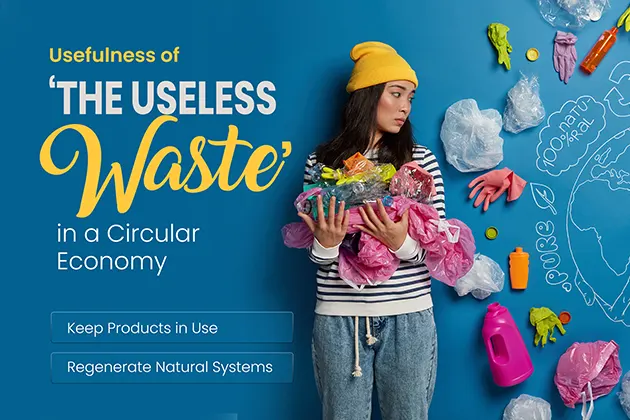
2. Keep Products in Use
In the circular economy model, the products and materials should be in use for as long as possible. That means that some parts of the products should be designed so that they can be reused and remanufactured even after they can no longer serve their original purpose.
3. Regenerate Natural Systems
The third principle of the circular economy goes even further than just protecting the Earth from new waste. It involves actively trying to improve the environment by replacing fossil fuels with renewable energy sources. That, in turn, means returning valuable nutrients to the soil and other ecosystems. If we managed to do that, we would be able to improve our natural resources and start working on truly recovering our planet.
Why Waste Would Still Be Necessary in a Circular Economy?
Before we get to how to deal with waste, we must first understand what waste is. As you might imagine, waste is anything that people no longer want or have a use for. Right now, we are all guilty of not paying much attention to things once they become waste. For instance, as soon as we no longer need old furniture, most of us just throw it out without thinking about where it will end up.
But unfortunately, this goes much deeper than people throwing out their old furniture or waste disposal. Of course, each of us should try to do better, but not everything is up to an individual. For instance, there’s the fact that industrial waste tends to end up in all the wrong places, such as ecosystems from which we get our food and water. The root cause of this issue, essentially, is ineffective waste collection and treatment. So, how can we make handling waste more effective?
The Use Potential of Waste
Since governments define everything we discard as waste, there are strict regulations for its transport, treatment, and disposal. One would think such strict regulations actually help us pollute less. But it’s more complicated than that.
Once something is defined as waste, it becomes more difficult to reuse it for a different purpose. It involves a lot of paperwork and permits, and people often give up and just get the new material. On the other hand, if there weren’t such strict regulations put in place, reusing waste could potentially be dangerous. So what’s the solution, then?
We’ve already established it, actually: the solution is thinking in advance. When we talked about the principles of circular economy, we mentioned designing waste out. That, however, does not mean making the products last forever. It means that we need to design products in such a way that they are safely reusable. In addition, we need rules and regulations that encourage reusing waste, not ones that make it more difficult.
And that is where the potential of waste lies. If, before any product is made, we think about what will happen to it once it becomes waste, we will make a lot of progress. That means planning out not only the entire lifespan of a product but also planning beyond it.
But like anything related to environmental preservation, the potential use of waste is not a job for an individual. Governments should help manufacturers see that there is potential in designing and making products so that they can be reused for a longer time. The way to do this is not to create more complicated rules and regulations but to find more effective ones.
The Potential of Waste in Practice
Luckily, we don’t need to wait for a remote future to see how the circular economy works. One example of the potential of waste is a sustainable clothing brand, For Days. They created a closed-loop system that helped them reduce the amount of clothes that end up in landfills.
First off, they make clothes that are 100% recyclable. Next, they let their customers return items they no longer wear and earn credits they can use for a new purchase. Finally, they use those returned items to make future clothes. It’s a great system that any clothing manufacturer could put in place. And similar ones could be carried out in other industries.
Whatever we come up with next, one thing’s for sure: our current way of life no longer cuts it. So we must all find a way to do better. Hopefully, that is what will happen in the next ten to twenty years.
The CEO Views is a rapidly growing business magazine published from Texas, United States. By bringing all relevant information related to the business world, it helps leaders, professionals, entrepreneurs, business owners, and business enthusiasts to stay ahead in what they do to excel in the competitive business landscape. This article is one such presentation of the magazine that enlightened readers about waste management within a circular economy.