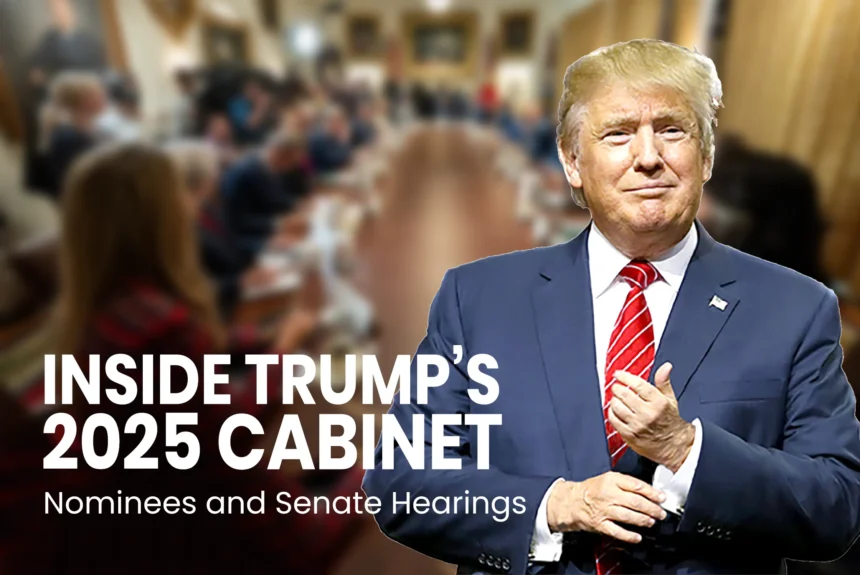
When Donald Trump returned to the White House in January 2025, his administration began assembling a Cabinet to lead federal departments responsible for foreign policy, national security, immigration, trade, energy, healthcare, education, labor, and the economy. The Trump cabinet nominees faced Senate confirmation hearings that gave lawmakers an opportunity to question them about their experience, qualifications, policy positions, and approach to their prospective roles. While some nominees secured broad bipartisan support, others faced intense scrutiny and closely divided confirmation votes.
How Cabinet Confirmation Works in the Senate
The U.S. Constitution gives the president the authority to nominate Cabinet secretaries and other senior executive officials, while the Senate provides advice and consent on those appointments. The process generally involves a hearing before the Senate committee with jurisdiction over the relevant department. Senators question the nominee, after which the committee can consider the nomination before it moves to the full Senate.
The 2025 confirmation process attracted considerable attention because many of Trump’s nominees were expected to play important roles in advancing his administration’s priorities. Their hearings covered a broad range of issues relevant to the departments they were nominated to lead.
The Senate confirmation votes also varied significantly. Marco Rubio was confirmed as Secretary of State by a 99-0 vote, while Pete Hegseth was confirmed as Secretary of Defense by a 51-50 vote, with Vice President JD Vance casting the tie-breaking vote.
Marco Rubio’s Path to Secretary of State
Marco Rubio was Trump’s nominee for Secretary of State and was among the first Cabinet nominees to complete the confirmation process.
The Senate Foreign Relations Committee held Rubio’s confirmation hearing on January 15, 2025. The hearing provided senators with an opportunity to question him about his views on U.S. foreign policy and the responsibilities of the State Department.
Rubio’s previous experience as a U.S. senator and his involvement in foreign policy made him a prominent figure during the confirmation process. The Senate confirmed him on January 20 by a 99-0 vote, giving him overwhelming bipartisan support.
The State Department’s leadership can have implications for businesses with international operations. Diplomatic relationships, sanctions, trade policy, and geopolitical developments can influence multinational companies, financial institutions, technology businesses, manufacturers, and energy companies.
Pete Hegseth’s Closely Contested Defense Nomination
Pete Hegseth’s nomination to become Secretary of Defense was among the most closely contested Cabinet confirmations of Trump’s second administration.
The Senate Armed Services Committee held his confirmation hearing on January 14, 2025. Senators questioned Hegseth about his qualifications and experience for leading the Department of Defense, as well as matters concerning his record and views on military leadership.
The nomination attracted significant attention during the confirmation process. The Senate ultimately confirmed Hegseth on January 24 by a 51-50 vote, with Vice President JD Vance casting the deciding vote.
The narrow vote highlighted the division surrounding his nomination. The Defense Department also has a major role in the U.S. economy through federal procurement and research. Its priorities can affect defense contractors, aerospace companies, cybersecurity providers, artificial intelligence developers, and advanced technology businesses.
For example, companies developing autonomous systems, military communications, cybersecurity solutions, and other defense technologies may monitor changes in Pentagon priorities because federal contracts and research programs can influence their business strategies.
Robert F. Kennedy Jr. and a Closely Watched HHS Confirmation
Robert F. Kennedy Jr.’s nomination to lead the Department of Health and Human Services drew substantial attention during the 2025 confirmation process.
Kennedy appeared before the Senate Finance Committee for his confirmation hearing on January 29. He also appeared before the Senate Health, Education, Labor, and Pensions Committee on January 30. The hearings gave senators opportunities to question him about healthcare and public health issues, including his views on vaccines and other controversial positions he had previously expressed.
The HHS secretary leads a department responsible for major federal healthcare programs and agencies, including the Food and Drug Administration, the Centers for Disease Control and Prevention, and the Centers for Medicare & Medicaid Services.
Kennedy was confirmed on February 13 by a 52-48 vote.
The confirmation was closely followed by the healthcare sector. HHS policies can affect pharmaceutical companies, hospitals, biotechnology firms, insurers, medical device manufacturers, and healthcare technology businesses.
Changes in federal healthcare priorities may influence regulatory compliance, research funding, reimbursement policies, and product development, making HHS leadership relevant to businesses across the healthcare ecosystem.
Scott Bessent and the Treasury Department
Scott Bessent was nominated as Secretary of the Treasury, placing him in charge of one of the federal government’s most important economic departments.
The Senate Finance Committee held his confirmation hearing on January 16, 2025. The hearing gave senators an opportunity to question Bessent about his experience and views on economic and financial policy.
The Senate confirmed him on January 27 by a 68-29 vote.
The Treasury Department’s responsibilities make its leadership important to financial institutions, investors, multinational companies, and businesses involved in international commerce.
For example, companies with global supply chains may monitor trade and tariff developments, while financial institutions follow Treasury policies involving sanctions and international financial measures.
Howard Lutnick and the Commerce Department
Howard Lutnick was nominated as Secretary of Commerce, a position with responsibilities spanning trade, economic development, technology, and business-related policy.
The Senate Commerce, Science, and Transportation Committee held his confirmation hearing on January 29, 2025. The hearing gave senators an opportunity to question Lutnick about his experience and views relevant to the Commerce Department and the administration’s economic priorities.
Lutnick was confirmed on February 18 by a 51-45 vote.
The Commerce Department is particularly relevant to technology and manufacturing companies. Businesses involved in semiconductors, telecommunications, advanced manufacturing, and artificial intelligence may follow federal trade and technology policies closely.
For instance, semiconductor manufacturers can be affected by international technology policies and supply-chain developments, while manufacturers may monitor tariffs and other trade measures that influence production costs.
Doug Burgum and Chris Wright Bring Energy Policy into Focus
Energy was another important area of Trump’s Cabinet appointments.
Doug Burgum was nominated as Secretary of the Interior. The Senate Energy and Natural Resources Committee held his confirmation hearing on January 16, 2025. The Senate confirmed him on January 30 by an 80-17 vote.
Chris Wright was nominated as Secretary of Energy. His confirmation hearing before the Senate Energy and Natural Resources Committee took place on January 15. The Senate confirmed him on February 3 by a 59-38 vote.
The two departments have distinct responsibilities, but both are important to U.S. energy and natural-resource policy.
The Interior Department oversees federal lands and natural resources, while the Energy Department handles a range of responsibilities involving energy programs, research, and nuclear security.
Their leadership can therefore be relevant to oil and gas producers, renewable energy developers, utilities, nuclear energy companies, battery businesses, and clean technology firms.
Kristi Noem and the Department of Homeland Security
Kristi Noem was nominated as Secretary of Homeland Security, a position responsible for a broad range of national security functions.
The Senate Homeland Security and Governmental Affairs Committee held her confirmation hearing on January 17, 2025. The Senate confirmed Noem on January 25 by a 59-34 vote.
The Department of Homeland Security has responsibilities that include border security, immigration enforcement, cybersecurity, emergency management, and protection of critical infrastructure.
These areas have implications for businesses as well. Cybersecurity companies and organizations operating critical infrastructure may follow DHS policies, while industries such as agriculture, construction, hospitality, and food processing can be affected by changes in immigration policy and enforcement.
Sean Duffy and Transportation Policy
Sean Duffy was nominated as Secretary of Transportation and appeared before the Senate Commerce, Science, and Transportation Committee for his confirmation hearing on January 15, 2025.
The Senate confirmed Duffy on January 28 by a 77-22 vote.
The Department of Transportation oversees policies affecting aviation, highways, railways, trucking, and other parts of the nation’s transportation system.
Its decisions can therefore have consequences for airlines, logistics providers, automobile manufacturers, rail operators, infrastructure companies, and businesses that depend on the movement of goods.
Other Notable Cabinet Nominees
Several other nominees also completed Senate hearings and confirmation votes during the first months of Trump’s second administration.
- Pam Bondi, nominated as Attorney General, appeared before the Senate Judiciary Committee on January 15 and 16. The Senate confirmed her on February 4 by a 54-46 vote.
- Doug Collins, nominated as Secretary of Veterans Affairs, appeared before the Senate Committee on Veterans’ Affairs on January 21. He was confirmed on February 4 by a 77-23 vote.
- Brooke Rollins, nominated as Secretary of Agriculture, appeared before the Senate Agriculture, Nutrition, and Forestry Committee on January 23. She was confirmed on February 13 by a 72-28 vote.
- Eric Scott Turner, nominated as Secretary of Housing and Urban Development, appeared before the Senate Banking, Housing, and Urban Affairs Committee on January 16. He was confirmed on February 5 by a 55-44 vote.
- Linda McMahon, nominated as Secretary of Education, appeared before the Senate Health, Education, Labor, and Pensions Committee on February 13. She was confirmed on March 3 by a 51-45 vote.
- Lori Chavez-DeRemer, nominated as Secretary of Labor, appeared before the Senate Health, Education, Labor, and Pensions Committee on February 19. She was confirmed on March 10 by a 67-32 vote.
Together, these nominations covered departments with significant influence over agriculture, housing, education, labor, veterans’ services, and federal law enforcement.
What the Senate Hearings and Votes Revealed
The 2025 Cabinet confirmation cycle demonstrated that Trump’s nominees did not receive uniform levels of Senate support. The outcome varied according to each nominee’s background, policy positions, and political standing.
Rubio’s 99-0 confirmation showed overwhelming bipartisan support. Burgum’s 80-17 and Duffy’s 77-22 votes also reflected substantial support from senators across party lines.
Other nominations were more closely divided. Hegseth’s 51-50 confirmation was decided by the vice president’s tie-breaking vote, while Kennedy’s 52-48 and McMahon’s 51-45 votes demonstrated the level of opposition faced by some nominees.
The hearings served an important oversight function by allowing senators to publicly question nominees before they took charge of major federal departments.
Why Trump’s Cabinet Matters to Industry
The importance of Trump’s Cabinet extends beyond the political process.
- Technology: Commerce, Defense, and Energy policies can influence semiconductors, artificial intelligence, cybersecurity, and advanced technology.
- Healthcare: HHS leadership can affect pharmaceutical companies, hospitals, biotechnology firms, insurers, and medical device manufacturers.
- Energy: Interior and Energy policies can influence oil and gas production, renewable energy, nuclear power, and emerging energy technologies.
- Manufacturing: Treasury and Commerce policies can affect tariffs, supply chains, imports, exports, and domestic production.
- Transportation: Transportation Department policies can affect airlines, logistics providers, automobile manufacturers, rail operators, and infrastructure companies.
- Agriculture: Agriculture Department policies can influence farmers, food producers, commodity markets, and agricultural technology businesses.
These are potential industry implications of the departments involved, rather than claims about specific discussions during the Senate hearings. The Cabinet officials leading these agencies can influence the regulatory and policy environment in which businesses operate.
The Road Ahead for Trump’s Cabinet
Trump’s 2025 Cabinet confirmation cycle established the leadership of key federal departments while giving the Senate an opportunity to examine the president’s selections.
The hearings brought public attention to nominees with different backgrounds and policy perspectives, while the confirmation votes showed a wide range of Senate support. Some nominees secured overwhelming bipartisan backing, while others faced significant opposition and narrow victories.
The process also highlighted the Senate’s constitutional role in reviewing presidential appointments. For businesses, investors, and industry leaders, the hearings offered an early look at the people responsible for implementing policies that could affect regulation, government spending, trade, energy, healthcare, technology, and national security.
Ultimately, the Senate confirmation process for cabinet nominees remains a central part of the U.S. system of checks and balances, requiring presidential selections for major executive departments to undergo public scrutiny and receive Senate approval before taking office.
FAQs
- Who were some of Trump’s key Cabinet nominees in 2025?
Key nominees included Marco Rubio for Secretary of State, Pete Hegseth for Secretary of Defense, Robert F. Kennedy Jr. for Secretary of Health and Human Services, Scott Bessent for Treasury Secretary, Howard Lutnick for Commerce Secretary, and Doug Burgum for Interior Secretary. - What is the role of the Senate in Cabinet appointments?
The Senate provides advice and consent on presidential Cabinet nominations. Nominees typically appear before relevant Senate committees for confirmation hearings before the full Senate votes on their appointments. - Which Trump Cabinet nominee received the most bipartisan support?
Marco Rubio received one of the strongest bipartisan confirmations, with the Senate approving his nomination as Secretary of State by a 99-0 vote. - Which Cabinet confirmation was decided by the narrowest vote?
Pete Hegseth’s nomination for Secretary of Defense was confirmed by a 51-50 vote, with Vice President JD Vance casting the tie-breaking vote. - Why are Senate confirmation hearings important?
Confirmation hearings allow senators to question nominees about their qualifications, experience, policy views, and plans for leading federal departments before deciding whether to approve their nominations. - How can Cabinet appointments affect businesses and industries?
Cabinet officials oversee departments that influence policies affecting industries such as technology, healthcare, energy, manufacturing, transportation, agriculture, and financial services. - How did Trump’s Cabinet nominees perform in Senate confirmation votes?
The results varied considerably. Some nominees received strong bipartisan support, while others faced closely divided votes, reflecting differences in their backgrounds, policy positions, and levels of political support.
The CEO Views is a global business media platform dedicated to discovering and showcasing the companies, brands, and leaders shaping the future of business. Through thought-provoking leadership profiles, company spotlights, industry perspectives, and technology-focused content, it provides a platform for innovators and changemakers to share their journeys, ideas, and achievements. By bringing remarkable stories to a wider professional audience, The CEO Views aims to celebrate business excellence and spotlight the visionaries driving meaningful progress across industries.