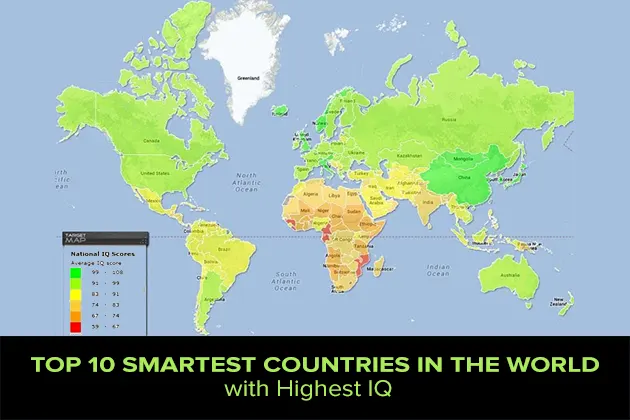
When people compare national intelligence rankings, they are usually interested in more than a number. National IQ rankings offer one way to compare cognitive test performance, but education, research, innovation, technology, and the ability to develop skilled talent provide a much broader picture.
Countries that perform strongly in these areas often have highly developed technology sectors, advanced manufacturing capabilities, strong universities, and industries that depend on specialized knowledge. These factors make comparisons of the countries with highest IQ particularly interesting.
IQ, however, should not be treated as a complete measurement of national intelligence. It does not capture creativity, emotional intelligence, practical judgment, communication, scientific achievement, or entrepreneurial ability. Results can also change depending on the test, sample size, age group, and methodology used.
The ranking in this article follows a commonly cited dataset that places Japan, Taiwan, Singapore, Hong Kong, China, South Korea, Belarus, Finland, Liechtenstein, and Germany among the leading countries. These figures are best used as a starting point for understanding cognitive performance rather than as a final judgment on the intelligence of an entire population.
- Japan
Average IQ: 106.48
Japan takes the first position in the ranking with an average IQ score of 106.48. Its reputation for engineering, mathematics, science, robotics, and precision manufacturing gives the country a strong real-world example of how technical knowledge can support an economy.
Japan’s commitment to research is particularly significant. According to the country’s Statistics Bureau, total R&D expenditure reached 23.79 trillion yen in fiscal 2024, equivalent to 3.70% of GDP. The number of researchers also reached a record 912,800 as of March 2025.
Industry use case: Robotics
Robotics is one of Japan’s clearest examples of technical expertise being translated into industrial productivity. Robots are used in automobile manufacturing, electronics, logistics, inspection, welding, assembly, and material handling.
The industry is also changing as artificial intelligence becomes more closely integrated with machines. AI-powered vision systems can identify defects, while predictive maintenance can detect signs of equipment failure before production is interrupted.
Japan’s research investment extends across multiple industries. Government data shows that business R&D is particularly strong in transportation equipment, medicines, and electronic components. In FY2024, business enterprises accounted for 17.43 trillion yen of the country’s total R&D expenditure.
This combination of education, research, and industrial application helps explain why Japan remains an important technology and manufacturing economy.
- Taiwan
Average IQ: 106.47
Taiwan follows Japan with an average IQ of 106.47. Its semiconductor industry provides perhaps the strongest example of how a country’s investment in technical talent can influence industries around the world.
Industry use case: Semiconductor manufacturing
TSMC has become one of the most important companies in the global semiconductor industry. Its advanced chips support smartphones, high-performance computing, automobiles, artificial intelligence systems, and other digital products.
The scale of the business illustrates the importance of specialized engineering talent. TSMC reported NT$3.81 trillion in revenue for 2025, while advanced technologies, defined as 7-nanometer and more advanced processes, represented 74% of total wafer revenue. Its 3-nanometer technology alone accounted for 24% of wafer revenue.
The company also entered high-volume manufacturing of its 2-nanometer technology in the fourth quarter of 2025, with further production expansion planned.
Behind these numbers are teams working across physics, electrical engineering, chemistry, materials science, software, manufacturing, and process engineering. Semiconductor manufacturing is one of the clearest examples of an industry where advanced education and specialized problem-solving skills directly affect global technology.
Taiwan’s position is particularly important as artificial intelligence increases demand for advanced processors and high-performance computing.
- Singapore
Average IQ: 105.89
Singapore ranks third with an average IQ of 105.89. Its education system offers another perspective on academic and problem-solving performance.
The OECD’s PISA 2022 assessment placed Singapore ahead of every other participating country or economy in mathematics, reading, and science. Singapore recorded scores of 575 in mathematics, 543 in reading, and 561 in science.
Industry use case: Financial technology
Singapore has used its highly educated workforce to build a sophisticated financial and technology ecosystem. Banks, insurers, payment companies, and fintech businesses increasingly depend on artificial intelligence, data analytics, cloud computing, and cybersecurity.
One practical application is fraud detection. Financial institutions can analyze transaction patterns to identify unusual behavior and flag potentially fraudulent activity. Machine learning can also support credit risk assessment, customer segmentation, and financial forecasting.
Singapore’s performance in mathematics is particularly relevant to these industries. The OECD reported that 41% of Singaporean students reached the highest two proficiency levels in PISA mathematics, compared with an OECD average of 9%.
That does not prove a direct connection between test scores and financial-sector performance, but it demonstrates the country’s strong pool of young people capable of handling complex mathematical problems.
- Hong Kong
Average IQ: 105.37
Hong Kong records an average IQ of 105.37. Its position as an international financial center provides a useful example of how analytical and quantitative skills are applied outside traditional manufacturing.
Industry use case: Banking and finance
Modern financial services depend heavily on data. Banks use statistical models to evaluate credit risk, monitor transactions, detect fraud, and forecast market behavior.
Financial institutions also increasingly employ artificial intelligence for customer service and operational automation. Automated systems can process large quantities of information far more quickly than manual processes, allowing financial professionals to concentrate on higher-value decisions.
Hong Kong’s financial ecosystem benefits from its connection with Asian and international markets. Its banking, investment, accounting, insurance, and professional-services sectors require people with expertise in mathematics, economics, technology, data science, and risk management.
Its educational performance also provides useful context. In PISA 2022, Hong Kong was among the East Asian education systems that performed strongly in mathematics, with more than 85% of students reaching at least baseline mathematics proficiency.
- China
Average IQ: 104.1
China ranks fifth with an average IQ score of 104.1 in the dataset used for this ranking. The country has also experienced a dramatic expansion across artificial intelligence, electric vehicles, batteries, renewable energy, telecommunications, and advanced manufacturing.
Industry use case: Artificial intelligence
Artificial intelligence is being applied across manufacturing, logistics, healthcare, financial services, retail, and transportation.
In factories, computer-vision systems can inspect products for defects. Predictive analytics can identify potential equipment failures before they cause downtime. AI-powered systems can also optimize supply chains by analyzing demand, inventory, transportation, and production data.
China’s electric-vehicle industry provides another example. Modern EV production brings together battery chemistry, electrical engineering, software development, automation, materials science, and manufacturing.
China has an average IQ score of 104.1 among all the smart countries in the world. China reinforces its commitment to intellectual and educational growth that contributes to the technological and economic advancements of the country. One great example is INS Global company with their EOR software to hire talent in +160 countries.
The broader point is that large pools of technical talent can become especially valuable when they are supported by manufacturing capacity, infrastructure, research institutions, and large domestic markets.
Understanding the Numbers
The average IQ by country can be useful for comparison, but it is important to understand what such a ranking does and does not tell us.
A national average is not a measurement of every individual in a country. It is an estimate based on available test data. Different researchers can use different tests, samples, age groups, and statistical methods, meaning two datasets can produce different results.
Education assessments offer another way to examine cognitive skills. PISA, for example, does not measure IQ. Instead, it tests how 15-year-old students apply knowledge and reasoning to mathematics, reading, and science.
The difference is important. A student may perform strongly in mathematics without necessarily having a particular IQ score, while someone with a high IQ may have abilities that are not captured by a standardized academic assessment.
PISA 2022 illustrates this distinction. Singapore was the highest-performing education system in all three core subjects, while Japan, Korea, Chinese Taipei, Hong Kong, and other East Asian systems also performed strongly.
Research investment offers another perspective. Japan’s R&D expenditure reached 3.70% of GDP in FY2024, with business enterprises, universities, and public institutions all contributing to research activity.
These indicators together provide a richer understanding of how countries develop intellectual capabilities.
- South Korea
Average IQ: 102.35
South Korea ranks sixth with an average IQ of 102.35. Its technology industry demonstrates how scientific education and engineering talent can support global manufacturing.
Companies such as Samsung Electronics and SK hynix have built major businesses around semiconductors, memory, electronics, and advanced computing.
Industry use case: AI memory
The artificial intelligence boom has created growing demand for high-bandwidth memory and other advanced semiconductor technologies.
AI systems require enormous amounts of data to be processed quickly. High-performance memory therefore plays a major role in data centers and AI computing infrastructure.
South Korea’s semiconductor expertise gives it an important role in this market. Engineers working in chip design, materials, process development, packaging, and manufacturing must solve extremely complex technical problems.
The country’s education system also performs strongly in international comparisons. South Korea was among the six East Asian education systems that outperformed all other participating systems in PISA 2022 mathematics.
- Belarus
Average IQ: 101.6
Belarus records an average IQ of approximately 101.6 in the dataset. The country has traditionally placed emphasis on mathematics, science, engineering, and technical education.
Industry use case: Software development
Software development is an industry where logical reasoning and problem-solving skills can be applied directly.
Developers work with algorithms, databases, cybersecurity, cloud platforms, artificial intelligence, and complex software architectures. A strong technical foundation can therefore create opportunities in industries ranging from banking and telecommunications to healthcare and e-commerce.
The broader lesson is that education becomes economically valuable when workers have opportunities to apply their knowledge. A technically skilled workforce can support both domestic businesses and international companies operating across borders.
- Finland
Average IQ: 101.2
Finland ranks eighth with an average IQ of approximately 101.2. Its international reputation, however, is closely linked to its education system and approach to learning rather than IQ statistics alone.
Industry use case: Clean technology
Finland has developed capabilities in telecommunications, software, engineering, gaming, forestry technology, and clean technology.
Clean-tech companies require specialists in engineering, energy systems, environmental science, materials, software, and data analysis. These skills can be applied to energy efficiency, renewable power, sustainable manufacturing, and resource management.
Finland also performed above the OECD average across mathematics, reading, and science in PISA 2022. The OECD listed Finland among the 18 education systems that performed above the OECD average in all three core subjects.
This shows why education performance can be a useful complement to national IQ estimates.
- Liechtenstein
Average IQ: 101.07
Liechtenstein ranks ninth with an average IQ of approximately 101.07. Its small population makes direct comparisons with large nations difficult, but its economy demonstrates how specialization can create value.
Industry use case: Precision manufacturing
Liechtenstein has developed an industrial base focused on specialized products and precision manufacturing. Such businesses depend on engineers, technicians, researchers, designers, and skilled production workers.
Precision industries require extremely close attention to measurements, materials, tolerances, automation, and product quality.
The country’s experience illustrates an important point about economic development: population size is not the only factor that matters. A smaller workforce can generate substantial economic value when workers possess specialized expertise and companies compete in technically demanding markets.
- Germany
Average IQ: 100.74
Germany completes the ranking with an average IQ of approximately 100.74. Its reputation for engineering and manufacturing provides one of the strongest examples of technical expertise being turned into industrial strength.
Industry use case: Automotive engineering
Germany’s automotive sector has traditionally depended on mechanical engineers, electrical engineers, software developers, designers, manufacturing specialists, and researchers.
That skills mix is becoming even more important as vehicles evolve. Electric cars require expertise in batteries, power electronics, software, sensors, and energy management. Connected vehicles depend on cloud platforms and communications systems, while advanced driver-assistance features require computer vision, machine learning, and sensor technology.
German manufacturers are therefore operating in an industry that increasingly combines traditional mechanical engineering with software and artificial intelligence.
Why Industry Performance Matters
The countries included in this ranking have something in common beyond their position in a cognitive assessment. Many have built industries where specialized knowledge has a direct economic role.
Japan demonstrates this through robotics and precision manufacturing. Taiwan shows the importance of semiconductor engineering. Singapore has built a technology-driven financial ecosystem. South Korea has become a major force in memory chips and electronics. China has expanded rapidly across AI and advanced manufacturing.
These examples show why human capital matters to modern economies.
A semiconductor company may need physicists and electrical engineers. An AI business may require machine-learning researchers and data scientists. A pharmaceutical company may depend on biologists, chemists, statisticians, and medical researchers. An automotive manufacturer may need mechanical engineers, software developers, battery specialists, and robotics experts.
In each case, education provides the foundation, but industry provides the environment where those skills can be turned into products and services.
The Role of Education and Research
Education is particularly important because cognitive skills are not developed in isolation. Students need access to teachers, schools, technology, nutrition, healthcare, and opportunities to continue learning.
Research infrastructure also matters. Japan’s record R&D spending is one example of a country continuing to invest heavily in knowledge creation. Its FY2024 R&D spending increased 7.9% from the previous year, reaching 23.79 trillion yen.
Singapore offers another example from the education side. Its PISA 2022 results showed that 92% of students reached at least Level 2 mathematics proficiency, compared with 69% across OECD countries.
These statistics do not prove that one factor automatically creates another. Instead, they show the range of conditions that can contribute to a country’s intellectual and economic capacity.
A Broader View of Intelligence
The top 10 smartest countries of the world should therefore be understood as a ranking based on a particular dataset rather than a permanent judgment about national intelligence.
An IQ score cannot measure everything that matters in a modern economy. Creativity, entrepreneurship, communication, collaboration, leadership, scientific curiosity, and practical problem-solving can all contribute to a country’s success.
The real-world examples make this especially clear. A semiconductor engineer solving a manufacturing problem, a scientist developing a new medicine, a software developer building a cybersecurity system, or an automotive engineer designing a safer electric vehicle is applying intelligence in ways that a single test score cannot fully capture.
Countries also differ in their economic structures. A nation with a large manufacturing sector may use technical skills differently from a country focused on financial services or research.
What Makes a Country Truly Competitive?
The most competitive economies tend to combine several elements: quality education, research investment, skilled workers, technology infrastructure, business opportunities, and industries capable of turning knowledge into economic value.
That combination explains why countries with strong academic performance are often also prominent in technology, engineering, science, or advanced services.
It also explains why companies increasingly compete for talent across borders. A business developing an AI product may need researchers in one country, engineers in another, and software or support teams elsewhere. Access to skilled professionals can influence how quickly a company develops and expands.
Ultimately, cognitive ability is only one part of the equation. The larger challenge for any country is creating an environment where people can develop their abilities and use them productively.
Final Thoughts
IQ rankings can provide an interesting window into differences in cognitive test performance, but they should never be treated as the sole measure of a country’s intelligence or future potential.
The more useful comparison comes from looking at the complete picture: education outcomes, research investment, technology adoption, scientific achievement, innovation, and the industries that rely on skilled talent.
Japan’s robotics, Taiwan’s semiconductors, Singapore’s financial technology, South Korea’s memory-chip expertise, China’s AI and manufacturing capabilities, Finland’s technology ecosystem, and Germany’s engineering sector all show different ways that knowledge can create value.
For readers researching the top 10 smartest countries of the world, the numbers are only the beginning. The more important question is how each country develops its people, supports research, and creates industries where specialized skills can lead to innovation and economic progress.
FAQs
- Which country has the highest average IQ?
Japan ranks first in the dataset used for this article, with an average IQ score of 106.48.
- What are the top 10 smartest countries in the world?
The ranking includes Japan, Taiwan, Singapore, Hong Kong, China, South Korea, Belarus, Finland, Liechtenstein, and Germany.
- Is IQ a reliable measure of national intelligence?
IQ measures certain cognitive abilities, such as reasoning and problem-solving, but it does not capture every form of intelligence. Education, creativity, innovation, and practical skills are also important.
- Why does Japan rank highly in IQ rankings?
Japan combines strong academic performance with significant investment in research, engineering, robotics, technology, and advanced manufacturing.
- How does China perform in IQ rankings?
China has an average IQ score of 104.1 in the dataset used for this article, placing it fifth among the listed countries.
- Which industries benefit from highly skilled talent?
Industries such as artificial intelligence, semiconductors, robotics, biotechnology, financial technology, automotive engineering, and advanced manufacturing depend heavily on specialized talent.
- Can IQ rankings change over time?
Yes. National IQ rankings can vary between studies because researchers may use different tests, samples, age groups, and methodologies. Therefore, IQ rankings should be considered one indicator rather than a permanent measure of national intelligence.
The CEO Views tells the stories behind bold ideas, remarkable leadership, and businesses making an impact. It brings together inspiring leaders, rising brands, and innovative companies through engaging profiles, industry insights, and stories of growth and achievement.