A new wave of industrial innovation is sweeping across global manufacturing floors, changing the rules of traditional production. Human-machine collaboration now stands at the centre of this transformation, indicating the rise of safer, smarter, and more adaptive industrial systems. This collaboration is emerging as the new rhythm of production, blending the precision of automation with the adaptability of human intelligence.
Modern-day factories are no longer dominated by rigid machines performing repetitive tasks in isolation. Instead, flexible automation frameworks powered by AI, data analytics, and robotics are enabling companies to scale operations faster and with greater precision. As factories evolve into intelligent ecosystems, automation is redefining how industries work, innovate, and compete on the global stage.
This article delves deep into the responsible adoption of automation across industries, with special focus on the safety-first automation approach being the foundation of this responsible industrial practice.
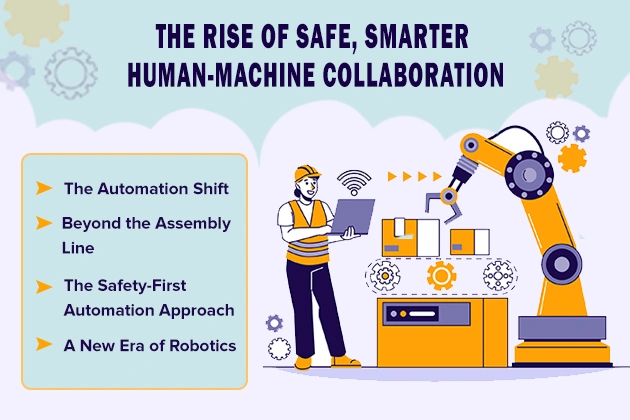
The Automation Shift: Where Efficiency Meets Safety in Modern Industry
Industries are rapidly modernizing across sectors. According to the International Federation of Robotics (IFR), global industrial robot installations surpassed 590,000 units in 2023, marking the strongest growth the industry has ever recorded. This surge isn’t just about accelerating manufacturing—it’s about eliminating inefficiencies that have historically slowed production lines.
Companies are now leveraging automated systems to optimize workflows, cut downtime, and boost throughput, while simultaneously enabling human workers to focus on oversight, problem-solving, and innovation. But the rise of automation isn’t driven by efficiency alone. A new priority has taken center stage: safety. The shift toward safety-first automation is equally important.
Smart sensors, predictive monitoring tools, and collaborative robots are reducing on-site hazards with unprecedented accuracy. Industries are embedding real-time monitoring, fail-safe systems, and AI-driven hazard detection to protect workers from accidents and high-risk tasks. According to the Occupational Safety and Health Administration (OSHA), automated systems have helped reduce injury rates in high-risk environments by minimizing human exposure to repetitive strain, heavy lifting, and hazardous machinery, especially in sectors like automotive and electronics manufacturing.
What makes this era groundbreaking is not just automation, but the philosophy behind it. It’s a shift toward “automation with empathy”—designing systems that amplify human capability while building safer, more resilient industrial environments.
Beyond the Assembly Line: How Smart Automation Is Rebuilding Industry
A McKinsey research suggests that automation could raise global productivity growth by 0.8% to 1.4% annually, creating massive efficiency gains across manufacturing, logistics, and energy sectors. And these gains aren’t coming at the cost of workers—they’re enhancing human roles, not replacing them. Cobots work alongside teams to improve accuracy, reduce fatigue, and support advanced problem-solving at every stage of production.
This new era of automation is about balance: blending human insight with machine intelligence to create production systems that are not just faster, but safer and smarter. As companies compete in an increasingly digital industry landscape, the real winners will be the ones who integrate automation in ways that elevate workers, strengthen operational resilience, and unlock unprecedented levels of innovation.
A 2024 Deloitte report shows that 74% of manufacturing executives plan to expand automation investments to streamline critical processes, reduce operational costs, and improve overall equipment effectiveness. From automated quality inspections to robotics-powered warehousing, automation is reshaping workflows that once depended solely on manual labor.
This evolution of automation represents more than technological change; it signifies a cultural shift toward smarter, more sustainable industrial growth. By combining automation with human expertise, industries are creating ecosystems that are resilient, agile, and prepared for the challenges of tomorrow. The future of industry is not just automated; it is intelligently collaborative.
With the safety-first automation adoption across industries, smart robotic systems blend with adaptive safety mechanisms. This allows humans and machines to operate in shared spaces without compromising well-being. The result is a work environment where workers face fewer hazards and can focus on supervisory, analytical, and creative responsibilities that machines cannot replicate.
The Safety-First Automation Approach: A Foundation of Responsible Automation
Since the introduction of robotics in the industrial realm, safety has become the topmost priority for robotic automation developers. Among all the Three Laws of Robotics by Isaac Asimov, industries have made the “do no harm” approach mandatory with the strength and speed of today’s industrial robots, widely used for heavy lifting on automotive assembly lines and other industrial manufacturing sites.
However, with the advent of cobots, the rules of robotics are being rewritten with new specifications, updating the way these lower-payload, smaller, and slower-speed robots can be included within the assembly lines to work alongside workers.
The technical specification of ISO/TS 15066 provides new guidelines for design and implementation practices for new cobots to automation developers and users. The 15066 specification and ISO’s standard describe guidelines related to the use of collaborative robot models spanning four key areas, including hand-guiding, power and force limiting, including safety-monitored stops, and speed and separation monitoring.
The use of artificial intelligence (AI), machine learning (ML), sensors, IT, and wireless communication has become an integral part of industrial automation and Industry 4.0. With this growing development of digital transformation, ensuring that the robotics, machinery, and vehicles are safe for workers has become even more challenging. According to the Market Research Future report, the functional safety market is expected to grow from $14.4 billion in 2024 to $22 billion by 2032. This increases the need for safety requirements and regulatory scrutiny.
Functional safety requires building and designing in the proper automatic protection and safety functions. By embracing a multi-faceted approach of integrating hardware, operations, and software, industries ensure a safety-first adoption of automation. Leveraging model-based design methodologies and advanced simulation tools empowers teams to rapidly prototype and validate safety-critical systems, significantly streamlining development and accelerating product launch.
With cutting-edge advances in embedded systems, AI-driven algorithms, and robust cybersecurity protocols, today’s safety-critical solutions achieve unprecedented levels of sophistication and resilience against cyberthreats and external disruptions. However, these innovations also introduce new layers of complexity, making rigorous functional safety practices more essential than ever—especially as software becomes more autonomous and reliant on advanced technology.
A New Era of Robotics: The Assembly Robots
The competitive landscape of global production has escalated the adoption of automation across industries. With autonomous robots in assembly, industries are stepping into a new era of robotics in production. A report by Insight Partners shows that the autonomous mobile robots market is estimated to reach $8.73 billion by 2030, growing at a CAGR of 25.7% from 2022 to 2030.
Autonomous robots perform tasks without constant human control by using AI, sensors, and decision-making systems to adapt in real time. Robot manipulators streamline the assembly processes with precision in manufacturing companies. One of the most repetitive, frequent, and demanding tasks in manufacturing is assembly. It involves putting different parts together to finish a product. Modern industries are aiming to automate their assembly lines to ensure efficiency in industrial production.
With robotics assembly operations, manufacturers could easily adapt to changes in the product design and assembly process. It also eliminates the need to transport parts from one place to another, reducing downtime and optimizing production time. Autonomous robots are equipped with advanced sensors and navigation systems to operate safely in workers’ environments. Most crucially, these robots may demand initial investment, but in the long run, they significantly reduce operating costs and increase manufacturing productivity.
At The CEO Views, we deliver the most up-to-date insights into the technologies and trends transforming business operations across every industry. From manufacturing to finance and beyond, our comprehensive coverage keeps you informed about the developments shaping your sector. Our meticulously researched articles and thoughtfully crafted blog posts are designed to empower you with the knowledge you need to make confident, forward-thinking business decisions.