

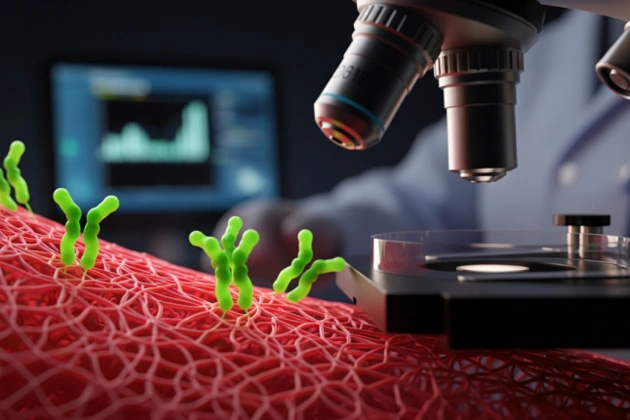
Smooth Muscle Actin (SMA) is a protein found in smooth muscle cells, which are responsible for the movement of blood vessels and the digestive tract. It plays a major role in muscle contraction, tissue repair, and maintaining the structure of the organs.
Issues like fibrosis and vascular disease arise due to the abnormal behavior of smooth muscle actin, disrupting the functioning and healing of the tissue. This makes it important for the researchers to study its function.
Researchers use various antibodies and special proteins that can identify other proteins to understand the role of specific proteins in various diseases and biological processes.
Read this post to learn how monoclonal antibodies help scientists understand SMA’s role in these conditions.
What Is Smooth Muscle Actin?
SMA is important for muscle contraction and maintaining tissue structure. It is used as a marker for the division of activated fibrogenic cells, myofibroblasts (important for wound healing and tissue remodeling), and cells involved in tissue repair and fibrosis.
Scientists need a reliable market like SMA to identify and study smooth muscle cells and myofibroblasts, and understand how they can be involved in disease and the healing process.
What Techniques Study Smooth Muscle Actin With Monoclonal Antibodies?
Monoclonal antibodies act as an effective tool in the study of smooth muscle actin (SMA) through various techniques:
- Western blotting (WB):
Monoclonal antibodies bind to SMA in a sample, which helps detect the amount of SMA protein present.
- Immunocytochemistry (ICC):
In this, SMA is stained in living cells growing in the lab under controlled conditions, allowing researchers to see protein location inside the cells.
- Immunohistochemistry (IHC):
This technique is used to visualize the SMA in a tissue sample, to help researchers determine where the protein is found in different types of tissues.
- Flow cytometry (FC/FACS):
This method evaluates the individual cells in a sample to identify which cell produces SMA, enabling researchers to analyse the cell population.
- Enzyme-linked immunosorbent assay (ELISA):
This kit measures the amount of SMA in a sample, providing researchers with a precise measurement.
Monoclonal antibodies enhance the accuracy of these techniques, ensuring an accurate analysis.
Applications Of Anti-Smooth Muscle Actin Monoclonal Antibodies
-
Muscle-related disease:
It helps in the study of smooth muscle cells, such as vascular disease (damage to blood vessel walls), fibrosis (scarring in tissues), and cancer (uncontrolled growth of cells).
-
Tissue Engineering:
It is used to study the cell behavior of smooth muscle cells in the lab-grown tissue.
-
Wound Healing:
It helps researchers understand how these cells contribute to the healing process and tissue repair.
-
Developmental Biology:
It is used to track the functioning of smooth muscle cells in various organs during growth.
-
Anti-ACTA2 Antibody In Research:
This anti-ACTA2 antibody is used to study smooth muscle cells in disease and body processes. It acts as a highlighter under a microscope, making the cells easy to examine in research.
Final Thought
Monoclonal antibodies play an essential role in research, helping scientists study protein function in different diseases. Antibodies like the anti-ACTA2 antibody are essential tools for this work.
If you are someone looking to purchase this antibody, make sure to buy it from a reliable source like AAA Bio to get the best results.