


A business can grow faster than its leadership structure. A CEO who once handled most important decisions may eventually find that finance, operations, product development, hiring, customer relationships, and expansion all demand attention at the same time. When every major issue still depends on one person, progress slows and opportunities can slip away.
The answer is not always to hire more executives. Sometimes the business needs clearer responsibilities, stronger coordination, or a different mix of experience at the top. Building an effective leadership team requires understanding what the company needs next, identifying the capabilities it lacks, and ensuring that its leaders can make decisions and work towards shared objectives. Knowing how to build a leadership team means creating a structure that supports current business performance while preparing the organisation for its next stage of growth.
1. Evaluate the Team Before Making New Appointments
A company facing delays or missed targets may assume it needs another senior executive. However, adding someone to the leadership team will not necessarily solve the problem. The existing executives may already have the right expertise but lack the authority to make decisions, or they may be working towards different priorities.
Consider a business preparing to enter a new market. The sales head may be ready to pursue new customers, while the finance team is concerned about investment costs and the operations head is unsure whether the existing infrastructure can support expansion. Hiring another executive will not resolve these differences. The CEO first needs to understand whether the problem lies in a skills gap, unclear decision-making authority, or a lack of coordination between departments.
Netflix offers a useful example of how leadership readiness and succession planning can be developed over time. Reed Hastings explained that the company had discussed succession for years. Ted Sarandos became co-CEO in 2020, while Greg Peters took on the COO role. In 2023, Peters became co-CEO alongside Sarandos, and Hastings moved to executive chairman. Their long working relationship and complementary experience helped prepare the transition. Netflix’s announcement shows why succession should be an ongoing process rather than a decision made only when a CEO is ready to leave.
Smaller businesses do not need to copy Netflix’s leadership structure, but they can follow the same principle of preparing people before expanding their responsibilities. A CEO can begin by assessing the existing leadership team across four areas: expertise, decision-making authority, collaboration, and readiness for broader responsibility. An executive may understand their function well but struggle to work across departments. Another may have the ability to take on a larger role but lack the authority to make important decisions. Someone else may need experience with budgets, strategy, or cross-department projects before moving into a senior position.
This assessment helps the CEO decide what the team actually needs. If the problem is a lack of expertise, hiring may be necessary. If capable executives are waiting for approval on every decision, responsibilities and authority need to change. If departments are working against each other, the priority should be improving collaboration and setting shared goals. Evaluating these differences before making new appointments helps businesses build a leadership team that can solve problems instead of adding another layer of management.
2. Choose a Structure That Fits the Business
There is no single executive team structure that works for every company. A growing technology business may need stronger product and engineering leadership, while a manufacturer may need closer coordination between operations, supply chain, and quality.
Apple follows a functional structure in which specialists lead their respective areas. Hardware experts lead hardware, software experts lead software, and design experts lead design. The company explains that decision-making authority sits with people who have deep knowledge of their functions. This allows expertise to guide decisions that affect the wider product. Apple’s explanation of how it works offers an example of how specialist leadership can support company-wide decisions.
Microsoft provides another example of specialization at scale. Its executive structure includes dedicated leadership for finance, people, commercial business, marketing, and corporate affairs. These roles allow different areas of a complex business to receive focused attention while remaining part of the wider executive team. Microsoft’s executive leadership illustrates how responsibilities can be divided without losing senior oversight.
Smaller businesses may not need a separate executive for every function. Some responsibilities can sit with one person until the workload and complexity justify a dedicated role.
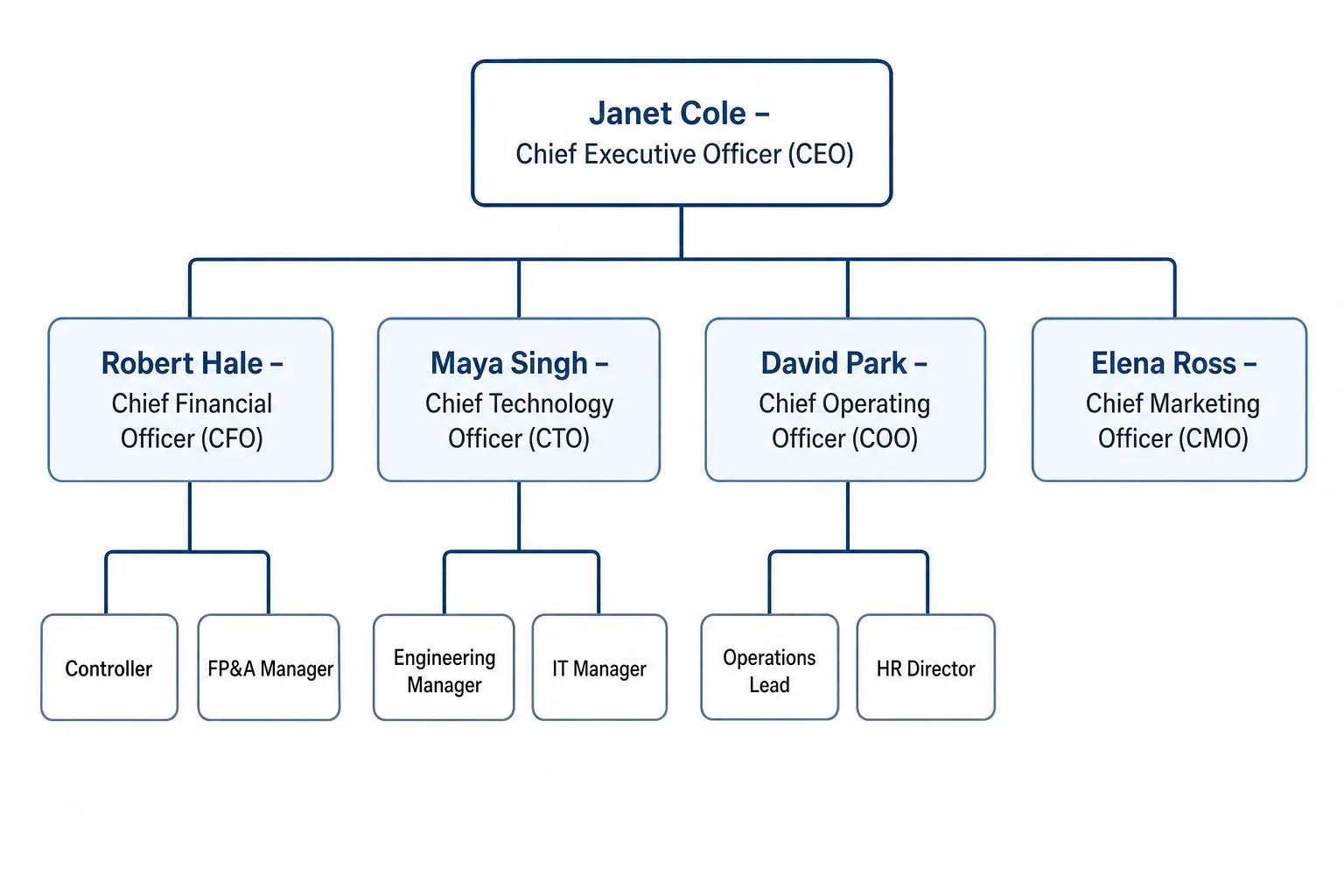
3. Give Each Executive Clear Responsibilities
A leadership title can look clear on an organizational chart but create confusion in practice. This often happens when two executives have influence over the same decision. When a company introduces a new product, for example, the technology team may focus on feasibility, finance on investment, and operations on production capacity. If nobody owns the final decision, discussions can continue while the project remains on hold.
Companies have addressed this challenge by defining leadership roles and decision-making responsibilities more clearly. Toyota, for example, has restructured its management system to separate management oversight and decision-making from operational execution, with the aim of speeding up decisions and bringing responsibility closer to the business and its customers. Toyota’s Integrated Report 2025 provides insight into its governance structure and management responsibilities. The lesson is that executives need authority that matches their responsibilities.
A company’s leadership team can establish similar clarity by defining who owns each decision and who contributes expertise before it is made.
|
Apple also offers a practical example of functional leadership. Its executive structure assigns responsibilities across software engineering, hardware, operations, finance, marketing and services. Apple’s official leadership structure shows how executives oversee specialized functions while contributing to broader company decisions. A technology decision, for instance, requires engineering input, but its financial implications and operational impact may need to be evaluated by other executives before the company commits.
For a growing business, the same principle applies without requiring a large executive team. The CEO should establish who can approve spending, who owns project delivery, which decisions can be made independently and what requires escalation. A CFO may approve expenses within an agreed budget, while a major investment or acquisition requires CEO or board approval.
Clear responsibilities do not prevent executives from working together. They prevent collaboration from turning into a situation where everyone participates but nobody is accountable. When ownership is established, decisions move faster, disagreements become easier to resolve and the CEO can assess performance based on the responsibilities each leader was actually expected to manage.
4. Make Accountability Part of Daily Operations
Some of the most difficult leadership problems emerge when a project involves several departments. A product launch, for example, may be delayed because the marketing team has prepared its campaign, but the operations department cannot confirm delivery dates. The sales team is waiting for product availability, while finance wants to understand the cost of the delay.
Each department may have completed its own work, yet the business has still failed to meet its target. This happens when executives measure success mainly through departmental performance rather than the final business outcome.
Toyota’s production system offers a practical example. When a worker identifies an abnormality, production can be stopped and a team leader is alerted. The issue must be addressed before work resumes. Toyota also emphasizes coordination between production processes and suppliers to keep operations moving. Toyota’s explanation of its production system shows how quality and operational responsibility extend beyond one department.
A leadership team needs a similar approach to shared problems. When a delay occurs, the executives involved should establish who will resolve it, what support is required from other departments, and when the issue must be addressed. Without this clarity, teams can spend more time explaining why something went wrong than finding a solution.
5. Encourage Debate Without Delaying Decisions
Not every disagreement among executives is a problem. Important business decisions often require opposing views. For example, during an acquisition, the sales team may see an opportunity to gain customers, while the CFO raises concerns about debt and the operations head questions how easily the businesses can be integrated.
Ignoring these concerns can expose the company to risks, but allowing discussions to continue indefinitely can delay important decisions and give competitors an advantage.
Amazon addresses this through its leadership principle, “Have Backbone; Disagree and Commit.” Leaders are expected to challenge decisions respectfully but support the final decision once it is made. Amazon’s Leadership Principles explain this approach.
This helps effective leadership teams consider different viewpoints without letting disagreements slow progress. CEOs should encourage executives to question assumptions, present evidence and highlight risks. Once a decision is reached, everyone must take responsibility for carrying it out. Disagreement should improve decisions, not become an excuse to avoid accountability.
6. Prepare Leaders for the Complexity of Growth
A leadership role changes as a company expands. Managing one location is different from overseeing several regions, markets, or business units. Executives must understand local needs while keeping company-wide priorities in view.
Walmart’s leadership structure reflects this complexity. Its executive team includes leaders for Walmart U.S., Walmart International, and Sam’s Club, alongside executives responsible for finance, technology, people, and growth. The company also has leadership teams for individual international markets. Walmart’s leadership structure shows why large, geographically distributed businesses need both central oversight and leaders who understand their own markets.
For a growing company, this may mean developing regional managers, strengthening operational leadership, or giving business-unit heads more authority. The right choice depends on where decisions are getting delayed and how much responsibility the central team can realistically manage.
7. Review Whether the Leadership Team Is Working
A leadership team may appear successful because every department is meeting its individual targets. Yet the wider business may still be struggling. Sales could be increasing while customer complaints rise, or the company could be expanding into new markets without having enough operational support.
This is why CEOs need to look beyond departmental reports when reviewing executive performance. The more useful questions concern how well the leaders work together and whether their decisions are producing the intended results.
Some indicators can make these reviews more meaningful:
| Performance indicator | Questions to ask | What to evaluate |
| Decision-making time | Are important decisions being made within reasonable timelines, or do they repeatedly get stuck between executives? | Delays, unnecessary approvals, unresolved disagreements |
| Project delivery | Are departments completing shared projects according to agreed deadlines? | Project completion, missed deadlines, ownership and coordination |
| Financial and operational results | Are business priorities translating into measurable improvements? | Revenue, profitability, productivity, costs and operational efficiency |
| Succession readiness | Are there capable people who can step into senior positions when required? | Internal talent, leadership development and succession plans |
| Problem resolution | Are recurring issues being addressed permanently, or do they keep returning in executive meetings? | Root-cause resolution, repeated failures and corrective actions |
| Cross-functional collaboration | Are executives working toward shared objectives when decisions affect multiple departments? | Communication, cooperation and conflicting departmental priorities |
| Accountability | Does each executive take responsibility for decisions and outcomes? | Ownership, follow-through and responsibility for results |
These reviews can also reveal when the leadership structure needs to change. A company expanding internationally may discover that its central executives are spending too much time approving regional decisions. Giving local leaders more authority could help the business respond faster without adding unnecessary layers of management.
Building a leadership team is not a one-time exercise. As the company changes, its leadership structure must change with it. The goal is not to have the largest executive team or give every function a separate leader. It is to have people who can make sound decisions, take responsibility for their outcomes, and work together when the interests of different departments meet.
This version keeps all five of your original indicators and questions intact, while the table makes the review process more actionable for a CEO.
Conclusion
Building a leadership team is an ongoing process that changes as a business grows. The right structure at one stage may no longer work when the company enters new markets, adds business units, or takes on more complex operations. CEOs need to review whether their executives have the right skills, understand their responsibilities, and can make decisions without creating unnecessary delays.
A strong leadership team is not simply a group of senior people with impressive titles. It is a group of executives who take ownership of their areas, share information, challenge decisions when needed, and remain accountable for the company’s overall performance.
Frequently Asked Questions
- How do you build an effective leadership team?
Identify the company’s priorities, select executives with complementary skills, define responsibilities, and encourage collaboration across departments.
- What roles should be included in a leadership team?
A leadership team typically includes a CEO, CFO, COO, CHRO, CTO, and CMO. Roles depend on the company’s size, industry, and needs.
- What are the key responsibilities of a leadership team?
Leadership team responsibilities include setting business goals, managing operations, overseeing finances, developing employees, and ensuring departments work towards shared objectives.
- How can CEOs improve leadership team performance?
CEOs can improve performance through clear goals, regular reviews, open communication, defined accountability, and timely decision-making.
- When should a company restructure its executive team?
Restructuring may be necessary when a company expands, enters new markets, adds business functions, or faces repeated decision-making delays.
About The CEO Views
The CEO Views is a global business and technology magazine that highlights entrepreneurs, business leaders, company innovations, and industry insights.