

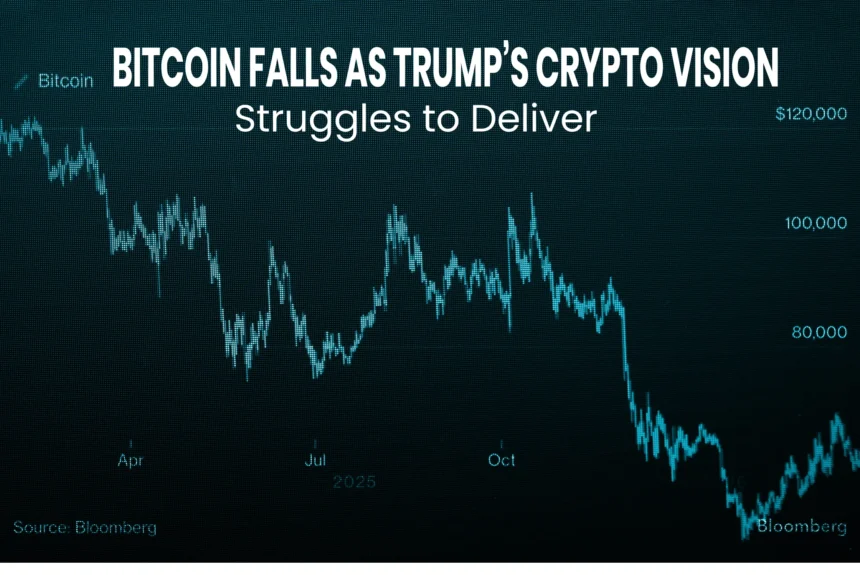
Bitcoin’s sharp decline has left investors asking why is bitcoin falling today, especially after President Donald Trump’s strong support for the cryptocurrency industry and his promise to make the United States the world’s leading crypto hub. Trump’s return to the White House initially created a wave of optimism among digital asset investors, who expected friendlier regulations, greater institutional participation, and stronger government support for Bitcoin and other cryptocurrencies.
Yet Bitcoin’s price performance has demonstrated that political support alone cannot guarantee a sustained rally. Interest-rate expectations, inflation, institutional investment flows, ETF demand, market leverage, and investor risk appetite continue to influence where the cryptocurrency market moves next.
Trump’s Crypto Promise Raised Expectations
Donald Trump’s political support for cryptocurrency represented a major shift in the relationship between the U.S. government and the digital asset industry.
During his campaign, Trump repeatedly presented himself as a supporter of cryptocurrency. He promised to make the United States a global leader in digital assets and argued that the country should encourage innovation rather than push crypto companies overseas.
For an industry that had spent years dealing with regulatory uncertainty, the change in political tone was significant. Crypto businesses and investors hoped a more supportive administration would provide clearer rules for exchanges, stablecoins, digital asset companies, and financial institutions.
Investors were particularly optimistic about:
- Clearer regulations for cryptocurrency businesses
- Greater participation from banks and financial institutions
- Increased institutional investment in Bitcoin
- Stronger support for blockchain and digital asset innovation
The expectation was that regulatory clarity would encourage more companies to build in the United States and attract additional institutional capital. Bitcoin investors also saw Trump’s position as a potential catalyst for the market.
The optimism was supported by the arrival of spot Bitcoin exchange-traded funds in the United States in January 2024. These products made it easier for traditional investors to gain exposure to Bitcoin through regulated financial markets.
Together, the combination of institutional access and a crypto-friendly political environment created strong expectations for a new period of growth. But markets rarely move according to political expectations alone.
Bitcoin’s Price Tells a Different Story
Bitcoin’s performance has increasingly highlighted the difference between a favorable political environment and actual market conditions. The cryptocurrency can benefit from long-term regulatory support while still falling in the short term.
That is because Bitcoin is traded globally. Its price is influenced by investors around the world, and those investors respond to factors that have little connection to U.S. political promises.
Interest rates are one of the most important examples. When borrowing costs remain high, investors may prefer assets that generate predictable income. Government bonds and other fixed-income investments can become more attractive compared with assets such as Bitcoin, which do not provide interest payments or dividends.
When investors expect interest rates to decline, the environment can become more favorable for riskier assets. This relationship has made Federal Reserve policy an important factor for Bitcoin traders.
Even if Trump supports cryptocurrency, his administration cannot directly control global interest rates, inflation, or the investment decisions of institutional funds. That is why Bitcoin’s price can fall even while the broader regulatory outlook for crypto becomes more positive.
The contrast is central to the current market story. Trump’s policies may influence the industry’s long-term direction, but Bitcoin’s short-term price remains dependent on the broader financial environment.
ETF Flows Have Become a Critical Indicator
The introduction of spot Bitcoin ETFs fundamentally changed the cryptocurrency investment landscape. Before these products became available, many traditional investors faced practical difficulties when attempting to gain direct exposure to Bitcoin. They had to deal with cryptocurrency exchanges, digital wallets, custody arrangements, and other technical considerations.
Spot Bitcoin ETFs simplified the process. Investors could gain exposure through a conventional brokerage account, while asset managers handled the underlying Bitcoin holdings. The development created a new channel for institutional money to enter the market.
However, ETF demand is not always positive. When investors buy ETF shares, the funds can increase their exposure to Bitcoin. When investors sell, the funds may reduce their holdings. This means ETF flows can amplify both market rallies and downturns.
Investors are therefore paying close attention to whether these products are attracting fresh capital or experiencing sustained withdrawals.
The significance of this trend extends beyond Bitcoin. Institutional demand has become an important measure of confidence in the digital asset market, and changes in institutional positioning can influence the entire crypto ecosystem.
This also explains why Bitcoin can experience price pressure even when the industry’s political outlook appears positive. If institutional investors become more cautious, their decisions can outweigh the optimism created by policy announcements.
The Federal Reserve Still Matters to Bitcoin
One of the major challenges for the crypto market is ongoing uncertainty over monetary policy. Central banks continue to closely monitor inflation, and if price pressures remain higher than expected, interest rates could stay elevated for an extended period. Higher rates can weigh on riskier investments, including cryptocurrencies, as investors may become more cautious about allocating capital to volatile assets.
Bitcoin has sometimes been described as a hedge against inflation because its supply is limited to 21 million coins. However, its actual market behavior has often been more complicated. During periods when investors become concerned about inflation and interest rates, Bitcoin can fall alongside technology stocks and other growth-oriented assets.
Many investors still view Bitcoin as a high-risk asset, making its price highly sensitive to changes in market sentiment. The comparison with gold is particularly relevant. Gold has long been considered a defensive investment that investors often turn to during periods of economic uncertainty and market volatility.
Bitcoin, despite being widely described as “digital gold,” has historically experienced sharp price swings during times of market stress. This fundamental difference helps explain why Trump’s pro-crypto policies have not, by themselves, been enough to ensure sustained growth in Bitcoin’s price.
The key factors influencing Bitcoin’s price include:
- Inflation and interest-rate expectations
- Federal Reserve monetary policy
- Bitcoin ETF inflows and outflows
- Institutional investor sentiment
- Market leverage and forced liquidations
- Overall appetite for high-risk investments
Leverage Can Turn a Correction into a Crash
Another factor behind sudden Bitcoin declines is leverage. Cryptocurrency markets have a large derivatives ecosystem, allowing traders to take positions that are significantly larger than their available capital.
Leverage can magnify profits when prices move in a trader’s favor, but it can also significantly increase the risk of losses and forced liquidations. For example, a trader who borrows money to bet on a rising Bitcoin price may face automatic liquidation if the cryptocurrency falls below a specific threshold.
When multiple leveraged positions are closed at the same time, the resulting forced selling can add further downward pressure to the market and accelerate Bitcoin’s decline.
The process can become self-reinforcing. Bitcoin falls, leveraged positions are liquidated, forced selling increases, and the additional selling pushes Bitcoin even lower.
This is one reason cryptocurrency markets can experience sharp price movements within a short period. It also explains why a price decline does not necessarily mean that investors have completely abandoned Bitcoin. In some cases, a significant portion of the movement is caused by traders unwinding highly leveraged positions.
Trump’s Strategic Bitcoin Reserve Is Significant, But Not Unlimited
The Trump administration’s establishment of a Strategic Bitcoin Reserve became one of the most closely watched developments in the cryptocurrency industry. For many crypto supporters, the move signalled a major shift in how the U.S. government views Bitcoin, elevating it from a speculative digital asset to a potential strategic reserve asset.
However, the details of the policy are important. The reserve was structured around Bitcoin already held by the U.S. government, much of which was acquired through asset forfeiture proceedings. This is different from a policy that would require the government to make large-scale Bitcoin purchases in the open market.
That distinction is significant for investors. A government actively buying Bitcoin could create a new and potentially substantial source of market demand. By contrast, a reserve built primarily from existing government-held Bitcoin does not create the same immediate buying pressure.
Even so, the policy carries considerable symbolic and strategic significance. It represents a notable change in the U.S. government’s approach to Bitcoin and could influence how other governments, financial institutions, and investors view the cryptocurrency.
However, the reserve does not shield Bitcoin from broader market forces such as interest rates, inflation, institutional flows, and investor sentiment, all of which continue to play a major role in determining its price.
Why Crypto Market Is Down Despite Trump’s Pro-Crypto Policies
The broader question of why crypto market is down can be explained by several interconnected factors. Macroeconomic uncertainty remains a major concern, with investors closely monitoring inflation trends and expectations around future interest-rate decisions. At the same time, institutional investors can quickly move large amounts of capital between asset classes as their perception of risk changes. ETF activity is another important influence, as strong inflows can support Bitcoin prices, while sustained outflows can increase selling pressure.
Leverage can further intensify these market movements. When prices fall sharply, highly leveraged traders may face forced liquidations, triggering additional selling and accelerating the decline. This can create a chain reaction in which falling prices lead to liquidations, which then put even more downward pressure on the market.
Investor expectations are also playing a crucial role. The cryptocurrency market may have already priced in a significant amount of optimism surrounding Trump’s pro-crypto policies. As a result, even positive developments may fail to trigger another major rally if they are less impactful than investors had anticipated.
This is a common pattern across financial markets. Investors often buy assets based on expectations of future developments, meaning much of the anticipated good news may already be reflected in the price. When that news eventually arrives but fails to exceed expectations, prices can still decline despite the development itself being positive.
This dynamic may help explain Bitcoin’s recent weakness. Trump’s support for cryptocurrency is no longer simply a campaign promise; investors are now looking closely at the administration’s actual policies, regulatory decisions, and their potential impact on the industry’s long-term growth.
As the market moves beyond political optimism, Bitcoin’s performance will increasingly depend on whether these policies translate into meaningful regulatory clarity, stronger institutional participation, broader adoption, and sustainable demand. The promise of a crypto boom may have boosted expectations, but turning that optimism into lasting market growth will require more than political support.
Crypto Companies Are Also Feeling the Pressure
The Bitcoin downturn is affecting more than just cryptocurrency prices, with companies across the digital asset ecosystem also feeling the impact. Businesses that rely on crypto trading, mining, or digital asset investments are particularly sensitive to changes in market activity and investor sentiment.
Coinbase, one of the largest cryptocurrency exchanges in the United States, is closely tied to the overall health of the crypto market. When Bitcoin and other digital assets attract strong investor interest, higher trading volumes can benefit exchanges through increased transaction activity. However, when prices decline and investors become more cautious, trading volumes can weaken, potentially putting pressure on exchange revenues.
Bitcoin miners face a different set of challenges. Mining requires specialized hardware and significant amounts of electricity, making operating costs an important factor in profitability. When Bitcoin prices fall while energy and infrastructure costs remain high, miners can face tighter profit margins and greater financial pressure.
Companies that hold Bitcoin as part of their corporate treasury strategy are also directly exposed to the cryptocurrency’s volatility. Strategy, formerly known as MicroStrategy, is one of the most prominent examples of a company that has made Bitcoin a central part of its treasury strategy.
Its approach has encouraged other businesses to explore Bitcoin as a potential corporate asset, but it also highlights the risks involved. Companies with significant Bitcoin exposure can benefit when prices rise, but a prolonged decline can reduce the value of their holdings and increase financial pressure.
The Crypto Boom Will Need More Than Bitcoin
The broader digital asset industry continues to develop despite Bitcoin’s volatility. Financial institutions are exploring tokenization, in which traditional assets such as bonds, investment funds, and other financial instruments are represented digitally on blockchain networks.
Stablecoins are also attracting attention for digital payments, cross-border transfers, trading, and financial settlement. Unlike Bitcoin, stablecoins are designed to maintain a relatively stable value, typically by being pegged to fiat currencies such as the U.S. dollar.
These developments demonstrate that the crypto industry is broader than Bitcoin speculation. Bitcoin can experience a significant decline while investment in blockchain infrastructure, tokenization, and stablecoin-based financial services continues.
For Trump’s promised crypto boom to have a lasting impact, the growth of these practical applications will be just as important as the performance of Bitcoin itself.
What Trump’s Crypto Boom Needs to Succeed
For Trump’s vision of a U.S. crypto boom to become a lasting reality, political support will need to translate into clear and practical policies.
Regulatory clarity will be particularly important, as businesses need to understand how digital assets will be classified, regulated, and taxed. Financial institutions also require clear guidelines before expanding their crypto-related products and services, while consumers need stronger safeguards against fraud, market manipulation, and other risks associated with digital assets.
Investors, meanwhile, will be looking for confidence that the regulatory framework will remain stable and consistent over the long term.
For the U.S. crypto industry to achieve sustained growth, investors and businesses will be watching for:
- Clear and consistent digital asset regulations
- Stronger consumer protections
- Rules that allow financial institutions to participate confidently
- Greater institutional adoption
- Continued investment in digital asset infrastructure
- A stable long-term policy environment
If these conditions improve, the United States could become more attractive to cryptocurrency companies, institutional investors, and technology developers seeking a predictable environment for innovation.
However, a stronger regulatory framework would not guarantee that Bitcoin prices would rise continuously. The cryptocurrency market will remain cyclical, with prices influenced by demand, liquidity, interest rates, economic conditions, and investor sentiment.
Trump’s policies can shape the industry’s long-term direction and create more favorable conditions for growth, but they cannot eliminate the volatility of a global market that remains highly sensitive to broader financial and economic forces.
Trump’s Crypto Boom Faces a Bitcoin Reality Check
The biggest lesson from Bitcoin’s recent decline is that political optimism does not always translate into immediate market gains. Trump’s pro-crypto agenda has created a more supportive environment for digital assets and could have a lasting impact on regulation, institutional adoption, and blockchain innovation.
However, Bitcoin’s price continues to be shaped by broader forces, including interest rates, inflation, ETF flows, market leverage, and global investor sentiment.
The real test of Trump’s crypto strategy, therefore, will not be whether Bitcoin rises immediately but whether his administration can establish a stable regulatory and financial framework that encourages sustainable investment and long-term adoption.
Until then, the question of why is bitcoin falling today will continue to have an answer that extends beyond politics. Bitcoin is now closely connected to the global financial system, meaning its price remains vulnerable to the same economic pressures and shifts in risk appetite that influence other high-risk investments.
FAQs
- Why is Bitcoin falling despite Trump’s pro-crypto policies?
Bitcoin is influenced by several factors beyond government policy, including interest rates, inflation, ETF flows, institutional investor sentiment, leverage, and broader market conditions. Trump’s support may benefit the industry over the long term, but it does not guarantee short-term price gains. - What is Trump’s crypto boom promise?
Trump has promoted making the United States a global leader in cryptocurrency and supporting a more favorable regulatory environment for digital assets. His approach has raised expectations for greater institutional adoption, investment, and innovation in the crypto industry. - How do interest rates affect Bitcoin prices?
Higher interest rates can make traditional investments such as bonds more attractive and reduce investors’ appetite for riskier assets like Bitcoin. Expectations around future interest-rate changes can therefore have a significant impact on cryptocurrency prices. - Do Bitcoin ETFs affect the price of Bitcoin?
Yes. Strong inflows into spot Bitcoin ETFs can increase demand and support Bitcoin prices, while sustained outflows may create additional selling pressure. ETF activity has become an important indicator of institutional interest in Bitcoin. - What is the Strategic Bitcoin Reserve?
The Strategic Bitcoin Reserve is a U.S. government initiative involving Bitcoin already held by the government, much of which came through asset forfeiture proceedings. While the policy has significant symbolic importance, it does not necessarily create the same immediate market demand as large-scale government purchases of Bitcoin. - Why does leverage make Bitcoin price declines worse?
Leverage allows traders to take larger positions using borrowed funds. When Bitcoin prices fall sharply, highly leveraged positions may be automatically liquidated, creating additional selling pressure and potentially accelerating the market decline. - Can Trump’s crypto policies still lead to a crypto boom?
Trump’s policies could support long-term growth if they result in clearer regulations, stronger institutional participation, greater adoption, and continued investment in digital asset infrastructure. However, Bitcoin will likely remain sensitive to global economic conditions, interest rates, inflation, and investor sentiment.
The CEO Views is a global business media and recognition platform that highlights innovative companies, emerging brands, and accomplished business leaders across industries. Through its editorial features, entrepreneur-focused stories, industry insights, and technology coverage, the platform brings attention to organizations and executives making an impact in the evolving business landscape. Its mission is to recognize excellence and help innovative brands and leaders gain greater visibility in the new-age business world.