

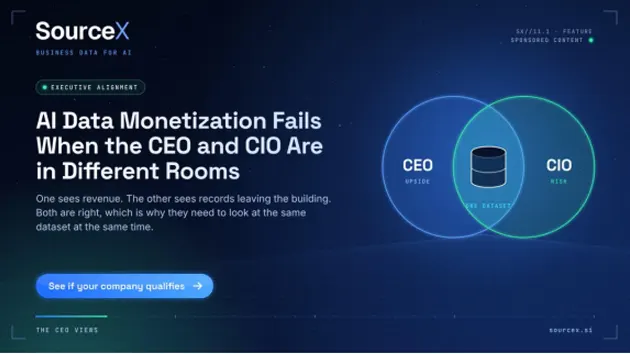
One sees revenue. The other sees records leaving the building. Both are right, which is why they need to look at the same dataset at the same time.
The CEO sees a new revenue line. The CIO sees customer records crossing a boundary that has never been crossed before.
Both are looking at a real part of the same decision. The trouble starts when they look at it separately.
One avoidable failure starts with separate conversations. The commercial team talks up an attractive payout in one meeting. In another, technology is asked to approve an export whose purpose, scope and obligations nobody has written down. Each side assumes the other has the hard part covered.
The fix is simple to describe and harder to practice: put one defined dataset in front of both leaders, with the same scope, proposed uses, restrictions and acceptance conditions.
Start with a unit small enough to understand
“Company data” is too broad to approve. “Resolved service cases from a named three-year period” is concrete enough to argue about productively.
Each function then answers its own question about that same collection. Operations explains what the records show. Technology explains how the collection can be assembled and kept separate from excluded material. Commercial explains which rights are proposed and why the transaction might make sense.
If the number of systems or years shifts during the discussion, update the scope before anyone compares economics. Two leaders evaluating different datasets can mistake a scope disagreement for a disagreement about the opportunity itself.
Put opportunity cost next to the payment
A licensing payment can look excellent while its restrictions deserve a much harder look. Would exclusivity block another planned arrangement? Will preparation eat scarce engineering time? Does the company need to preserve rights for its own future AI products?
List the trade-offs before deciding whether the price is right. You do not need a speculative valuation of the whole archive, only an honest comparison between a proposed deal and your realistic alternatives.
And one rule for the spreadsheet: an advertised upper-bound figure should never become the base case.
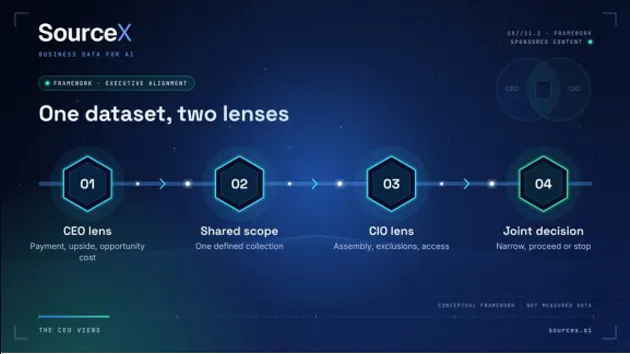
One dataset, two lenses. A conceptual framework drawn from the article, not measured performance or a completed transaction.
Give every review a named owner
The NIST AI Risk Management Framework emphasizes governance across the AI lifecycle. Applied to a licensing assessment, it means assigning an owner to each question that would otherwise fall between departments:
- Who confirms authority over the selected records?
- Who reviews confidential content?
- Who approves the prepared delivery?
- Who can accept a material change in scope?
- Who checks that the invoice matches the signed deal?
Write the answers in plain language. A named person who understands the pending decision beats a long policy reference every time.
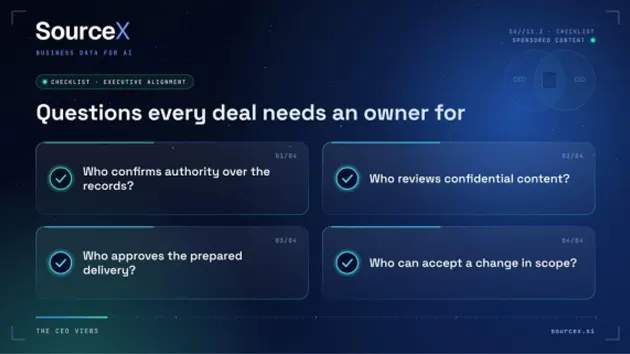
Questions every deal needs an owner for. Four review points from the article; the full text supplies the context and conditions.
Replace optimistic labels with commercial evidence
Take SourceX as an example of how this can work. The supplying company contracts with SourceX directly for approved AI training and evaluation data, and each transaction’s selected dataset, net payout and terms are written into a deal-specific confirmation. That gives both executives the same document to read.
Its public offer reaches up to $4 million. That is the ceiling for the largest enterprise datasets, not a typical outcome, a commitment to buy or a valuation of a company nobody has assessed. The first step is a fit check with no data uploads.
Once a concrete offer exists, the CEO can judge the compensation and the CIO can judge whether the scope and preparation are reviewable. Neither has to accept a vague description of the other’s concern.
What should a joint review produce?
A clear next action: narrow the scope, resolve a rights question, improve the inventory, review a concrete proposal or stop. Drifting forward by default is also a decision, just an unaccountable one.
Capture the collection considered and the reason for the next step in a short written record. It protects the company when people or circumstances change.
Can data licensing become recurring revenue?
Some agreements can provide for recurring deliveries. SourceX describes its usual payment as a one-time fee with no royalties or usage fees, while repeat deliveries are paid as their agreement specifies. The signed terms decide. Executives should not present one possible transaction as a revenue stream until repeatability is proven.
The strongest leadership position is a shared one: understanding a commercial opportunity well enough to accept it deliberately or decline it with a clear reason.
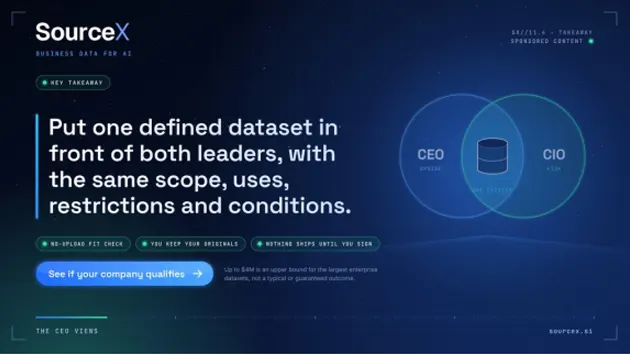
Key takeaway: Put one defined dataset in front of both leaders, with the same scope, uses, restrictions and conditions.
Bring the same one-page inventory to both leaders, then use SourceX to check company fit. The first assessment needs business information, rather than an export for the commercial team to circulate.
About the founder
Noah Loul is a four-time founder and the founder and CEO of SourceX, which licenses business data directly from companies for AI training and evaluation. He previously founded B2B Rocket, acquired by Blackpearl Group. His work focuses on building permission-based data infrastructure for AI.