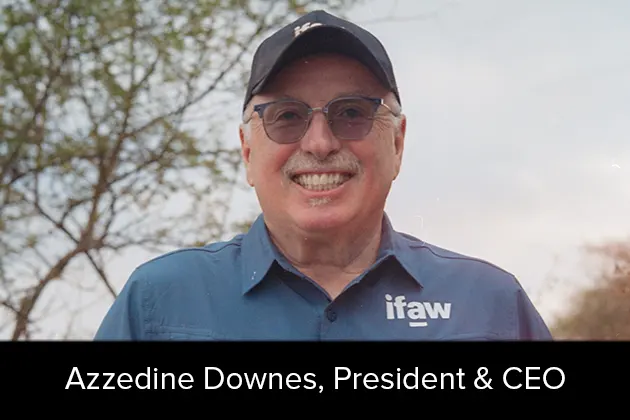
In a world that often rewards speed, reaction, and certainty, Azzedine Downes has built his leadership on something far less common—patience, empathy, and the discipline to act with intention.
As the President and CEO of the International Fund for Animal Welfare (IFAW), Downes leads not by imposing direction, but by ensuring clarity in complexity. His approach has been shaped by a life lived across cultures and contexts, where understanding nuance was not optional—it was essential. Those experiences instilled in him the ability to listen carefully, interpret meaning beyond words, and navigate challenges with perspective rather than impulse.
In an era defined by rapid change and growing uncertainty, Downes’s leadership stands out not for its urgency, but for its steadiness—grounded in the belief that meaningful progress comes from thoughtful, consistent action and a willingness to listen.
Lessons to Leadership
For Downes, leadership is not something learned in theory—it is shaped through experience, challenge, and reflection. Like many leaders, his journey was not without obstacles. But it was through navigating those early challenges that he developed a deeper understanding of what leadership truly requires. One of the most persistent realities he encountered was resistance to change. “Leaders can change behaviors,” he notes, “but they rarely change the reasons behind those behaviors.” This insight shaped his approach. Rather than forcing change, he focuses on helping people understand the reasons behind it—recognizing that transformation is not just external, but deeply personal.
Early in his leadership journey, much of his effort was spent helping others see that the world is constantly evolving—and that our work, ambitions, and expectations must evolve with it. By embracing change as a constant rather than a disruption, Downes reframed it as an opportunity for growth. At the same time, he recognizes a generational shift. While previous generations were driven by urgency to protect wildlife and biodiversity, many younger leaders today face a different challenge—uncertainty, anxiety, and the weight of global instability. For Downes, this makes one responsibility clear: leadership must inspire hope.
“Learning to navigate resistance, foster resilience, and cultivate hope has been central to my growth as a leader,” he shares.
An Anti-Bureaucratic Leadership
Downes’s leadership philosophy challenges traditional organizational structures. He views bureaucracy not as a necessity, but as a reflection of mistrust—an assumption that people need to be controlled rather than empowered. Instead, he focuses on building environments where individuals are trusted to think, act, and grow. His approach is rooted in inspiration rather than enforcement. He encourages people to go beyond defined roles, to take initiative, and to contribute in ways that extend beyond their formal responsibilities. At the same time, he is clear-eyed about human nature. Not everyone will strive for their full potential—but strong leadership lies in creating the conditions where those who do can thrive.
Patience in the Face of Volatility
In a fast-moving, unpredictable world, Downes’s leadership is defined by calm focus. Where others may feel pressure to react quickly, he emphasizes the importance of stepping back, listening carefully, and identifying what can realistically be influenced. Not every problem can be solved immediately—and not every challenge lies within one’s control.
This perspective allows his teams to channel their energy more effectively—focusing on actions that create tangible impact rather than becoming overwhelmed by what cannot be changed. For Downes, patience is not about waiting—it is about choosing where and when to act. This principle has helped IFAW remain resilient and effective, even in times of uncertainty and disruption.
Encouraging Innovation
Innovation, in Downes’s view, begins with creating the right environment. It requires giving people the confidence to experiment, to take risks, and—critically—to fail without fear. At the same time, it demands accountability and a clear connection to real-world challenges. He emphasizes that innovation does not emerge from abstract thinking alone. It comes from engaging directly with problems and responding to what is actually happening, rather than imagined scenarios.
The shift toward more flexible work environments following the pandemic, for example, has introduced new challenges in maintaining alignment and demonstrating leadership. For Downes, this reinforces the importance of consistency—ensuring that values are not just communicated but visibly practiced. Striking the balance between experimentation and discipline is what allows innovation to move from idea to impact.
Breaking Barriers at the Workplace
Leading a globally distributed organization brings unique challenges—particularly when it comes to communication and culture. Language differences, varied interpretations, and cultural nuances can easily create friction. Downes has learned that clarity is not achieved through a single message, but through consistency and reinforcement. “Our approach is to create an organizational culture that respects these differences,” he explains. To strengthen connection, he prioritizes opportunities for in-person engagement—recognizing that human relationships cannot be fully replaced by virtual interaction. These moments of connection play a critical role in building trust, alignment, and a shared sense of purpose.
Building a Future-Ready Organization
Looking ahead, Downes sees two critical areas shaping the future of IFAW: technology and financial sustainability. He is particularly focused on the potential of artificial intelligence to enhance conservation efforts—from monitoring wildlife populations and tracking migration patterns to improving engagement with supporters and reducing operational inefficiencies.
At the same time, he challenges traditional economic assumptions that nature must “pay for itself.” This flawed mindset, he argues, limits the resources available to address environmental challenges at scale. Futureproofing IFAW requires more than adopting new tools—it requires rethinking systems, expanding possibilities, and maintaining a sense of optimism. Because, ultimately, hope is what drives action.
A Legacy of Purpose
For Downes, legacy is not defined by recognition, but by genuine impact. While honors such as the Order of the California Condor Award reflect his contributions, his true focus lies in what continues beyond his leadership. He envisions an organization that keeps pushing boundaries—placing life at the center of every decision and integrating science, compassion, and action into a unified approach. More than anything, he hopes to leave behind a lasting shift in mindset: one that prioritizes connection over division, and possibility over limitation.
Advice to Aspiring Leaders
Downes’s advice to future leaders is grounded in a principle that is both simple and powerful: be generous with your time. It is a lesson he learned through experience, and one he now emphasizes early on. Leadership is not only about achieving outcomes—it is about investing in people, supporting their growth, and creating space for others to succeed. “Leadership is about creating an environment where people rise to challenges, take initiative, and do work that matters, rather than simply following rules,” he says. Because in the end, the most inspiring leaders are not those who move the fastest—but those who create the conditions for others to move forward with purpose.