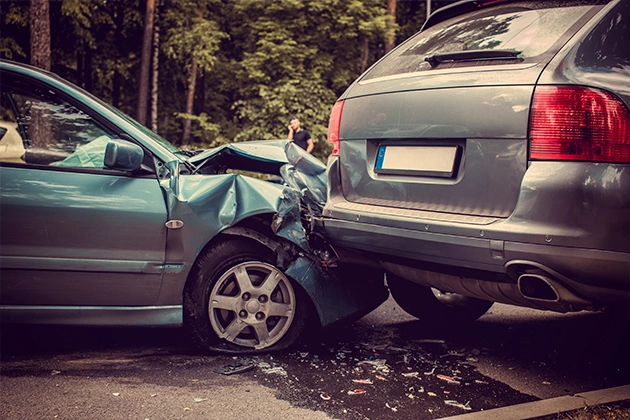
Road accidents involving company vehicles or employees on the clock cost U.S. businesses far more than most executives realize. The National Safety Council estimated that work-related injuries and deaths cost the nation $171 billion in a single year, with motor vehicle incidents making up the largest share.
Yet the true cost of a single road accident never shows up in one line item. It fragments across insurance, legal, HR, operations, and lost contracts. By the time anyone notices, it has already compounded into a serious financial problem.
Direct Costs: Settlements, Medical Claims, and Vehicle Losses
The expenses that hit the balance sheet after a road accident (settlement payments, medical claims, vehicle repair, legal defense) are only the visible portion.
According to the National Council on Compensation Insurance, the average workers’ compensation claim for a motor vehicle crash is $85,311, more than double the average for any other injury category. That covers medical treatment, wage replacement, and disability for the injured employee. It does not include third-party liability.
Third-party liability is where costs escalate. When a company driver injures a pedestrian or cyclist, the employer owes the settlement directly. People on foot or on bicycles sustain far more severe injuries per incident than vehicle occupants, and injury severity is the single largest factor pushing settlement costs up.
Traumatic brain injuries, spinal cord damage, and multi-fracture cases regularly land in six- and seven-figure territory. The average bicycle accident settlement ranges from $10,000 to $100,000, and catastrophic injury cases routinely exceed $1 million. If the at-fault driver was operating a company vehicle, the doctrine of respondeat superior assigns that liability to the employer, not the individual driver.
A single incident can exceed a small company’s annual net income. And that is just the visible portion.
The 4x–10x Multiplier: Indirect Costs Most CEOs Miss
Decades of research from Liberty Mutual, the National Safety Council, and OSHA confirm that indirect costs of a workplace road accident run four to ten times higher than direct costs. A $100,000 settlement can carry $400,000 to $1,000,000 in total organizational impact. These costs are well-documented but poorly tracked, and that gap is where money disappears.
Insurance Premiums
One at-fault accident triggers an experience modification recalculation that inflates commercial auto and general liability premiums for at least three years. For fleets of 10+ vehicles, a single severe claim can push annual premiums up 20–40%, compounding over the full recalculation window. A bad quarter in 2025 is still affecting the balance sheet in 2028.
Lost Productivity
The disruption extends well beyond the injured employee. Supervisors spend 20–40 hours on documentation, internal investigations, and regulatory reporting. Co-workers absorb the extra workload. If the employee was customer-facing or critical to a project, timelines slip and revenue recognition delays follow.
Replacement and Retraining
SHRM estimates the cost of replacing an employee at six to nine months of salary. Injury-related departures drive up hiring costs and reduce candidate quality. In skilled trades, logistics, and field service, finding a qualified replacement can take six months, with the position sitting empty or covered by expensive overtime.
Legal and Administrative Overhead
Beyond settlements, companies absorb attorney fees for liability defense, regulatory inquiries, and internal compliance audits. OSHA’s per-instance citation policy means one investigation can produce multiple violations, with willful or repeat penalties reaching $145,027 each.
Reputation and Contract Risk
In regulated industries (transportation, construction, government contracting), a serious road accident can trigger contract review clauses, loss of preferred vendor status, or disqualification from future bids. Incidents involving cyclists or pedestrians attract more media coverage than vehicle-on-vehicle collisions. Local news covers a delivery van hitting a cyclist in a way it never covers a fender-bender on the highway.
Why Bicycle and Pedestrian Accidents Carry Outsized Business Risk
Not all road accidents carry equal financial exposure. Collisions involving cyclists and pedestrians consistently generate the highest per-incident costs for the at-fault employer, for three specific reasons.
Injury Severity
Without a vehicle’s protective shell, cyclists and pedestrians absorb the full force of impact. Traumatic brain injury, spinal fractures, and internal organ damage require extensive treatment, rehabilitation, and often lifetime care. The long tail of medical costs pushes bicycle accident settlement amounts far higher than vehicle-on-vehicle incidents.
Jury Sympathy
When a commercial truck or company car hits a cyclist, juries assign higher non-economic damages (pain, suffering, loss of enjoyment of life) than in crashes between two motor vehicles. Defense attorneys in bicycle accident cases report this consistently: juries treat the size and power disparity as an aggravating factor, regardless of technical fault analysis.
Expanding Legal Liability
Forty-three states have enacted some form of vulnerable road user law or enhanced penalty for drivers who injure cyclists or pedestrians. In pure comparative negligence states, an injured cyclist can recover compensation even if partially at fault. Some states have added criminal penalties for distracted driving that causes serious injury. For companies operating across multiple states, these patchwork rules create liability that is difficult to predict and harder to budget for.
Bicycle accident injuries alone cost the U.S. roughly $23 billion a year.
The Prevention ROI
The financial case for fleet safety investment is unusually clear. Both OSHA and the National Safety Council have published data showing $4 to $6 in measurable return for every $1 invested in workplace safety programs, a ratio that holds for fleet safety specifically.
The highest-impact interventions are also the most affordable. A distracted driving policy with real enforcement costs almost nothing and addresses the leading cause of vehicle-cyclist and vehicle-pedestrian collisions. Telematics systems that flag hard braking, speeding, and phone use cost $15–$30 per vehicle per month and cut at-fault incidents by 20–30%. For a 50-vehicle fleet, that amounts to $9,000–$18,000 a year, less than a tenth of what one serious incident costs.
One notable gap: driver training programs that address interactions with cyclists, pedestrians, and scooter riders remain rare. Most commercial programs focus on highway driving. Urban environments, where most bicycle and pedestrian accidents occur and where per-incident costs are highest, receive almost no training attention.
What CEOs Should Be Measuring
Most executive dashboards track accident frequency but not financial severity. A company reports “only two incidents this quarter” without recognizing that one of them generated $400,000 in total cost.
Three metrics belong on the executive risk dashboard:
Total cost per incident. Direct costs plus estimated indirect costs using a validated multiplier. The American Transportation Research Institute suggests 4x–6x for motor vehicle incidents and 6x–10x for incidents involving cyclists or pedestrians.
Settlement exposure by accident type. Breaking down near-misses and incidents by road user type (vehicle, cyclist, pedestrian) allows risk teams to model worst-case scenarios rather than averages. A fleet operating in urban areas with heavy bike traffic carries fundamentally different risk than one on interstate corridors.
Prevention spending as a percentage of total loss cost. If a company spends $50,000 a year on fleet safety but absorbed $600,000 in accident-related costs, the investment ratio is inverted. Best-in-class companies maintain prevention spending at 15–25% of trailing three-year average loss costs.
The costs are quantifiable, the interventions are proven, and the actuarial data confirms these losses will occur. The question is whether an organization absorbs them reactively or manages them strategically.