

If a business hopes to grow and develop, it needs as many “self-actualized” functional leaders as possible. This requirement is especially critical when it comes to the CFO position. CFO or Chief Financial Officer, the economic driver that a modern business owner keeps at the forefront of their business to ensure its overall financial health.
What does it mean to be a ‘self-actualized’ leader?
Rooted in the levels of Abraham Maslow’s Hierarchy of Needs, self-actualized leadership allows leaders to exercise their full potential by pursuing personal growth, purpose, and authenticity, which not only ensures business growth but also inspires teams. With a strong sense of mission, self-actualized leaders focus on growth and contributing beyond basic needs.
Standing at the forefront of business development and growth, the self-actualized leadership of CFOs involves moving beyond the traditional method of technical finance management and embracing a purpose-driven, holistic, and people-centric leadership.
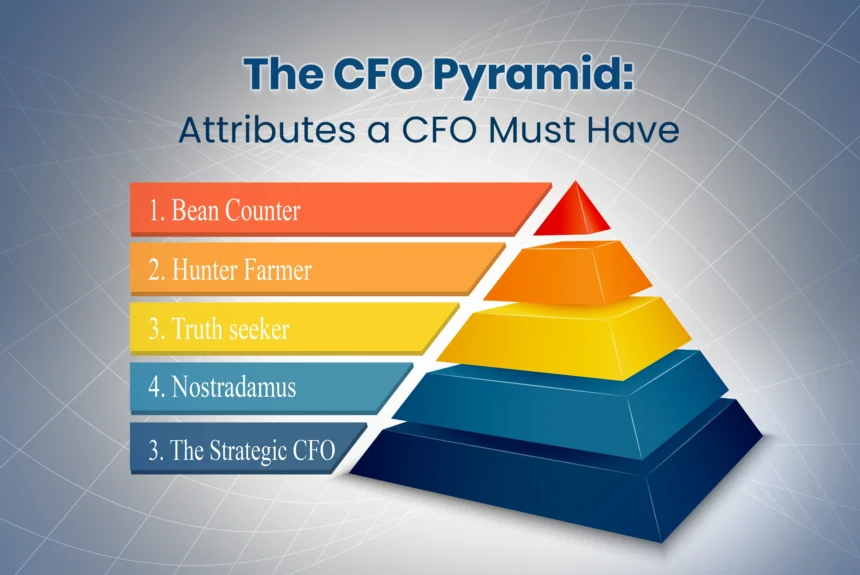
For a company to be great, it needs a CFO who is process-minded, detail-oriented, tactical, good with people, has a keen understanding of how data and strategy tie together, and can bring it all together to empower insightful decision-making. Just like Maslow defines a hierarchy of human needs, and Jim Collins describes Five Levels of Leadership, there is a pyramid of actualization that a CFO must ascend to optimally impact a company.
This write-up by The CEO Views sheds light on the attributes that modern CFOs must have, as referred to in the CFO Pyramid or finance activity pyramid. The CEO Views is one of the reputable business magazines in the USA, which aims to empower readers with information about industries, leadership, entrepreneurship, technology, innovation, and several other business aspects. Whether it is the technology sector or the finance sector, our magazine could be a one-stop solution for all your business knowledge needs.
The Finance Activity Pyramid: Tasks CFOs Should Have the Competence to Execute
-
Transaction
‘Transaction’ being the first basic level of financial activities, CFOs should be competent enough to send payments and checks on time, to avoid any stakeholder discrepancies. A CFO must be skilled in executing basic tasks like invoicing, payroll, payments, and reconciliations. Large enterprises consider finance a strategic weapon that drives growth, optimizes capital, and helps achieve long-term success. On the other hand, small businesses hardly prioritize financial management as a strategic tool, and often grapple with money management and financial losses.
CFO, as a self-actualized leader, should work to fulfill the purpose of helping businesses achieve their financial goals by strategically handling money and directing the business toward success.
-
Record Keeping
At the second level of the financial activities pyramid lie the tasks of maintaining ledgers, ensuring the successful capturing of financial data, and keeping books in order. While working with the finance team, CFOs must ensure that crucial financial data is recorded safely and securely. Guiding individuals responsible for these tasks is what a CFO does skillfully.
-
Reporting and Compliance
Making sure that all financial status is timely reported and that compliance with financial regulations is maintained, a CFO’s role spans a vast number of tasks. Small businesses mostly struggle with this financial responsibility, and hiring a CFO could be a wise decision for any business owner to ensure complete transparency and compliance with financial regulations.
-
Financial Planning
As we move up in the activities pyramid, we find financial planning as the second most crucial task allocated to a CFO in an organization. From forecasting to financial modeling, a strategic CFO is responsible for planning finances to ensure money is earned well and spent wisely.
-
Strategic Finance
Strategic finance encompasses activities such as fundraising, mergers and acquisitions, long-term financial planning, and other strategic steps that determine the future of a business. This is the activity that holds the most value for a CFO to look into while sitting in an executive position. Being responsible for maximizing a business’s financial health, strategic finance should be a priority for CFOs.
An Insight into the Levels of the CFO Pyramid
If you’re a CFO, these levels are what you should strive to reach. If you’re a CEO, these attributes are what you should look for in a CFO partner:
Level #1: Bean Counter
At the most basic level, CFOs must be able to tabulate accurate historical results on a monthly and year-over-year basis. They should be able to put these results together within two to three weeks after the end of each month. Additionally, at the end of the fiscal year, if they’ve done their job well, minimal audit adjustments will occur.
Level #2: Hunter Farmer
In the most fundamental sense, “basic needs” for a CFO include the ability to develop sufficient rapport with others in the organization so they can gather key information, then disseminate that information to the rest of the organization. In the search for business finance that promises profitability, CFOs should have their eyes on building a highly-efficient finance team that could leverage this business potential to the maximum. If they don’t work well with others or don’t have a track record of being able to efficiently extract and share factual data points for decision-making, chances are they won’t be able to move your company in the right direction. Or if they do, it will be an extremely slow, excruciating process.
Level #3: Truth seeker
It’s one thing to be able to gather factual information and disseminate it within an organization. It’s quite another to have the intellectual curiosity and analytical capability to share with your team why something happened. Level three CFOs should not only be able to accurately tell you what variances were, but why they occurred. They should also be able to tell you the select few key performance indicators that drive business performance.
Level #4: Nostradamus
The best CFOs are not only able to gather information and understand why things happened in the past, but also harness insights from across the organization to form perspectives on what will happen in the future. Every good company needs to have a sense of where it’s going financially. If a company doesn’t have a clear lens aimed at the future, it won’t know if the light at the end of the tunnel is a new horizon or a freight train. To assess these skills in a CFO, look at how accurate their projections are. Business conditions do change; hence, variances will occur. However, there should not be a pattern of variances and, if they happen episodically, the CFO should be able to seamlessly inform the team why they occurred.
Level #5: The Strategic CFO
Fully actualized CFOs understand not only what happened and what will happen, but also what should happen. They leverage data, experience, and insights to form perspectives that enable and, at the right times, persuade the rest of the team to make the right decisions. This is a financial leader who not only knows how to say “no” when a project isn’t right, but also to get the team to “yes” when it could be so much easier to just not take a risk.
This is the Strategic CFO: both data-driven and emotionally intelligent, they are a true thought partner to the CEO and other executives. Not all CFOs can reach this level due to the rare attributes required. Furthermore, not all CEOs are comfortable with true “peer CFOs.” A company that harnesses the full power of a strategic CFO will not only have a competitive advantage but will also create value much more quickly. In the end, it’s a win-win. Keeping your eyes on highly popular entrepreneur magazines, you may come across famous CFOs who have changed the scenario of business finance while working closely with CEOs who envision long-term growth.