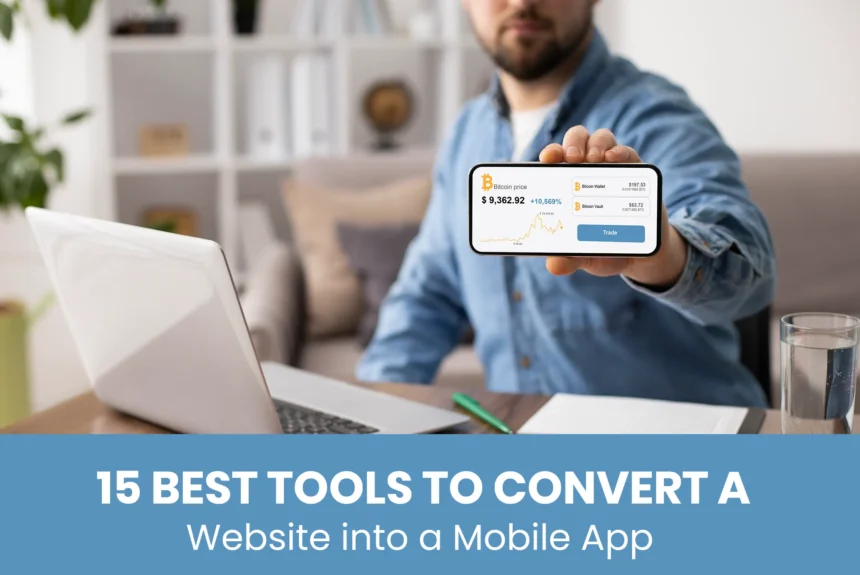
Creating a mobile application from an existing website has become one of the smartest ways for businesses to improve customer engagement, increase conversions, and strengthen brand loyalty.
Whether you run an online store, a blog, a restaurant, or a SaaS platform, choosing the right application to make your website available on mobile devices can dramatically improve the user experience. According to Statista, mobile devices generate more than 60% of global website traffic, while mobile apps account for over 85% of smartphone usage time, making apps a critical digital asset for modern businesses.
Instead of investing thousands of dollars in custom development, businesses can now use website-to-app platforms that simplify the process. Many no-code and low-code solutions enable companies to publish Android and iOS apps quickly while maintaining their existing website.
In this guide, we explore 15 of the best tools available today, along with their strengths, industry-specific use cases, and practical examples.
Why Convert Your Website into a Mobile App?
Turning your website into a mobile application provides several business advantages.
- Better customer engagement
- Push notifications for promotions
- Faster loading times
- Improved customer retention
- Offline accessibility
- Higher conversion rates
- Stronger brand visibility
For example, Starbucks, Amazon, and Domino’s have significantly improved customer engagement through mobile apps that offer personalized experiences and instant notifications.
Today, companies across industries are searching for how to convert a website into a mobile app because consumers increasingly prefer mobile experiences over traditional websites. Research from Data.ai shows that smartphone users spend significantly more time inside apps than browsing mobile websites, making mobile applications an effective channel for customer engagement and repeat purchases.
With dozens of no-code and low-code platforms available today, choosing the right solution depends on your business goals, technical requirements, and budget. Some tools specialize in eCommerce, while others are better suited for enterprise applications, hospitality, education, or content-driven websites.
To help you make an informed decision, we’ve compiled 15 of the best website-to-app converter tools that simplify the app development process and enable businesses to launch high-quality Android and iOS applications with minimal effort.
- Mobiloud
If you’re running an Ecommerce brand and are wondering, “How do I turn my website into an app? Mobiloud is one of the ideal options. It’s a fully managed service that fits your project’s specific needs. They help turn your Shopify, custom, and headless store into a mobile app without extra dev work. They help you get a direct channel to your best customers through push notifications. As a result, they recover abandoned carts, increase repeat revenue, and bring about repeat purchases. With over a decade of experience, they are a proven choice for Ecommerce businesses.
Best for: Shopify, WooCommerce, Magento, and headless commerce stores.
Real example: Several Shopify brands use MobiLoud to launch native shopping apps without maintaining separate codebases.
- Appy Pie
Appy Pie is one of the most recognized no-code app builders in the market. You can build apps easily, so no programming knowledge is required. The drag-and-drop interface allows entrepreneurs, startups, and small businesses to create apps quickly.
The platform includes hundreds of templates, social media integrations, appointment booking, payment gateways, and GPS functionality. Businesses can customize colors, branding, menus, and navigation to match their websites.
Best for: Small businesses, educational institutions, local services, and startups.
- BuildFire
BuildFire provides a highly customizable platform for organizations that require more advanced features. It supports numerous plugins that extend app functionality without requiring developers to build features from scratch.
Its analytics dashboard helps businesses understand user engagement, retention, downloads, and in-app activity.
Industry use case: Healthcare providers use BuildFire for appointment scheduling, while fitness businesses create membership apps with workout content.
- GoodBarber
GoodBarber focuses heavily on design and user experience. Businesses can choose from professionally designed templates while customizing layouts, fonts, animations, and navigation.
Push notifications, offline reading, loyalty cards, and eCommerce integrations make it suitable for retailers, bloggers, and publishers.
Real example: Independent news publishers often use GoodBarber to convert digital magazines into mobile apps with offline reading capabilities.
- Shoutem
Shoutem uses a modular approach that allows businesses to add features block by block. This flexibility makes it suitable for organizations with evolving needs.
Users can integrate social media feeds, event calendars, customer support tools, and booking systems.
Shoutem is particularly popular among event organizers, churches, educational institutions, and local communities.
- Andromo
Andromo enables creators to monetize their apps using advertising and premium content. It supports multiple revenue models, making it attractive for bloggers, content creators, podcasters, and digital publishers.
Developers can publish Android applications quickly while integrating AdMob and other advertising platforms.
Industry use case: News publishers frequently use Andromo to monetize content through display advertisements.
- AppInstitute
AppInstitute is designed specifically for small businesses that want professional mobile apps without hiring developers.
Restaurants can add online ordering, salons can manage appointments, gyms can promote memberships, and retail stores can offer loyalty rewards directly through the app.
The platform also includes social media integration, booking systems, and promotional tools.
- Swiftic
Swiftic offers an intuitive interface that allows businesses to create customer-focused mobile applications.
Its strongest features include loyalty programs, digital coupons, mobile ordering, and push notifications. Businesses looking to improve customer retention often choose Swiftic because of its marketing capabilities.
- AppMakr
AppMakr is a browser-based platform that simplifies app creation for users with little or no coding experience. Businesses can transform website content into a functional mobile application while customizing layouts, branding, menus, and navigation. Since it supports multiple types of content, AppMakr is suitable for blogs, online magazines, educational portals, and local businesses.
One of its key advantages is the ability to integrate advertising, allowing publishers and content creators to generate additional revenue through their mobile apps.
Best for: Bloggers, publishers, community organizations, and local businesses.
- Bizness Apps
Bizness Apps is designed specifically for small and medium-sized businesses that want to improve customer communication. It includes built-in loyalty programs, mobile ordering, appointment scheduling, customer reviews, and push notifications.
These features help businesses encourage repeat purchases while maintaining stronger customer relationships. The platform is especially useful for restaurants, salons, fitness centers, and retail stores looking to increase customer engagement.
Industry use case: A local restaurant can use Bizness Apps to enable online ordering, send promotional offers, and reward loyal customers through digital loyalty cards.
- Appytect
Appytect focuses on the hospitality industry by helping hotels, restaurants, and resorts build customized mobile applications. Businesses can integrate room booking, online reservations, room service requests, digital menus, and local travel recommendations into a single application.
Mobile apps built with Appytect improve guest experiences by providing instant access to services without requiring customers to visit the front desk.
Real example: Boutique hotels can use Appytect to allow guests to check in digitally, order food, and explore nearby attractions directly from the app.
- Appery.io
Appery.io is a cloud-based low-code development platform suitable for organizations that require advanced integrations. Businesses can connect their mobile apps with existing databases, APIs, CRM platforms, and enterprise software.
The platform supports Android and iOS development while providing collaborative tools for development teams.
Industry use case: Financial institutions and healthcare providers often require secure integrations with internal systems, making Appery.io a practical choice for enterprise applications.
- Thunkable
Thunkable offers one of the easiest ways to create cross-platform mobile applications using a visual drag-and-drop interface. Users can build applications for both Android and iOS without writing traditional code.
Real-time testing allows developers to preview changes instantly, significantly reducing development time.
Educational institutions frequently use Thunkable to teach students app development concepts because of its beginner-friendly interface.
- AppGyver
AppGyver is known for building powerful business applications without coding. It provides hundreds of reusable components that help businesses develop sophisticated workflows, customer portals, and internal management tools.
The platform also integrates with various third-party services, making it suitable for companies that need automation and advanced functionality.
Industry use case: Manufacturing companies use AppGyver to build inventory management and employee workflow applications.
- PhoneGap
PhoneGap is an open-source framework that enables developers to build mobile applications using HTML, CSS, and JavaScript. Instead of learning platform-specific programming languages, web developers can reuse their existing skills to create Android and iOS applications.
Although newer technologies have emerged, PhoneGap played an important role in helping businesses transition from websites to mobile applications using familiar web technologies.
Best for: Web developers looking to reuse existing code.
Industry-Specific Use Cases
Different industries benefit from website-to-app converters in unique ways.
- eCommerce: Online retailers use mobile apps to reduce cart abandonment, send personalized offers, and improve customer loyalty through push notifications.
- Healthcare: Hospitals and clinics build apps for appointment scheduling, telemedicine consultations, prescription reminders, and patient communication.
- Education: Educational institutions create mobile apps for online classes, digital assignments, learning resources, and student notifications.
- Hospitality: Hotels, restaurants, and resorts improve guest experiences through online reservations, room service requests, loyalty programs, and local travel recommendations.
- Media and Publishing: News websites and digital magazines convert their websites into apps to deliver breaking news alerts, offline reading, and personalized content.
- Professional Services: Law firms, accounting firms, consultants, and agencies use mobile apps for client communication, appointment scheduling, secure document sharing, and notifications.
What Should You Consider Before Choosing a Website-to-App Platform?
Before selecting a platform, evaluate several important factors:
- Ease of use
- Android and iOS compatibility
- Push notification support
- Offline functionality
- Payment gateway integration
- Customer support
- Analytics and reporting
- Scalability
- Security
- Pricing
Choosing the right platform depends on your business goals, target audience, and technical requirements.
Final Thoughts
Building a mobile application from your existing website is no longer limited to companies with large development budgets. Today’s platforms allow businesses of every size to launch professional mobile apps quickly while improving customer engagement, retention, and brand visibility.
Whether you operate an eCommerce store, healthcare organization, educational platform, hospitality business, or media company, there is a solution that matches your requirements. From beginner-friendly no-code builders to enterprise-grade development platforms, these tools make app creation faster and more affordable than ever before.
If you’re searching for the best website to app converter, compare each platform’s features, integrations, customization options, and long-term scalability before making a decision. Selecting the right solution today can help your business deliver a seamless mobile experience and stay competitive in an increasingly mobile-first digital world.
FAQs
- Can I convert my website into a mobile app without coding?
Yes. Many platforms such as MobiLoud, Appy Pie, BuildFire, and GoodBarber allow users to create Android and iOS apps without writing code.
- Which industries benefit most from website-to-app converters?
eCommerce, healthcare, education, hospitality, media, finance, and professional services are among the industries that benefit the most.
- Are website-to-app converters suitable for small businesses?
Absolutely. Most no-code platforms are designed for startups and small businesses that want affordable mobile apps without hiring developers.
- Do website-to-app platforms support push notifications?
Yes. Most modern platforms include push notifications to help businesses engage customers, promote offers, and increase retention.
- Can I publish my app on both Android and iOS?
Most leading website-to-app converters support publishing on both Google Play and the Apple App Store.
- How much does it cost to convert a website into an app?
Costs vary depending on the platform and features. No-code builders are generally more affordable than custom app development.
- What is the best website to app converter?
The best choice depends on your needs. MobiLoud is ideal for eCommerce businesses, while Appy Pie, BuildFire, GoodBarber, and Thunkable are excellent options for businesses seeking flexible, no-code app development.
The CEO Views brings together influential leaders, pioneering organizations, and bold ideas that are redefining the business landscape. Featuring exclusive conversations, inspiring leadership journeys, and thought-provoking insights, it explores the strategies, innovations, and trends driving growth and shaping the future of industries around the world.