
As we are cruising through a world where modernization redefines almost every day, website development is embracing cutting-edge technologies that can revolutionize how sites are imagined, developed, and launched to stay ahead. Website modernization in 2026 is experiencing a new shift, where web development is transcending from page building to system thinking. While acting as an adaptive product, websites are now connecting themselves directly with business outcomes.
Modern web development has moved beyond the launch-day visuals. Businesses and customers are looking for websites that can offer reliability, speed, and the ability to support business goals. Unlike traditional websites, modern websites do not serve as a mere “set-it-and-forget-it” model; they are dynamic, user-centric, and leverage an agile development process to ensure a seamless user experience.
Traditional websites were built with a stoic approach where businesses considered them as a physical asset, with not much to contribute to the real business goals. This worked well for a longer period, but soon companies realized that developing a website is no longer an entrepreneurial vanity; it can actually cater to the business interests.
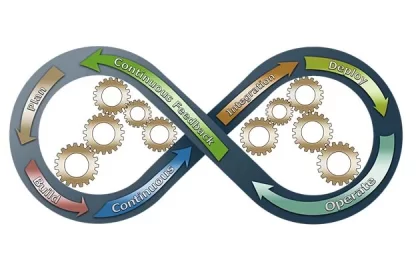
As the market is ever-evolving, the web presence of businesses must also. Traditional web development excluded the need for continuous monitoring and improvements based on data, leading companies toward losing competitiveness. The modern approach, on the other hand, is more dynamic and realistic. Modern websites are developed from a marketing perspective and include constant experimentation. Modern web development has no single technique; it is influenced by a range of trends that require reimagining of web designs as per the changing market scenario. It is more of a philosophy than a technique to bring modernization to website development.
The CEO Views, like other reputable business magazines of the modern-day world, is leveraging its website more than just a physical asset. Our website serves as a connective platform for industry experts, professionals, entrepreneurs, business owners, and individuals interested in the business world to connect, share, and gain knowledge to get empowered. By catering to the diverse needs of readers associated with the business world, we ensure that we keep our readers ahead of the industry trends through web-published articles, news, blogs, and magazines.
The Shifting Trends of Website Development to Follow in 2026
As we have stepped into 2026, businesses are gearing up for an improved start to achieve better business outcomes by the end of this year. With these trends making place in the web development industry, 2026 will surely witness an advancement in web development.
-
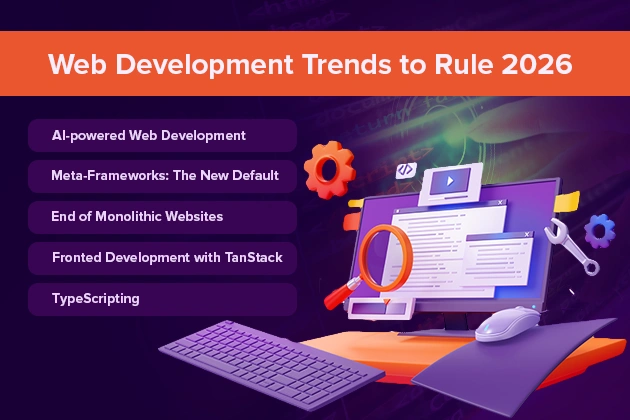
AI-powered Web Development
Artificial Intelligence (AI) has evolved from simple code-completion utilities into a core component of the web development lifecycle. With agentic workflows, developers now act as architects who oversee AI agents scaffolding features from a natural language prompt or a Figma URL. In addition, AI is also changing how developers explore and apprehend code. Team of developers now relies on AI to get an explanation of an unfamiliar logic, surface edge cases, and others. Above all, AI has dramatically changed web design processes, from generating UI variations to supporting AI-driven features directly in the product. This trend will continue to rule web development in 2026.
-
Meta-Frameworks: The New Default
Meta-frameworks like Nuxt and Next.js will be the default entry points for most professional web projects. These platforms serve as a one-stop solution for an array of web development tasks, from handling data fetching to API layers. Most generative UI builders also use generative AI to generate meta-framework projects by default.
-
End of Monolithic Websites
The all-in-one platforms for building websites are slowly petering out. Nowadays, most websites are built in smaller parts, working together to develop a website. Content, service departments, features, and frontend are separated, enabling a faster, scalable, and more secure development process. Developers can build without being blocked while launching new programs into the flow, and content teams can publish on their own. This modern approach will help eliminate long-term technical glitches and keep websites dynamic in 2026.
-
Fronted Development with TanStack
The TanStack suite of products has become the de facto standard for the logic layer, while meta-frameworks offer the structure. TanStack Query and TanStack Table solve complex problems related to data fetching, state synchronization, and caching practically. In 2025, TanStack expanded its product line, building a unified ecosystem that is already influencing application developments. We expect TanStack to continue making frontend applications easier, more portable, and more modular.
-
TypeScripting
Using JavaScript for a professional project will become a legacy approach in 2026. Today, TypeScript has become the baseline, which acts as a connecting tool between client and server.
The web development trends 2026 are rewriting the ways of designing and launching user-friendly and dynamic web applications for businesses. Marking 2026 as a crucial turn for website modernization, the above-discussed trends are likely to influence website development across industries.