For the first time in decades, the direction of a stubborn public-health trend has reversed. According to Gallup tracking, the share of American adults living with obesity peaked at 39.9% in 2022 and has since eased to 36.4% in early 2026. The decline is modest in percentage terms but large in human ones, and it coincides with a rapid shift in how millions of people now approach weight. Behind that shift sits a body of research that spent half a century in relative obscurity: the study of gut hormones and the signals they send to the brain about hunger and fullness.
That science has quietly reframed one of the most moralized topics in medicine. Where excess weight was long treated as a simple failure of discipline, the biology of appetite tells a more complicated story, one in which the digestive tract behaves less like a passive tube and more like an endocrine organ in constant conversation with the nervous system. Understanding that conversation is the key to understanding why the current era of weight care looks so different from what came before.
An accidental discovery that took decades to mature
The thread begins with a puzzle that intrigued physiologists in the 1960s, often called the incretin effect. Researchers noticed that glucose taken by mouth triggered a far larger insulin response than the same amount of glucose delivered intravenously, bypassing the gut. The only plausible explanation was that the intestine itself released substances that told the pancreas to prepare for incoming nutrients. These messengers were named incretins, and the search to identify them was on.
The first was isolated from intestinal tissue in the 1970s: glucose-dependent insulinotropic polypeptide, or GIP. It confirmed the theory but proved a disappointment as a potential therapy, because its insulin-stimulating effect faded in people with type 2 diabetes. The more consequential find came in 1986, when researchers including Jens Juul Holst and Joel Habener identified a fragment of the proglucagon precursor now known as glucagon-like peptide-1, or GLP-1. Unlike GIP, its effects held up in diabetes, and it soon showed powerful influence over blood sugar.
What almost no one anticipated was its second job. As investigators studied GLP-1 through the early 1990s, they observed that it slowed the rate at which the stomach emptied and appeared to blunt hunger. In a carefully controlled experiment conducted in 1995 and 1996, scientists infused synthetic GLP-1 into a small group of healthy, normal-weight young men in a randomized, blinded, crossover design. The result was striking: participants reported greater satiety, felt less hunger during a fixed meal, and spontaneously ate roughly 12% less at a later buffet lunch. A hormone discovered for its role in sugar metabolism had revealed itself as a regulator of appetite.
How the gut talks to the brain
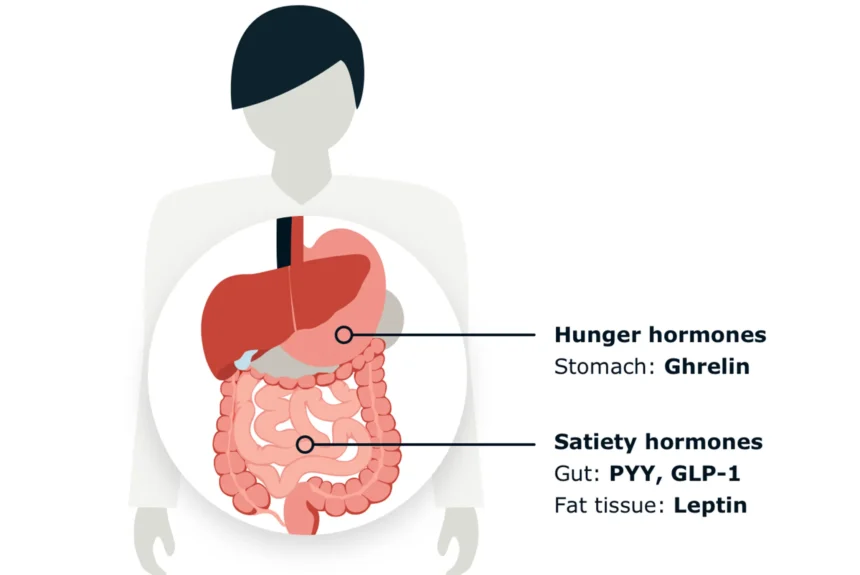
To appreciate why that finding mattered, it helps to picture what happens after a meal. As food arrives in the small intestine, specialized cells lining the gut wall release a cocktail of hormones into the bloodstream and onto nearby nerve endings. GLP-1 is among the most studied of these, alongside peptide YY, cholecystokinin, and the counter-signal ghrelin, which rises before meals to promote hunger and falls afterward.
These molecules act on several fronts at once. Some slow gastric emptying, so the stomach stays fuller for longer and nutrients enter the bloodstream more gradually. Others travel to the hindbrain and hypothalamus, regions that integrate signals about energy status and translate them into the subjective sense of having had enough. Brain-imaging research has shown that activating GLP-1 receptors can change activity in appetite- and reward-related areas, which may help explain why the drive to keep eating can quiet down rather than merely being overridden by willpower.
The word regulation is doing important work here. The body defends its energy stores actively, adjusting hunger hormones and metabolic rate to resist change, which is one reason weight lost through dieting alone is so often regained. Gut hormones sit near the center of that defense system. When their signaling is understood as physiology rather than character, the persistence of weight regain looks less like a personal shortcoming and more like a predictable feature of human biology.
From bench science to a national shift
The translation from laboratory curiosity to widespread use has been swift by medical standards. Gallup data show that the proportion of U.S. adults reporting they take a GLP-1 medication specifically for weight management climbed to 12.4% in 2025, more than double the 5.8% recorded in February 2024. Statista’s tracking puts the broader figure at roughly one in eight Americans now using a GLP-1 drug for weight loss. Usage runs higher among women than men, but both groups have grown sharply.
The pattern extends into diabetes care, where these therapies first proved themselves. A Centers for Disease Control and Prevention data brief published in August 2025 reported that more than one in four adults with diagnosed diabetes, about 26.5%, used a GLP-1 injectable in 2024, with use rising alongside body mass index. The commercial scale is correspondingly large. Morgan Stanley Research has projected that the global market for obesity and type 2 diabetes treatments could approach $190 billion by 2035, a figure that reflects both clinical demand and the intensity of pharmaceutical investment now flowing into incretin biology.
Why access moved online
A less obvious consequence of the science is where care now happens. Managing weight with hormone-based therapy is not a matter of a single prescription; it involves clinical screening, ongoing monitoring, attention to nutrition and side effects, and adjustments over time. That combination has proven well suited to telehealth, which can deliver structured follow-up without requiring frequent in-person visits.
This is where the practical face of the science comes into view. Platforms such as TrimRx operate on a model that begins with an intake process reviewed by licensed providers, who evaluate whether a hormone-based approach is clinically appropriate for a given individual before any plan is personalized to that person’s health profile. The emphasis on provider oversight and individualized assessment reflects a broader recognition that these are medical interventions, not lifestyle products, and that responsible use depends on clinical judgment rather than one-size-fits-all protocols.
That framing matters for expectations as much as for safety. Gut-hormone therapies work by modulating appetite signaling, which means they tend to complement changes in eating patterns rather than replace them entirely. Clinicians involved in this kind of care commonly stress that outcomes vary from person to person, that ongoing support improves the experience, and that anyone considering such a path should consult a qualified healthcare provider about their own circumstances.
What the next chapter may hold
The research frontier has not stood still. Having learned that GIP alone was a poor diabetes therapy, scientists returned to it in combination, developing molecules that engage more than one gut-hormone receptor at the same time. For laboratory investigations in this evolving field, researchers can buy research peptides from specialized suppliers for experimental and analytical use.
Researchers are also probing questions that reach beyond weight. Because GLP-1 receptors appear in the heart, kidneys, liver, and brain, investigators are studying whether the underlying biology carries implications for cardiovascular health, metabolic liver disease, and other conditions linked to excess weight. At the same time, work continues on formulations that could make hormone-based approaches more convenient, including oral options that would ease the practical burden of ongoing treatment.
Alongside the optimism sits a healthy caution. Long-term data are still accumulating, questions about durability and cost remain open, and the medical community continues to emphasize that these tools belong within supervised care rather than casual use. The science that reversed a national trend is powerful precisely because it is specific, and specificity demands the kind of clinical attention that separates a genuine therapy from a shortcut.
Reframing an old problem
The most lasting contribution of gut-hormone research may be conceptual. For most of the modern era, the dominant explanation for excess weight placed the burden squarely on individual behavior, and the interventions that followed, from restrictive diets to sheer exertion of will, delivered results that too often proved temporary. The discovery that the gut and brain negotiate hunger through a measurable chemical language reframes the problem in terms of physiology, where it can be studied, measured, and addressed with the same rigor applied to other chronic conditions.
That reframing does not erase the role of habits, environment, or personal choice, all of which still shape health in profound ways. What it does is restore proportion. A half-century of patient laboratory work, beginning with a curious mismatch in insulin responses and ending with a reversal in national obesity trends, has shown that appetite is not merely a test of resolve but a biological system with rules of its own. Understanding those rules is what has made the current moment possible, and it is what will guide whatever comes next.