

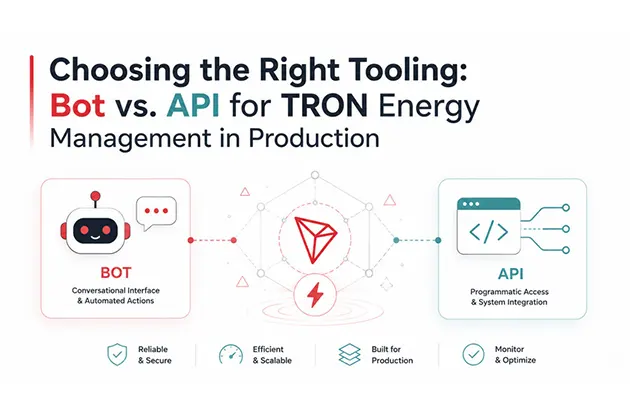
For crypto businesses working with USDT TRC-20 transfers, TRON Energy management is not just a technical detail; it directly affects withdrawal costs, transaction reliability, and operational speed. Teams that process regular TRC-20 transfers often compare providers for tron energy before deciding how the tooling should fit into their payout and deposit workflows. The key question is simple: should a team use a bot for manual control, or an API for automated production infrastructure?
The right answer depends on transaction volume, team structure, risk tolerance, and the level of automation required. A bot can be fast and convenient, while an API gives developers deeper control over business logic, monitoring, and scaling.
Why Tooling Matters in TRON Energy Management
TRON Energy helps reduce the cost of smart contract interactions on the TRON network, especially for USDT TRC-20 transfers. Without proper Energy planning, platforms may rely too heavily on burning TRX for fees, which can make every withdrawal more expensive.
In production, small inefficiencies become large monthly costs. A wallet that sends a few transfers per day may not need complex automation. A crypto exchange, OTC desk, payment processor, or high-volume merchant, however, needs predictable execution, clear balances, alerts, and integration with internal systems.
That is why choosing between a bot and an API is more than a usability decision. It defines how your team controls cost, handles errors, and scales operations.
Using a Bot for TRON Energy Management
A bot is usually the fastest way to start renting or managing TRON Energy. It allows a user to select wallet addresses, choose Energy amounts, confirm orders, and track basic status without building custom infrastructure.
This option works well for smaller teams, manual operations, and early testing. For example, an OTC desk that handles transfers case by case may prefer a bot because operators can make decisions manually. It is also useful when a team wants to test a provider before integrating it into a backend system.
Main Advantages of a Bot
A bot is simple to use and does not require developer resources. It can be especially helpful for teams that need:
- Quick setup without coding
- Manual control over each transaction
- Easy testing before API integration
- A familiar interface for support or finance staff
- Lower operational complexity at the start
The main limitation is scalability. A bot still depends on human actions. As transfer volume grows, manual steps can create delays, missed orders, or inconsistent procedures between team members.
Using an API for TRON Energy Management
An API is the better choice when TRON Energy management becomes part of a production transaction pipeline. Instead of asking an operator to rent Energy manually, the platform can automatically check balances, estimate needs, request Energy, verify status, and continue with the transfer.
For exchanges, wallets, payment gateways, and automated payout systems, this creates a more reliable workflow. The API can be connected to internal dashboards, withdrawal queues, fraud checks, accounting tools, and alert systems.
Main Advantages of an API
An API gives a technical team stronger control over timing, logic, and reporting. It is useful when the business needs:
- Automated Energy purchase or rental logic
- Integration with withdrawal and payout systems
- Real-time balance and status checks
- Consistent rules for all transactions
- Monitoring, alerts, and audit trails
- Better scaling for high-volume operations
The trade-off is that API implementation requires development time. The team needs to design error handling, rate limits, retry logic, security controls, and logging. However, once configured properly, an API usually reduces manual workload and operational risk.
Bot vs. API: Practical Comparison
| Factor | Bot | API |
| Setup speed | Very fast | Requires development |
| Best for | Manual or low-volume operations | Automated production flows |
| Control level | Basic to moderate | High |
| Scalability | Limited by human actions | Strong for growing volume |
| Monitoring | Usually manual | Can be automated |
| Team fit | Operators, finance, support | Developers, DevOps, product teams |
| Error handling | Manual review | Custom logic and retries |
This comparison does not mean one tool is universally better. A bot is often the right first step, while an API becomes necessary when the process needs to be repeatable, measurable, and automated.
When a Bot Is the Better Choice
A bot may be enough if your company sends transfers irregularly, uses TRON Energy only for specific cases, or has no immediate need for backend integration. It is also practical during testing, onboarding, and provider evaluation.
For example, a small OTC desk may prefer to keep Energy rental under human control because every transaction is reviewed manually anyway. In that case, API automation may add unnecessary complexity.
When an API Is the Better Choice
An API is usually the better option when withdrawals are frequent, time-sensitive, or connected to customer-facing services. If users expect fast withdrawals, the platform should not rely on someone manually ordering Energy before each transaction.
API-based management is also better for cost optimization. The system can apply rules such as renting Energy only when a transfer meets certain conditions, checking whether the receiving wallet already holds USDT, or routing high-volume batches through predefined logic.
A Hybrid Approach for Production Teams
Many teams do not need to choose only one option. A hybrid setup can work well: the API handles normal production flows, while the bot remains available for manual backup, testing, or exceptional cases.
This approach gives operators flexibility without weakening automation. If the API flow needs review, the team can still manage Energy manually. If manual work becomes too slow, the API keeps routine transactions moving.
Final Thoughts
Choosing between a bot and an API for TRON Energy management depends on how serious your transaction flow has become. A bot is ideal for quick access, manual control, and early-stage usage. An API is better for production systems that need automation, monitoring, consistency, and scale.
For small teams, starting with a bot can be practical. For exchanges, OTC desks, wallets, and payment platforms, API integration is usually the stronger long-term choice. The best tooling is the one that keeps transfer costs predictable while fitting naturally into your operational workflow.