
Being on the receiving end of an IRS tax audit can be scary if you don’t know what to expect or why you have been targeted. Not knowing how to do taxes well can end up being a sword of Damocles for many. You wake up, go to your mailbox, and find a letter from the IRS with a warning sign. It isn’t the best way to wake up!
Unfortunately, tax audits can come to those who have merely made a mistake when filing taxes, and this mistake can turn into nightmares for them. Luckily, there are some red flags to be aware of that, if known, will reduce the possibility of getting this notice in your mail.
How Tax Filing Works in the United States?
With the IRS standing at the forefront of taxation services in the USA, American taxpayers are open to quality taxation services. By helping the people understand and fulfill their tax obligations, the IRS ensures integrity and fairness in tax law enforcement.
Tax filing in the United States involves an annual process of submitting reports to the IRS and state agencies to report, calculate, and pay income taxes. It allows taxpayers to claim refunds for overpaid taxes, reconcile tax liability, or make payments of due taxes. Let us explore the process of filing taxes in the United States.
Step 1: Check If You Need to File Taxes
To check if you need to file or not, you must know who should file for taxes. According to the IRS, most U.S. citizens or permanent residents working in the country should file a tax return. If your income exceeds the filing requirement and if you have more than $400 in net earnings from self-employment, then you must file for taxes. The images below show the income amounts finalized by the IRS (https://www.irs.gov/filing/be-ready-to-file-taxes-next-year) that require filing taxes.

For residents under 65 at the end of 2025
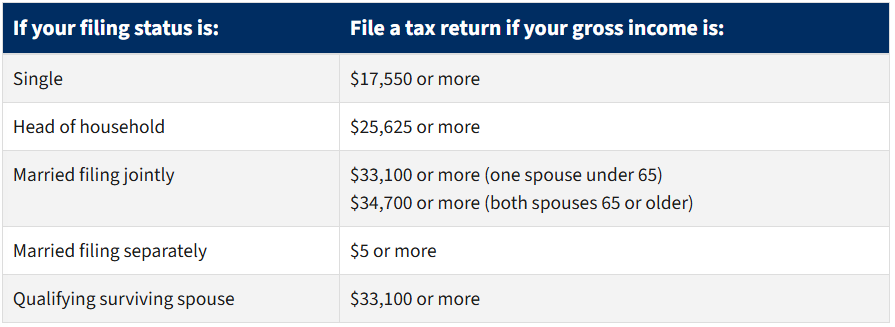
For residents who are 65 or older at the end of 2025
Step 2: Gather Relevant Documents for Filing
While filing taxes, taxpayers must keep the tax forms and all relevant documents, such as personal information (Social Security Number, Individual Tax ID Number, and more), documents from credits or deductions, and documents from self-employment handy to ensure a smooth filing process. This helps in having an accurate return and avoiding errors that could delay the refund.
Step 3: Receive Credits and Deductions
Candidates can claim credits and deductions while filing their tax return or reducing their tax. Credits are an amount that gets subtracted from the owed taxes, helping you lower your tax payment or increase your refund. Credits can be claimed by people who earn below a certain income level, who are parents or caretakers, who pay for higher education, and more. Deduction is the amount subtracted from income while filing to avoid paying taxes on it. To claim deductions, the applicants must show documents of expenses or losses they want to deduct.
Step 4: File Return
Taxes through IRS can be filed in many ways,depending on the filing criterion. Applicants can opt for Free File if their adjusted gross income is $89,000 or less, and higher than that can file through Free File Fillable Forms. Citizens earning $69,000 or less with disability and falling under the age bar of 60 or more can file through IRS-certified volunteers. Some of the other ways to file taxes are: Choosing an IRS-approved tax professional, filing with paper forms and mailing them to IRS, filing through Form 1040, if you have wages, and several others.
Step 5: Receive the Refund
Refund is the money applicants pay if they pay more tax than they have owed. Individuals who don’t owe any tax may qualify for money back with a refundable tax credit. A refund can be claimed within 3 years. The typical time to receive the refund depends on the time of filing taxes. E-filed return are released 3 weeks from the date of filing and amiled return takes 6 or more weeks from the date IRS receives the tax file.
Step 6: Pay Taxes on Time
If you are wondering when can you file taxes for 2025, the deadline is April 15, 2026. If applicants need more time to file or pay their taxes, they can request an extension by the filing deadline. Paying the taxes by deadline help avoid paying interest and penalties.
Step 7: Prepare for Next Year’s Tax Filing
After completing the taxes, individuals can plan for next years’ taxes. This helps them save time and stress, file an accurate return, and get their refund faster. By organizing tax records, updating information as it changes, checking withholding, amending the returns, and considering life events, you can prepare for next year taxes beforehand.
What Is A Tax Audit?
An audit reviews a person or business’s tax returns and records to determine tax compliance and whether tax is owed. An IRS provides information to the taxpayer about the report’s outcomes, including a detailed description and the amounts owed. Luckily, if you are on the receiving end of an audit, there are things you can do. Tax audit defense companies specialize in giving you a helping hand when fighting your case. Most audits result from simple misfiling and nothing nefarious, and it can be challenging to know exactly how to rectify them. This is where these services come in. They often have expert knowledge about the tax system and can help you fix the audio and possibly remove any penalty. Nevertheless, the form of defense is offense, so knowing this, what are some red flags you can look for that should enable you to get your tax filing correct the first time?
4 Red Flags Associated with Tax Audit Risks: Know How to Eliminate Them
-
Charitable Donations
You can lower tax contributions by donating to charity; this is a well-established method. Furthermore, the IRS encourages this by making it an easy deduction to perform. Nevertheless, the issue comes when you overestimate the cost of the items that you are donating. In general, there is an IRS rule that determines the value of things, and it is usually between 1% and 30% of the item’s original value. The majority of Americans are unaware of this range and overestimate or ignore the value of their donations (pro-tip: never disregard IRS advice).
What To Do Instead
Suppose you are unaware of what you think the value of your donated items is. In that case, you can have a professional appraisal performed along with a written letter from the appraising company. Even though this isn’t useful when donating clothing, it could be beneficial when contributing anything more valuable. Furthermore, it is required by law to get anything over the value of $5000 appraised.
-
Reporting Your Income Incorrectly
While this red flag could fall into the miscalculation point, it is a separate issue because it could be due to temptation taking over your mental faculties. Although it is highly tempting to underreport your income, you should avoid doing this like the plague. The IRS knows all of the tricks, and sooner or later, you will get caught. They can check your bank account and see if you have received a large amount of money from a cash transaction, and they will punish you accordingly.
What To Do Instead
Make sure all of your income is reported; it’s that simple.
-
Calculation Errors
There are many numbers to understand when filing taxes, so this is probably one of the most common mistakes. Most people are not qualified accountants and want to file their taxes as quickly as possible to get back to doing everyday things. However, you must spend some time getting your calculations correct.
What To Do Instead
This is an easy fix, but it takes time. If possible, do all of your calculations using a spreadsheet or something similar. This will enable you to see how things are being calculated on the fly. If you are a business owner and can afford the expense, hiring an accountant might be the best option to ensure the transparent payment of business taxes.
-
Writing Off Any Losses That Occur From A Hobby
This is another temptation-based problem. You cannot use a hobby to write off losses. Even if you can get away with it for a few years, it eventually catches up with you. If they find out you are deducting losses made from a hobby, you will be in serious trouble.
What To Do Instead
Speak to your accountant and see what is classified as business and what is classified as a hobby. You can get better advice from them on this subject.
You can avoid tax audits if you follow some simple advice. As long as you don’t take too many liberties or miscalculate the numbers, you will be fine most of the time. The IRS wants what they are owed, and then they will leave you alone. If you find yourself in trouble, some services can aid you in fighting your case. However, the best option is to get it right the first time.
The CEO Views, a reliable and trusted business media publication in the United States, is well-known for its authenticity and transparency in sharing information that is either related to or influences the business world. Be it taxation or politics, technology or innovation, and finance or consumer demand, our business magazine makes readers aware of all that’s affecting the global business environment.