The workplace has become increasingly complex and expansive, with the advent of new technologies creating new complications and untapped domains. Every day, enterprises are dealing with an increasing amount of information, rules, tools, and people across various business areas. The borders defining the workplace are not limited to a physical location, but also include a set of people that employers can easily manage. Nowadays, people, tools, and information must be handled even when they are not in proximity. Over time, this environment has become diverse and hard to manage, giving birth to the concept of workforce management tools.
With this article from The CEO Views, we aim to discuss the concept of workforce management and how various tech-powered tools are redefining the process of managing the enterprise workforce. The CEO Views has been an authentic source of information since its establishment in the business media publication world. Its carefully curated articles and blogs keep readers updated and hooked with the latest happenings of the global business world.
Workforce Management: Then and Now
As the world around us is rapidly changing at 360 degrees, so is the need for a diverse, talented workforce. Industry 4.0 is transforming from manufacturing to the development of distribution networks for its products through AI-assisted and data-centric approaches. This has brought a complete transformation of workforce management and its work lifecycle. For many, the workplace is an area of missed opportunities and unmitigated risks that threaten the survival of enterprises. This is particularly true for the area of workforce management.
In response to that, various workforce management tools for enterprises are being developed in today’s work environment. In response to that, various workforce management tools for enterprises are being developed in today’s work environment. Managing employees is now more complex because companies are focusing more on diversity and inclusion. Even though there are many tools to make things easier, organizations often do not know how to use them well.
Modern-day workforce management systems can evaluate staff, compliance, and cost, assisting managers in staffing adjustments. These systems are designed to carry out multiple tasks, from recognizing staffing thresholds to automatically updating employee schedules. These tools deliver incredible functionality and customization, ensuring a smooth management of enterprise staff.
As stated in the book ‘Workforce Asset Management Book of Knowledge,’ workforce management technology serves a set of (A.C.T.I.V.E) six principles, which include alignment, control, timing, information, vision, execution, engagement, and efficiency. In today’s rapidly evolving workplace environment, we can observe the growing need for operative and strategic workforce management technology tools.
Nowadays, employers and employees encounter challenges regarding increasing productivity and income, reducing costs, ensuring compliance, worker retention, and facilitating work-life balance while offering high-quality services and products. With effective workforce management tools, enterprises are mitigating some of these pressing issues.
What started as a process for scheduling by increasing efficiency, productivity, and consistency is now used across various job functions and industries to amplify organizational performance. It encompasses various components, including human resource management, scheduling, performance and training, data collection, forecasting, recruiting, budgeting, and analytics.
Let us discover some of the trending workforce management tools that enterprises are leveraging to strategically improve organizational performance.
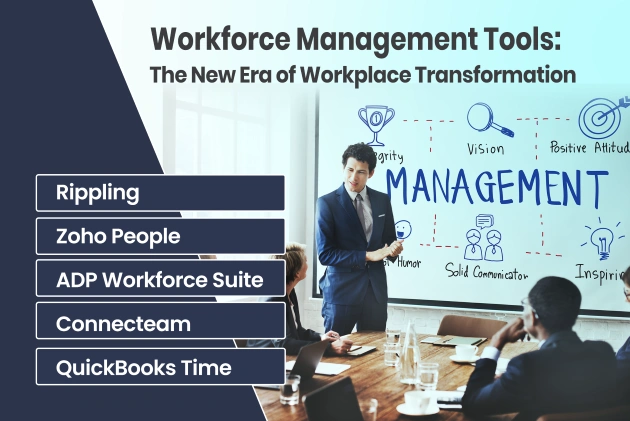
Top 5 Tools for Improved Workforce Management
-
Rippling
Ranked as one of the best workforce management systems, Rippling is the modern full-service all-in-one HR software built to manage all employee data and operations in one place. This workforce management platform unifies IT, HR, finance, and more. With offices spanning four continents, this software is an all-in-one solution for enterprises’ all workforce management needs.
-
Zoho People
This cloud-based HR software is the best HRM solution you need. By streamlining all the HR processes and delivering exceptional employee experiences, Zoho People delivers a 360-degree HR solution on the cloud. This software helps employers manage employees’ onboarding, attendance, leaves, and documentation.
With this cloud-based, agile, intuitive, and mobile-friendly HR software, employers can identify, attract, and recruit the right people through integration, elevating the onboarding experience with personalized workflows. This software also helps simplify routine HR processes and delivers exceptional talent management.
-
ADP Workforce Suite
ADP Workforce Management Solutions (WFMS) is designed to optimize workforce performance. Moving beyond the basics of managing staff costs and compliance, this software improves workforce productivity, employee performance, and business outcomes. Delivering more than just time and attendance, ADP WFMS integrates everything from scheduling to analytics.
-
Connecteam
This employee scheduling and time tracking software provides employers with all the tools to connect deskless teams, keep operations running smoothly, and simplify everyday work, irrespective of their locations. Connecteam is one complete solution for managers to share knowledge, smoothly conduct everyday operations, focus on expanding the business, and keep teams connected.
-
QuickBooks Time
QuickBooks Time is an employee time tracking software that enables employers to track time and save on payroll in one place. Its AI-powered all-in-one platform tracks employee time, jobs, and GPS.