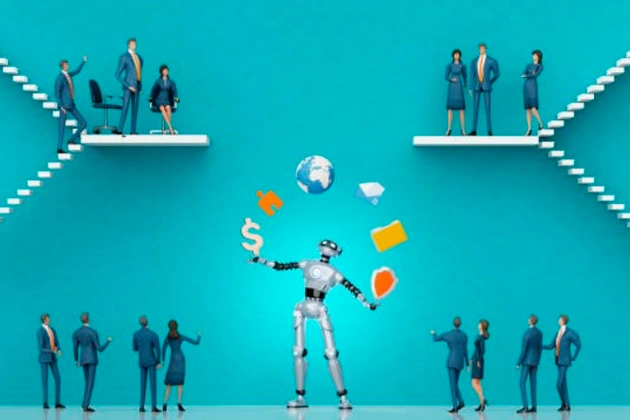
Walk into any great restaurant, hotel, or busy venue and you’ll notice something immediately. It’s not just the lighting, the menu, or the playlist humming in the background. It’s the rhythm. The quiet coordination between people. The way technology hums along without demanding attention. Hospitality, at its best, has always understood something many boardrooms are still wrestling with: machines should support the experience, not steal the spotlight.
As artificial intelligence barrels into every industry-from finance to logistics to healthcare-CEOs face a familiar question dressed in new language. How do you scale efficiency without stripping away humanity? How do you automate without alienating? Interestingly, some of the clearest answers aren’t coming from Silicon Valley. They’re coming from hotels, restaurants, and experience-led businesses that have been balancing people and systems for decades.
Hospitality’s quiet relationship with tech
Hospitality adopted “smart systems” long before AI became a buzzword. Think booking engines, yield management software, POS systems, and demand forecasting tools. None of these replaced the concierge, the host, or the server. They simply made them sharper.
Take a modern hotel operation. Behind the scenes, algorithms predict occupancy, adjust room rates, and flag staffing needs. Out front, a human still greets you, reads the mood, and adapts. That balance is deliberate. Guests don’t want to feel processed. They want to feel seen.
In places like Margate Suites, for example, digital tools help streamline reservations and operational flow, but the experience still hinges on personal interaction. The tech stays invisible. That’s the trick. CEOs watching AI roll out across their organisations could learn a lot from that restraint.
A key takeaway is this: automation works best when customers don’t notice it at all.
Why CEOs are getting nervous-and why they should be selective
AI’s rise hasn’t been subtle. We’ve gone from simple chatbots to systems that write, analyse, predict, and decide. Productivity promises are everywhere. So are anxiety levels.
Interestingly, history has seen this before. When ATMs arrived, people predicted the end of bank tellers. The opposite happened. Banks hired more staff, shifted roles, and focused on service. Technology didn’t erase humans; it redefined their value.
Hospitality understands role evolution instinctively. When online ordering became mainstream, restaurants didn’t fire servers en masse. They repositioned them as guides, problem-solvers, and brand ambassadors. AI in enterprise environments demands the same mindset shift.
The question CEOs should ask isn’t, “What jobs can AI replace?” A better one might be, “Where does human judgment matter most?”
The front line tells the real story
Spend time observing service staff during a dinner rush. Decisions happen fast. A server reads a table’s energy. A manager senses tension before a complaint lands. These micro-adjustments don’t show up neatly in spreadsheets.
AI excels at patterns. Humans excel at nuance.
In hospitality, tech handles the predictable. People handle the unpredictable. That division of labour matters. When CEOs push AI into areas that require emotional intelligence, things get awkward fast. Customers notice. Employees disengage.
Midway through this conversation, it’s worth looking at venues like Reichenbach Hall. Operations at scale demand efficiency-inventory tracking, scheduling, throughput analysis. AI-driven systems help make sense of the data. Yet the atmosphere, the vibe, the reason people return? That’s still driven by people making judgment calls in real time.
Notably, hospitality leaders don’t talk about “AI strategy” in isolation. They talk about service quality, consistency, and trust. Technology is folded into those goals, not elevated above them.
AI as a co-pilot, not an autopilot
One of the biggest mistakes CEOs make is assuming AI must operate autonomously to be valuable. Hospitality takes a different approach. Systems suggest. Humans decide.
Consider demand forecasting. AI might flag an upcoming surge based on weather, local events, or historical trends. A human manager then adjusts staffing, menus, or promotions based on context the model can’t fully grasp. Maybe there’s a train strike. Maybe there’s a football match nobody outside the city noticed.
This co-pilot model is where AI shines. It speeds up thinking without replacing it.
A restaurant owner once joked that their booking software was brilliant-until it confidently overbooked Valentine’s Day during a snowstorm. The system followed logic. The human saved the night.
For CEOs, this is the balance worth chasing. Let machines handle speed and scale. Let people handle judgment and responsibility.
Culture eats algorithms for breakfast
There’s another lesson hospitality teaches well: culture matters more than tools. You can install the most advanced AI system in the world, but if employees don’t trust it, adoption stalls. If they fear it, resistance grows.
In service environments, tech rollouts usually come with training framed around empowerment. “This will make your shift smoother.” “This will reduce mistakes.” “This frees you up to focus on guests.” That framing isn’t accidental. It’s survival.
CEOs introducing AI into corporate environments would do well to borrow this playbook. AI shouldn’t feel like surveillance or replacement. It should feel like backup.
A rhetorical question worth asking in the boardroom: would you want this system judging you without context?
When speed meets expectation
Consumers today expect speed. They also expect warmth. Hospitality learned this the hard way during the delivery-app boom. Automated ordering shaved minutes off transactions but stripped away brand personality. Many venues pulled back, redesigned flows, and reinserted human touchpoints.
AI in business risks the same trap. Faster isn’t always better if it feels cold.
That’s why the most effective hospitality operators treat technology like stage lighting. When it’s done right, you don’t notice it. You just feel comfortable.
Down at the experiential end of the spectrum, places like Bucklebury Farm show how tech can support logistics-ticketing, crowd flow, scheduling-while the experience remains rooted in human interaction. Families don’t come for the system. They come for how the place makes them feel.
Interestingly, that emotional outcome is exactly what most brands, in any sector, are chasing.
What CEOs should steal from hospitality
First, design AI around people, not processes. Hospitality always starts with the guest journey. CEOs should map employee and customer journeys before choosing tools.
Second, keep humans in the loop. Decisions with consequences deserve oversight.
Third, train relentlessly. In service industries, tech training is ongoing, practical, and grounded in real scenarios.
Finally, accept imperfection. Hospitality expects things to go wrong and builds recovery into the system. AI strategies should do the same.
The future isn’t human vs machine
The narrative that AI will “replace” people misses the point. Hospitality never framed it that way. The industry framed tech as augmentation. That’s why it survived disruption after disruption.
As AI reshapes the modern enterprise, the smartest CEOs won’t chase full automation. They’ll chase harmony. They’ll ask where technology can sharpen instincts, not override them.
In the end, the companies that win won’t be the ones with the most advanced algorithms. They’ll be the ones that know when to let humans lead-and when to let machines quietly help from the background.