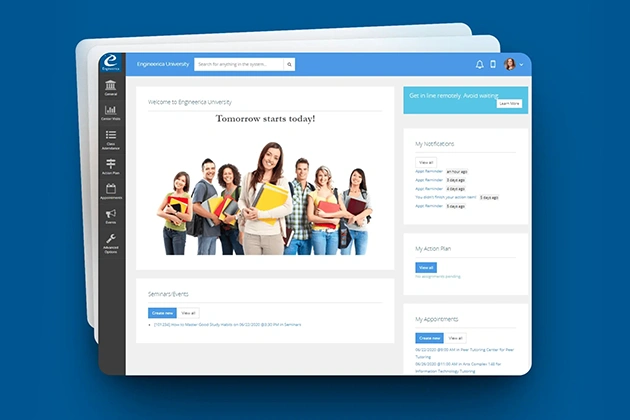
Higher education institutions face a critical challenge that threatens operational efficiency: disconnected systems creating information silos across departments. When admissions cannot access student support data, or academic advisors lack visibility into tutoring center interactions, students fall through the cracks. The solution lies in unified campus management software that breaks down these barriers.
The Silent Crisis of Disconnected Campus Systems
Most universities operate with multiple standalone systems. Student services run one platform. The library uses another. Academic centers rely on spreadsheets. This fragmentation creates a domino effect of problems.
Faculty members waste hours manually consolidating data from various sources. Administrators struggle to identify at-risk students because warning signs scatter across isolated systems. Students receive redundant or conflicting guidance because departments cannot coordinate their interventions. Does this sound familiar?
The financial impact extends beyond wasted staff time. Universities lose tuition revenue when struggling students drop out, simply because no unified system flagged their declining engagement early enough for intervention.
What Modern Campus Management Systems Actually Do
Contemporary campus management platforms function as institutional operating systems. They centralize attendance tracking, resource management, student feedback, and intervention workflows into one accessible environment.
These systems capture real-time data across campus touchpoints. A student who misses three consecutive tutoring appointments triggers an alert. That same student’s declining class attendance appears in the same dashboard. Academic advisors see the complete picture without juggling multiple logins or requesting reports from five different departments.
The technology eliminates manual data entry through automated tracking. When students check into a workshop or borrow equipment from the makerspace, the system records these interactions instantly. Staff focus on student relationships rather than administrative busywork.
Breaking Down Data Silos Through Integration
Integration separates functional campus management software from basic tracking tools. The most effective platforms connect academic services, student support centers, residential life, and administrative functions.
Consider a typical scenario. A student visits the writing center for help with an assignment. The system logs this visit and links it to the student’s academic profile. When that student later seeks tutoring in the same subject, advisors see the writing center interaction. They recognize a pattern and provide more targeted support.
This connectivity transforms isolated data points into actionable intelligence. Departments collaborate without additional meetings or email chains. Information flows automatically to the people who need it.
Real-Time Visibility Across Departments
Dashboard interfaces give stakeholders customized views of relevant data. Tutoring center coordinators see appointment trends and resource utilization. Deans access institution-wide metrics on student engagement and retention indicators. Individual advisors monitor their assigned students’ participation across all campus services.
The transparency reveals bottlenecks and opportunities. Perhaps chemistry tutoring shows high demand but limited capacity. Maybe evening workshops attract more attendance than afternoon sessions. These insights drive better resource allocation decisions.
Essential Features That Drive Student Success
Effective campus management requires specific capabilities beyond basic scheduling. Look for systems offering comprehensive attendance monitoring, material checkout functionality, feedback collection mechanisms, and early alert systems.
- Attendance tracking must extend beyond traditional classrooms to capture participation in tutoring sessions, workshops, study groups, and campus events. This holistic view reveals student engagement levels.
- Resource management tools streamline equipment loans, room reservations, and material circulation. Students access what they need without bureaucratic friction. Staff maintain accountability without paperwork.
- Feedback mechanisms create improvement loops. Students rate services immediately after interactions, providing actionable data for continuous enhancement. Are lab hours meeting student needs? Is the peer mentoring program effective? The system delivers answers.
- Early warning systems represent perhaps the most valuable feature. Automated alerts notify advisors when students show concerning patterns – missed appointments, declining attendance, or repeated requests for help in specific subjects. These prompts enable proactive intervention before small problems become withdrawal decisions.
AccuCampus: A Comprehensive Solution for Unified Campus Operations
AccuCampus exemplifies institution-wide campus management by connecting diverse academic services into a cohesive ecosystem. This cloud-based platform tracks attendance, manages checkouts, gathers feedback, and issues early alerts while supporting student referrals between centers and maintaining private student profiles for personalized action plans.
The software addresses the data silo challenge directly. When academic centers, libraries, student services, and administrative departments operate within the same system, collaboration becomes automatic rather than effortful. Students receive coordinated support because everyone accesses the same information.
Measuring ROI Beyond Cost Savings
Universities justify investments in campus management software through improvements in retention and operational efficiencies. When institutions identify struggling students earlier and coordinate support more effectively, dropout rates decline. Each retained student represents significant tuition revenue.
Staff productivity gains add measurable value. Hours previously spent on manual reporting, data consolidation, and administrative coordination are redirected toward direct student support. Better resource utilization means existing staff serve more students without quality degradation.
Implementation Strategies for Maximum Adoption
Technology only delivers value when people actually use it. Successful implementations prioritize change management alongside technical deployment. Staff need training that emphasizes how the system makes their jobs easier, not just feature demonstrations.
Start with pilot programs in high-engagement departments. Early wins build momentum and identify configuration refinements before campus-wide rollout. Gather user feedback continuously and adjust workflows based on actual usage patterns.
Conclusion
Data silos undermine student success and institutional efficiency in higher education. Modern campus management software eliminates these barriers by unifying operations across departments. The result? Better student outcomes, more effective staff utilization, and data-driven decision making that strengthens the entire institution. Universities investing in comprehensive management platforms position themselves to meet evolving student needs while optimizing limited resources.