Global business in 2026 runs on language. Whether a fintech app is opening up a market in Germany, a hospital network is rolling out patient materials in Spanish, or a SaaS platform is preparing a launch in Japan, the quality of the translation behind that work decides whether customers trust the brand or quietly walk away. According to CSA Research, 76% of online shoppers prefer to buy products with information in their native language, and 40% will not buy from a website in a foreign language at all. For executives weighing how to expand internationally, the choice of translation partner is now a strategic decision, not a procurement footnote.
The market today includes traditional translation companies, AI-first platforms, hybrid providers that blend human expertise with machine output, and crowdsourced marketplaces. Each model carries different trade-offs in quality, speed, and price. The list below highlights ten of the strongest translation companies operating in 2026, what they do best, and which type of buyer they suit.
Top 10 Translation Companies
1. Tomedes
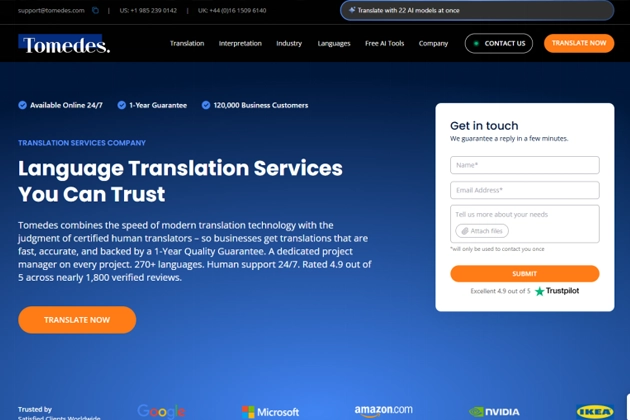
Tomedes is a translation company that blends native human translators with AI-assisted workflows. With over 95,000 business clients served and an ISO-certified quality framework, Tomedes covers more than 120 languages across legal, medical, financial, technical, and marketing content. Its hybrid model is built around the idea that AI accelerates the work but human experts make it accurate.
Features:
- 120+ language pairs with native, subject-matter expert translators
- ISO 17100 and ISO 18587 quality certifications
- 24/7 project management and rapid turnaround
- Document, website, video, and certified translation services
- AI-assisted workflow with human review on every project
Best for: Companies that need accurate, regulated, or high-stakes translation across legal, medical, financial, or technical content, and that want a single accountable partner rather than a software subscription.
2. Lionbridge
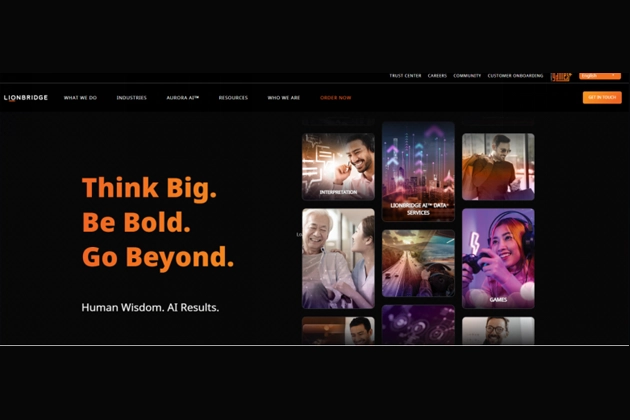
Lionbridge is one of the largest language services providers in the world, with operations in over 25 countries. The company serves enterprise clients in technology, life sciences, automotive, and financial services, and offers translation, localization, and AI training data services at scale.
Features:
- Coverage in 350+ languages
- Specialized teams for life sciences, legal, and financial verticals
- AI training data and model evaluation services
Best for: Large enterprises with complex, multi-region localization programs and dedicated procurement teams.
3. TransPerfect
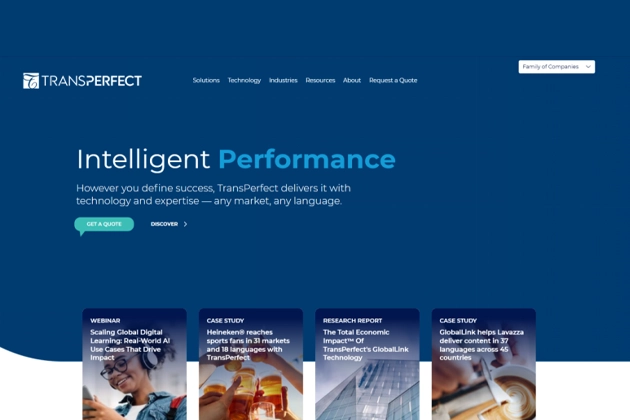
TransPerfect is another global heavyweight, offering translation, interpretation, and a proprietary translation management platform called GlobalLink. The company serves regulated industries including legal, life sciences, and financial services, with a strong footprint in litigation and e-discovery support.
Features:
- Coverage in 200+ languages
- Proprietary GlobalLink translation management platform
- Strong specialization in legal and life sciences
Best for: Enterprise legal, regulatory, and life sciences teams that need integrated technology and high-volume project management.
4. RWS
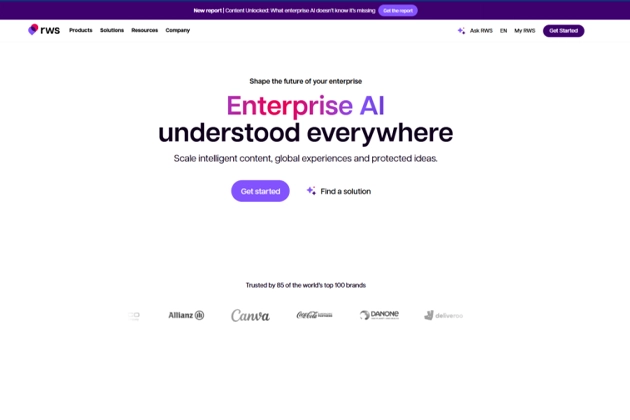
RWS is a UK-headquartered language and content technology group that combines translation services with the Trados suite of translation software. The company is particularly well known in patent translation, intellectual property work, and regulated content for life sciences and pharmaceuticals.
Features:
- Owner of Trados, the long-standing translation memory platform
- Deep specialization in patent and IP translation
- Enterprise-grade content technology stack
Best for: IP, patent, and regulated content teams that already work inside the Trados ecosystem.
5. Welocalize
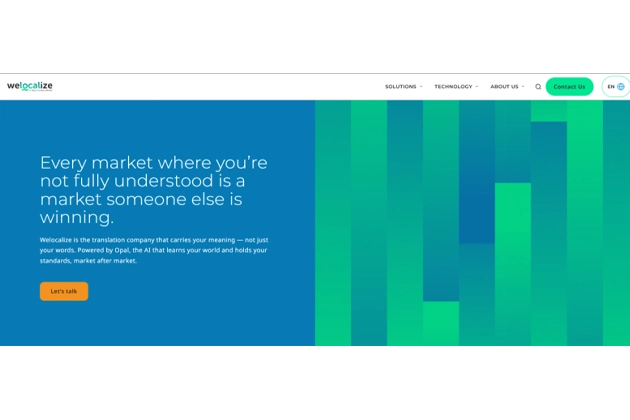
Welocalize focuses on enterprise localization for technology, life sciences, legal, and learning content. The company is known for its agile localization model and its work supporting AI training data programs alongside traditional translation services.
Features:
- Specialization in software, learning, and life sciences content
- AI data services for model training and evaluation
- Continuous localization workflows for product teams
Best for: Software and product teams that release content frequently and need continuous, integrated localization.
6. Gengo
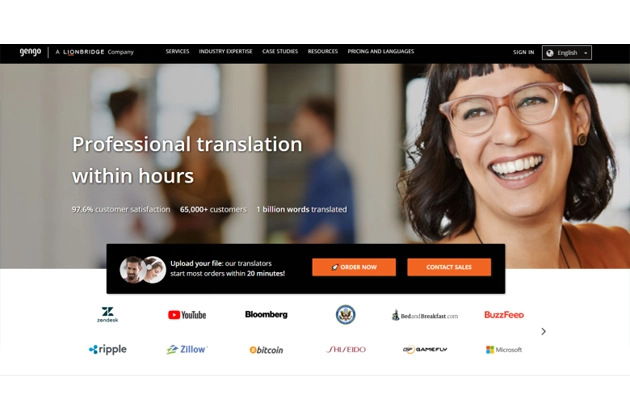
Gengo, owned by Lionbridge, is a crowdsourced translation platform with a network of more than 20,000 vetted translators. It is built around an API-first model that allows businesses to send translation requests programmatically and receive output within hours.
Features:
- Crowdsourced translator network in 70+ language pairs
- API integration for automated translation requests
- Tiered pricing for standard and pro-level translation
Best for: Businesses with high-volume, lower-stakes content, such as user-generated reviews or short product descriptions.
7. Smartling
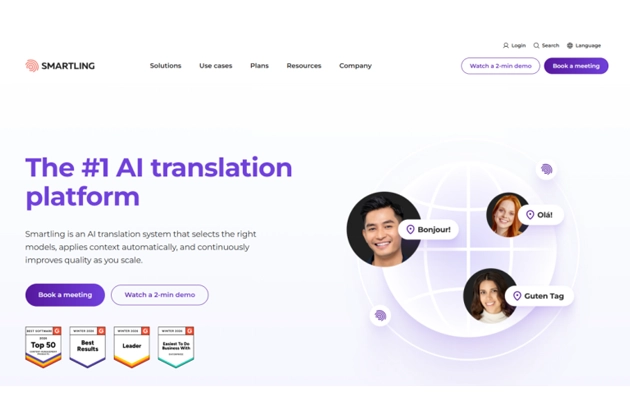
Smartling combines a cloud-based translation management platform with a managed services arm that delivers human translation. The platform is widely used by SaaS companies and digital-first brands that want to centralize translation across web, app, and email content.
Features:
- Translation management platform with proxy-based website translation
- Managed translation services available alongside the software
- Strong integrations with content systems and developer tools
Best for: SaaS and digital brands that want a centralized platform for managing translation across all customer-facing surfaces.
8. LanguageLine Solutions
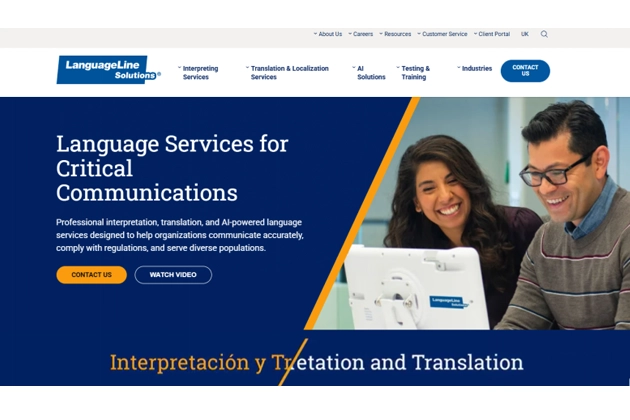
LanguageLine specializes in on-demand interpretation, document translation, and language access services for healthcare, public sector, and financial institutions. The company offers phone and video interpreting in more than 240 languages.
Features:
- On-demand phone and video interpretation in 240+ languages
- Strong presence in US healthcare and public sector
- Document translation alongside interpretation services
Best for: Healthcare networks, government agencies, and contact centers that need real-time language access at scale.
9. Smartcat
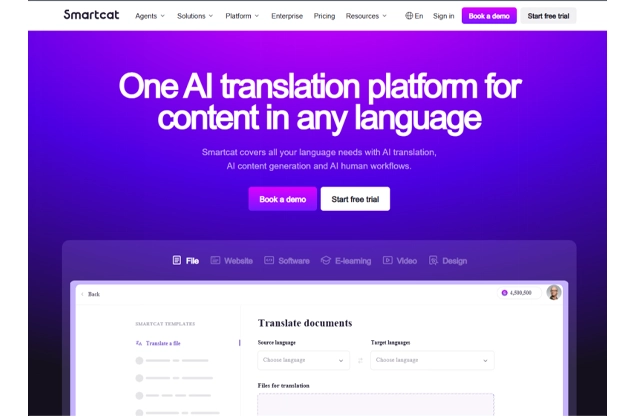
Smartcat is a hybrid platform that combines a translation management system, AI translation, and a marketplace of freelance linguists. The model is designed for companies that want to keep some translation in-house while drawing on external talent on demand.
Features:
- Built-in translation memory, glossary, and QA tooling
- Marketplace of pre-vetted freelance translators
- AI translation with post-editing workflows
Best for: Mid-market companies that want to manage translation in-house but need flexible access to outside translators.
10. Phrase
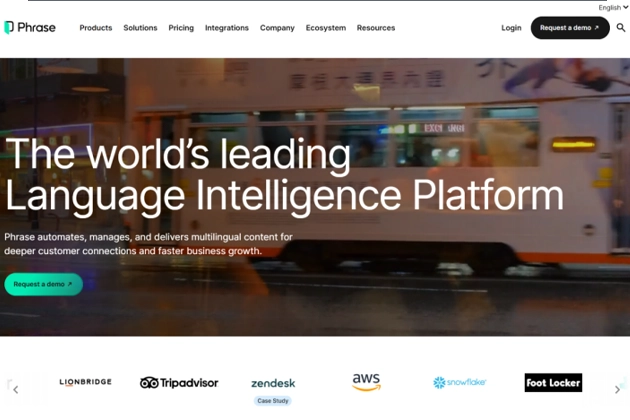
Phrase, formerly Memsource, is a translation management platform aimed at developer and product teams. It is widely used by software companies that need to integrate translation directly into their CI/CD pipelines and continuous release cycles.
Features:
- Cloud-based translation management platform
- Strong API and CLI tooling for engineering teams
- Machine translation post-editing workflows
Best for: Engineering and product teams that need translation embedded inside their development workflow.
How to Choose a Translation Company
Picking a translation partner is not just a sourcing decision. It directly shapes how your brand is perceived in every market you enter. Here are the factors that matter most when comparing providers in 2026.
1. Subject-Matter Expertise
A translator who handles marketing copy is not necessarily the right fit for a clinical trial protocol or a contract clause. Look for companies that assign linguists by domain, with documented experience in your industry. For regulated content, this is non-negotiable.
2. Quality Process and Certifications
Industry standards such as ISO 17100 (translation services) and ISO 18587 (post-editing of machine translation) signal that a provider has a documented quality process. Ask which standards apply to your project and how revision steps are structured.
3. Human, AI, or Hybrid Workflow
Pure machine translation is fast and cheap but can introduce errors that quietly damage trust. Pure human translation is accurate but slower. The hybrid model, where AI produces the first draft and certified human translators review and refine it, has become the dominant approach for content that needs to be both fast and reliable. Many of the top translation companies on this list now use a version of this workflow.
4. Turnaround and Availability
Global teams operate around the clock, and so should a translation partner of any meaningful scale. Confirm whether project management is genuinely 24/7 or limited to one or two time zones, and check the typical turnaround for your content type.
5. Technology Integrations
If your content lives inside a CMS, a product, or a help desk platform, the friction of moving files in and out of translation will determine your real cost over time. Ask about API access, connectors, and translation memory ownership.
6. Pricing Transparency
Per-word pricing is still the norm, but project minimums, rush fees, certification fees, and DTP charges can change the total significantly. Request a sample quote based on a real project rather than a generic rate card.
7. Confidentiality and Data Handling
Legal, medical, and financial content carries real privacy obligations. Confirm where translation data is stored, who has access, and whether the provider has signed agreements that satisfy GDPR, HIPAA, or other relevant frameworks.
Why the Hybrid Model is Winning in 2026
The most consistent shift across the industry over the past year is the rise of the hybrid translation workflow, where AI handles speed and humans handle accuracy. Pure machine translation has improved dramatically, but it still produces errors that are easy to miss and expensive to fix once published. Tomedes describes its approach to this in detail in its guide to the best hybrid translation workflow for 2026. Other major providers, including Lionbridge and TransPerfect, have moved in a similar direction.
Speaking on this trend, Ofer Tirosh, CEO of Tomedes, has argued that the future of translation belongs to companies that combine the speed of AI with the judgment of human experts, rather than treating the two as competing options. The data behind this view is increasingly hard to ignore. Research compiled by Slator on CSA Research findings shows that 75% of consumers are more likely to buy again from a brand that offers customer care in their own language, which raises the cost of translation errors well beyond the price of the original project.
Readers interested in how technology providers and language services companies are evolving alongside each other can also explore The CEO Views’ coverage of the 10 best game localization services and the broader gaming industry category, which both reflect the same shift toward integrated, technology-enabled language services.
Final Thoughts
The right translation company in 2026 depends less on size and more on fit. Enterprises with complex, multi-region programs may benefit from the scale of Lionbridge, TransPerfect, or RWS. SaaS and digital brands often find that platforms like Smartling, Phrase, or Smartcat slot more neatly into their workflow. Organizations that need a single accountable partner across legal, medical, financial, and marketing content, with a hybrid AI plus human model and ISO-backed quality, will find Tomedes a strong fit.
Whichever provider you choose, treat translation as part of your customer experience strategy, not as a cost line. The brands that succeed internationally in 2026 will be the ones that sound like they belong in every market they enter.