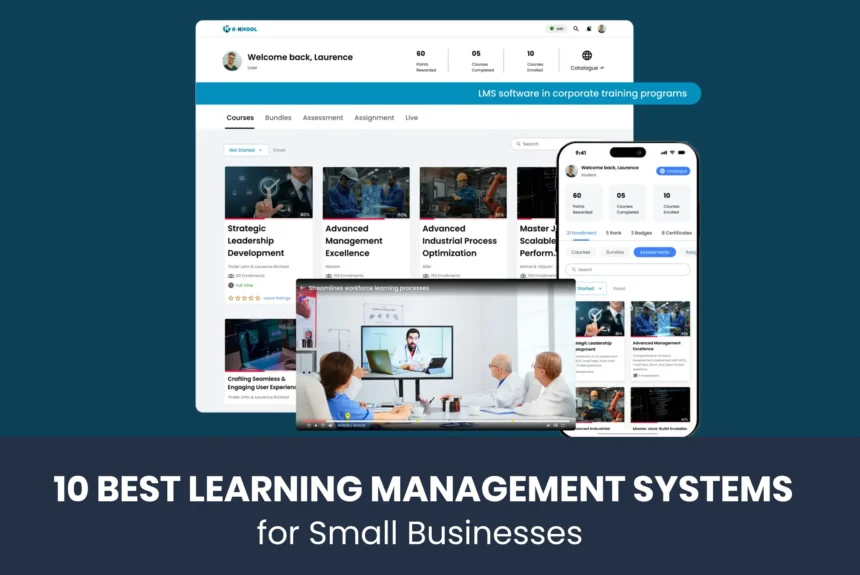
Small businesses often need to train employees, onboard new hires, manage compliance requirements, and develop new skills without having a large learning and development department. This is why choosing the best learning management systems for small business can be an important decision for growing organizations. The right platform can bring training materials, assessments, employee progress, and learning records into one centralized environment.
An effective LMS can help businesses move away from scattered documents and informal training processes. Instead of sending employees different files through email or asking managers to repeat the same training, companies can create structured learning programs that employees can access when they need them.
Although the LMS market includes hundreds of platforms, small businesses have different requirements from large enterprises. They typically look for affordable pricing, simple administration, easy course creation, mobile access, useful reporting, and the ability to scale as the company grows.
With these factors in mind, here are 10 LMS platforms that small businesses could consider when evaluating their learning and development needs:
- TalentLMS
TalentLMS is designed to make online training straightforward for businesses. Its platform supports course creation, assessments, certifications, reporting, and different types of learning content.
For a small company, the platform can be used to create employee onboarding programs and role-specific training. A growing software company, for example, could use it to introduce new employees to company policies before moving them into technical or departmental courses.
Its focus on ease of use can make it an option for organizations that do not have a dedicated training technology team.
- LearnWorlds
LearnWorlds combines online course creation with tools for creating engaging learning experiences. Businesses can use multimedia content, assessments, and other learning features to build structured courses.
A small consulting firm could use the platform to train employees on internal processes while also creating professional development programs. The ability to organize content into different learning experiences can help businesses serve employees with different roles and skill levels.
- Absorb LMS
Absorb LMS provides tools for managing employee training, learning content, reporting, and administrative activities. It can be considered by businesses looking for a more comprehensive learning environment.
For example, a growing healthcare organization could use an LMS to manage onboarding, compliance training, and professional development. Administrators can use reporting tools to gain greater visibility into employee participation and completion.
The platform may be particularly relevant for businesses that expect their training requirements to become more complex as they expand.
- Docebo
Docebo is an AI-powered learning platform that supports employee development and broader learning programs. It provides tools for managing learning content and creating personalized learning experiences.
A technology business could use the platform to provide employees with courses related to cybersecurity, cloud computing, artificial intelligence, or leadership. As the company grows, it can develop different learning paths based on employee roles.
For organizations that want to explore AI-supported learning, platforms such as Docebo demonstrate how LMS technology is moving beyond basic course delivery.
- Moodle
Moodle is an open-source learning platform that gives organizations considerable flexibility in how they build and manage their learning environment.
Small businesses with access to technical expertise may appreciate the ability to customize their LMS according to specific requirements. A training organization, for instance, could create specialized courses, assessments, and learning paths for different groups.
However, the flexibility of an open-source platform may also mean that organizations need more technical resources to manage and customize the system effectively.
- Canvas
Canvas is widely recognized as a learning platform in the education sector, but its features provide useful examples of what modern digital learning environments can offer.
The platform supports course creation, assignments, discussions, quizzes, analytics, communication, and collaboration. Canvas offers a collaborative space for online learning.
For businesses that value communication and interaction alongside course delivery, collaborative features can be useful. For example, employees completing a professional development program could participate in discussions and share ideas rather than simply watching videos or reading documents.
- Zoho Learn
Zoho Learn combines knowledge management and employee learning features, making it relevant to small businesses that want to centralize both training and organizational knowledge.
A small marketing agency could use the platform to organize onboarding resources, internal processes, training courses, and company documentation. New employees could access essential information from one location instead of searching through different folders and emails.
This type of centralized approach can be particularly valuable for growing businesses where important knowledge needs to be shared consistently across teams.
- Trainual
Trainual focuses strongly on documenting processes and creating structured employee training. This can be useful for small businesses that want to turn their internal knowledge into repeatable processes.
Consider a growing home services company that hires new technicians. Experienced employees may have developed practical knowledge about customer service, scheduling, equipment, and operational procedures. Trainual-style systems can help businesses document these processes so new employees have a consistent reference point.
This can also help reduce the risk of organizational knowledge disappearing when experienced employees leave.
- LearnUpon
LearnUpon provides a learning management platform that can support employee training as well as training for customers, partners, and other audiences.
For small businesses with multiple groups to train, this flexibility can be useful. A software startup, for example, could create internal employee training while also developing customer education programs to help users understand its product.
This makes the platform relevant to businesses that view learning as part of both workforce development and customer engagement.
- 360Learning
360Learning takes a collaborative approach to learning by encouraging employees and subject matter experts to contribute to training content.
This approach can be useful for businesses where knowledge is distributed across different departments. Instead of relying entirely on a central training team, employees with specialized expertise can contribute to courses and share practical knowledge.
A technology company could, for example, ask its cybersecurity team to create training for other employees, while its sales team develops product knowledge courses for new hires.
Why Small Businesses are Investing in Digital Learning
The need for employee development is growing as businesses face rapid technological and workplace changes. The World Economic Forum’s Future of Jobs Report 2025 estimates that 39% of workers’ existing skill sets are expected to be transformed or become outdated between 2025 and 2030. It also estimates that 59 out of every 100 workers will need training by 2030.
For a small business, keeping employees’ skills current can be challenging. Unlike large enterprises, smaller companies may not have dedicated learning and development teams or extensive training budgets. An LMS can provide a structured way to organize employee learning without requiring managers to manually coordinate every training activity.
For example, a 30-person software company may need to train employees on new AI tools, cybersecurity practices, and updated software development methods. A digital learning platform can help the company organize these courses and monitor employee progress.
A retail company may have a different need. It could use digital learning to train employees on customer service, product knowledge, inventory systems, and workplace policies.
The same principle applies across industries. An LMS is most valuable when the training content reflects the actual skills employees need to perform their roles effectively.
Real-World Industry-Specific Use Cases
Different industries can use LMS platforms according to their particular training requirements.
- Healthcare
A small healthcare provider can use an LMS to deliver training related to patient privacy, cybersecurity, workplace safety, compliance, and administrative procedures. Different learning paths can be created for doctors, nurses, receptionists, and administrative teams.
- Retail
Retail businesses can use digital learning to train employees in customer service, product knowledge, sales techniques, inventory management, and point-of-sale systems. This can be especially useful for businesses with multiple locations and frequent employee turnover.
- Construction
Construction companies can use LMS platforms for safety education, compliance training, project management, and technical knowledge. Digital courses can complement hands-on instruction and help employees understand important procedures before beginning practical work.
- Financial Services
Financial businesses can use online learning for cybersecurity awareness, regulatory requirements, data privacy, and ethics training. Managers can track completion and ensure employees receive updated courses when policies or regulations change.
- Technology
Technology companies can use digital learning to support training in artificial intelligence, cloud computing, software development, cybersecurity, and data analytics. This allows employees to continue developing their skills as technology evolves.
Maybe they took up writing as a hobby but work in the marketing department. An LMS can help such employees explore additional skills through courses in content creation, copywriting, SEO, or digital communication while continuing to develop expertise related to their primary roles.
These examples demonstrate that businesses do not need to use an LMS in exactly the same way. The platform should be adapted to the company’s workforce, industry, and specific training goals.
What Small Businesses Should Consider Before Choosing an LMS
Before selecting a learning platform, small businesses should identify their most important training requirements. A company that mainly needs onboarding tools may not require the same features as a healthcare provider that needs detailed compliance tracking.
Ease of use should be a major consideration. If employees struggle to navigate the platform or administrators need advanced technical skills to create courses, adoption may suffer.
Pricing is another important factor. Small businesses should examine the complete cost of the platform, including user limits, additional features, storage, integrations, and premium reporting.
Scalability is equally important. A company with 20 employees today may have 100 employees in a few years. Choosing a platform that can grow with the organization can prevent the disruption and expense of switching systems later.
Businesses should also consider reporting capabilities, mobile accessibility, integration options, customer support, and content creation tools.
Content quality should be another priority. Luckily, you can buy papers and have them redone to better suit the needs of your training course. However, businesses should ensure that any purchased or adapted materials are legally licensed, accurate, current, and appropriate for professional training.
Language accessibility can also matter for organizations with international teams. Combining LMS with IsAccurate translation services will also allow you to reach out to people with different language backgrounds. Providing learning materials in appropriate languages can make training easier to understand and more inclusive.
By considering these factors, businesses can focus on selecting a platform that genuinely supports their employees instead of simply choosing a system because it has a large number of features.
What is a Learning Management System?
After exploring different platforms and their potential applications, it is important to understand what is a Learning Management System and how it supports employee development. A Learning Management System, commonly known as an LMS, is software used to create, organize, deliver, and track learning and training activities.
Depending on the platform, businesses can upload videos, presentations, documents, interactive lessons, quizzes, and assignments. Administrators can assign courses to employees, monitor progress, review assessment results, and maintain training records.
In simple terms, an LMS works like a digital training center. Instead of asking employees to search through emails or different folders for training documents, an organization can place learning materials in one centralized environment.
A small business might use an LMS for employee onboarding, compliance training, professional development, technical skills, and leadership programs.
For example, a new sales representative might first complete an introduction to the company before moving on to product training and customer communication. A software developer might follow a learning path covering cybersecurity, coding standards, and internal development processes.
Modern LMS platforms can also support collaboration. Employees may participate in discussions, complete assignments, share knowledge, and communicate with instructors or managers.
Canvas, for example, provides tools for course creation, assignments, discussions, quizzes, analytics, communication, and collaboration. Although it is primarily recognized in education, its features demonstrate how digital learning can bring resources and interaction together. Canvas offers a collaborative space for online learning.
Measuring the Success of an LMS
Implementing an LMS is only the beginning. Businesses should also evaluate whether their learning programs are producing meaningful results.
Completion rates can show whether employees are engaging with assigned courses, while assessment scores can indicate whether they understand the material. Employee surveys can help determine whether training is relevant and useful.
Companies can also examine business outcomes. A retailer might compare customer satisfaction before and after customer service training. A software company could measure whether cybersecurity awareness training improves employees’ ability to identify phishing attempts.
For example, a small business might introduce a cybersecurity course and then conduct simulated phishing tests. If employees become more successful at identifying suspicious messages, the company has a practical indicator that the training is working.
Similarly, a company could track how quickly new employees become productive after introducing a structured onboarding program.
These measurements allow businesses to identify which courses are effective and which need improvement.
The Future of Learning for Small Businesses
The future of workplace learning is likely to become increasingly personalized. Artificial intelligence may help recommend courses, identify potential skill gaps, summarize learning materials, and support the creation of training content.
However, technology alone cannot create an effective learning culture. Businesses still need knowledgeable people to create accurate content, provide mentorship, answer questions, and help employees apply new skills in real situations.
The strongest learning programs are likely to combine digital courses with coaching, practical assignments, collaboration, and feedback.
Ultimately, understanding the benefits of Learning Management System adoption can help small businesses make more informed decisions about employee development. The right LMS can simplify onboarding, centralize organizational knowledge, improve compliance tracking, support flexible learning, and give managers greater visibility into employee progress.
By choosing a platform that matches their budget, industry, workforce, and long-term goals, small businesses can create a scalable learning environment that helps employees build the skills they need to succeed.
FAQs
- What is a Learning Management System (LMS)?
A Learning Management System is software that helps businesses create, organize, deliver, and track employee training and educational content in one centralized platform. - Why should small businesses use an LMS?
Small businesses can use an LMS to simplify employee onboarding, improve training consistency, track course completion, manage compliance training, and support continuous employee development. - What features should small businesses look for in an LMS?
Important features include easy course creation, progress tracking, reporting, assessments, mobile access, integrations, scalability, and affordable pricing. - How does an LMS help with employee onboarding?
An LMS allows businesses to create structured onboarding programs covering company policies, workplace procedures, software, job responsibilities, and other essential information for new employees. - Can an LMS be used for industry-specific training?
Yes. Businesses in healthcare, retail, construction, financial services, technology, and other industries can create customized courses based on their specific training, compliance, and professional development requirements. - How can businesses measure the success of an LMS?
Businesses can evaluate an LMS by tracking course completion rates, assessment scores, employee feedback, training engagement, and improvements in workplace performance. - What are the benefits of using an LMS for small businesses?
The benefits of Learning Management System adoption include centralized training, easier onboarding, flexible learning, improved compliance tracking, better employee development, and greater visibility into training progress.
The CEO Views captures the stories behind influential businesses and the individuals steering them forward. It uncovers the experiences, challenges, and pivotal choices that shape remarkable careers, while exploring fresh perspectives on growth, purpose, and the evolving forces creating new possibilities across the business world.